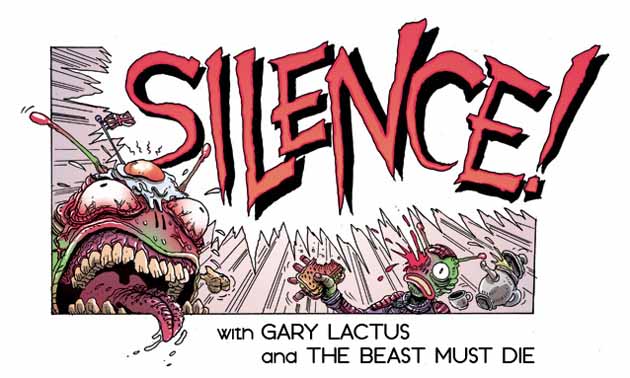
SILENCE! #96
March 15th, 2014
PACKED MY BAGS COS I’M OUTTA HERE, MOMMA DON’T LOVE ME AND MY MOMMA DON’T CARE
OI! i bloody love of it I do innit yes bruv yes bruv COME ON! Disemobodied Britbot X-15735 bruv innit? Bloody love those old times when you got your meat ‘n’ 2 veg innit? Yes bruv. Old times. Good times innit bruv. When a man had his right old bloody knees up didn’t he bruv. Yes bruv.
We all did bruv.
Now here come a trio of wendys to talk a load of old comics nosh innit bruv. It only bloody is ‘n’ all! Cor! What bloody larks. LA LA LA LA LA LAAAAAAH!
Oo did? Only Gary Lactus, The Beast Must Die & special guest Bobsy all havin’ a right old time of it! GET IN.
<ITEM> It’s a bumper edition as the boyce go long due to Friday night drunkeness and guest star gobshoite Bobsy! The most chaotic indulgent admin ever? They barely manage to thank their sponsors the loathsome oiks! Too much HOTTT COMICS ACTION to waste time though as we take a cooling plunge into…
<ITEM> The Reviewniverse wherein in epically meandering but actually pretty good (or maybe I’m still drunk) chat , the trio suckle on Stray Bullets, Nemo: Rose of Berlin (featuring the ‘Alan Moore Has Turned Into Chris Claremont’ argument which will soon be canon), the wonderful Auteur, Afterlife With Archie, Jonathan Ross & The Hugos, The Big Woof, The Comic Relief Comic, The Bojeffires Saga, Starlight, Avengers Undercover, Saviors, Hawkeye, and much much more.
<ITEM> The naughty tricksters try to make Gary piss himself.
So have a right old bloody listen, you bunch of effing WENDYHOUSES! IT’S SILENCE! 96!!!
Contact us:
[email protected]
@silencepod
@frasergeesin
@thebeastmustdie
This edition of SILENCE! is proudly sponsored by the greatest comics shop on the planet, DAVE’S COMICS of Brighton.
It’s also sponsored the greatest comics shop on the planet GOSH! Comics of London.

Revenge of the Giant Face
March 12th, 2014

Ah, let’s indulge in some time travel shall we? Let’s go all the way back to September 2009, when Sean Collins had this to say about Quentin Tarantino’s Inglourious Basterds:
It is, in other words, a deliberate assault on the facts surrounding the deaths of millions and millions of people, including the systematic genocide of six million Jews in the Holocaust… It’s morally monstrous and its practitioners are moral monsters.
Oh, wait, shit. That’s not quite right. That’s what Sean C. had to say about Nazi-sympathizing turd-monger Pat Buchanan. Sorry everyone, but problems like this tend to occur when you start to mess around with history, you know?
In order to find what Sean actually thought of Inglourious Basterds we have to go back even further, to August 2009 no less! It was a kinder time, a gentler time, a time where a man could read an essay on the cathartic, history rupturing violence of Tarantino’s latest picture without any danger of stumbling onto this long winded response.
Here’s what Sean actually said about the film:
…Inglourious Basterds may be the punkest movie I’ve seen in I can’t even think how long. Maybe ever. It’s about nothing less than the power of art to destroy evil. It’s about how important it is to love film more than the likes of Hitler hate life. It’s about how movie violence, art violence, art designed as a FUCK YOU, can help you deal with the violence that so terrified Chamberlain’s cohorts and to which Hitler and his cohorts were so indifferent. It’s Woody Guthrie’s “THIS MACHINE KILLS FASCISTS” guitar slogan made literal. It’s a lingering closeup on the bloodlust-saturated eyes of Eli Roth, the beautiful Jewish torture-porn poster boy and enemy of good taste, as he empties a machine gun into the bodies of members of the Third Reich. And it’s a total fucking fantasy. Yet that’s what makes it so vital.

Talking Comics #2
March 11th, 2014
Talking Comics is a highly irregular feature where I try to review a few new(ish) books with the help of my phone’s voice recognition software. It’s just like a regular comics review post except that it takes more mouth than fists to get it done on time, and is therefore far sexier than your average bloggy night on the town.
It’s also sort of like a bit of tech writing, except it’s even less useful to my future career as a failed magazine writer grumbling about social media in the corner of a pub on a cold Thursday morning.
Anyway, that’s enough warm-up for now. Onwards, to the reviews!
The Deleted, by Internet Villain Brendan McCarthy and Darrin Grimwood

Sex Criminals, by Chip Zdarsky and Matt “Matt” Fraction

LOEG: Nemo: The Roses of Berlin, by Kevin O’Neill and Alan Moore

Battling Boy, by Paul Pope and Hilary Sycamore

Multiple Warheads – Down Fall, by Brandon Graham

Dungeon Fun, by Colin Bell and Neil Slorance


That’s all we’ve got time for this week folks – don’t know if there’ll be any SILENCE! this week or not yet, but keep your eyes peeled because you never know what that amiable auld space god is capable of!
“Suck it nerds, I’m off to read some real books!” #1 – EGOMANIA
March 10th, 2014
George Eliot – Silas Marner

Despite its sentimental, Dickensian cover and premise – an outcast weaver is drawn back into society by the arrival of an orphaned child in his life – this short novel is yet more evidence of Eliot’s ability to create the impression of distance in her fictions. Eliot’s mastery of the bourgeois novel is of a similar kind and order to Milton’s mastery of the epic poem; the devil, as always, is in the details and how they’re relayed.
It’s worth comparing Marner’s transition over the first part of this novel with Scrooge’s in A Christmas Carol in order to better understand Eliot’s method. Dickens is one of the all time great narrators, and he trusts that the effects he has conveyed so spectacularly throughout his ghost story will linger with both his notorious outcast and miser and the reader even after he’s allowed the illusion to collapse in on itself:
For the first time the hand appeared to shake.
“Good Spirit,” he pursued, as down upon the ground he fell before it: “Your nature intercedes for me, and pities me. Assure me that I yet may change these shadows you have shown me, by an altered life!”
The kind hand trembled.
“I will honour Christmas in my heart, and try to keep it all the year. I will live in the Past, the Present, and the Future. The Spirits of all Three shall strive within me. I will not shut out the lessons that they teach. Oh, tell me I may sponge away the writing on this stone!”
In his agony, he caught the spectral hand. It sought to free itself, but he was strong in his entreaty, and detained it. The Spirit, stronger yet, repulsed him.
Holding up his hands in a last prayer to have his fate reversed, he saw an alteration in the Phantom’s hood and dress. It shrunk, collapsed, and dwindled down into a bedpost.
Compare the drama of Dickens’s line to the ever-shifting emphasis of this paragraph from the final bloom of Silas Marner‘s first volume:
Silas began now to think of Raveloe life entirely in relation to Eppie: she must have everything that was a good in Raveloe; and he listened docilely, that he might come to understand better what this life was, from which, for fifteen years, he had stood aloof as from a strange thing, with which he could have no communion: as some man who has a precious plant to which he would give a nurturing home in a new soil, thinks of the rain, and the sunshine, and all influences, in relation to his nursling, and asks industriously for all knowledge that will help him to satisfy the wants of the searching roots, or to guard leaf and bud from invading harm. The disposition to hoard had been utterly crushed at the very first by the loss of his long-stored gold: the coins he earned afterwards seemed as irrelevant as stones brought to complete a house suddenly buried by an earthquake; the sense of bereavement was too heavy upon him for the old thrill of satisfaction to arise again at the touch of the newly-earned coin. And now something had come to replace his hoard which gave a growing purpose to the earnings, drawing his hope and joy continually onward beyond the money.
In Eliot’s hands a seemingly romantic conceit – a child’s improving effect on an alienated adult – is nevertheless established to be effective only inasmuch as Marner’s continued obligations to the child necessitate a continued interaction with society as a whole. This is typical of Eliot’s approach, which emphasises connection and consequence over the triumph of kind hearts and stirring rhetoric.
This comparison is, however, not offered in order to disparage Dickens, whose busy narration looks simultaneously backward to the jarring shifts of the best English poetry and forward to the juddering machinery of modern comedy. And if it’s true that those same novels are premised on a call to individual kindness that overlooks the necessity for any broader or more systematic change then that does not diminish their effectiveness in making vivid the muck and dirt of unreformed reality.
The simple truth is that Eliot’s talents are slightly different in nature, and their magnitude does not need to be exaggerated by the disparagement of other novelists even if they may be better understood in light of the comparison.
Staying mindful of the example of Dickens, it occurs that the subject of the novelist vs. the social order that produced them is a curious one when applied to Eliot’s work. The form of the bourgeois novel she so excels at may in itself may replicate bourgeois values by way of its sheer confidence, but Eliot interrogates these conventions through the startling depth and clarity of her narrative judgements, which contrast with the narrative itself in a way that can’t help but provoke quiet inquiry.
The introduction to the edition I read makes up for any awkwardness its cover may engender by virtue of an astute introduction by R.T. Jones (an Honorary Fellow of the University of York, apparently), in which Jones tracks some of the juxtapositions that exist in Silas Marner‘s framing story, arguing that for all Eliot’s narration chides Godfrey for foolishly hoping that all would work out well when he didn’t claim his secret child, the story bears out his actions more than it does her words:
…the novel leads us to conclude that if Godfrey had done the right thing, acknowledged his first wife and her baby as his, Nancy would not have married him; Eppie (under a different name, of course) would have grown up in the Red House with no mother and a resentful father; so Godfrey, Nancy and Eppie would have had very little oppotunity for happiness, and of course Silas Marner would have remained an exile from human society.
Silas Marner ends on a statement of total happiness that somehow fails to ring false, but the novel never once lets you forget that fairy-tale conclusion has been built on a series of disappointments, lies, and betrayals, and it is Eliot’s ability to keep both of these seemingly contradictory positions in perspective that gives the truest account of her peculiar genius in this short novel.
The Weegie Board presents – C.R.E.A.M. part 1
March 9th, 2014

The Weegie Board will return at the same time next week with the second part of C.R.E.A.M.!
Salla Tykkä: The Palace
March 8th, 2014

A video triptych by Finnish artist Salla Tykkä, The Palace comprises of three short films – Victoria, Airs Above the Ground, and Giant – that de-naturalise their subjects in a series of increasingly overwhelming ways. The contrasts upon which these pieces have been built risk obviousness, but if the slow, immersive quality of Tykkä’s visuals doesn’t quite break down this objection on its own, the steady accumulation and alteration of meaning that accrues through the progression from subject to subject ensures that this is not merely a prolonged statement of the obvious.

An Amazonian plant transported to England and named in honour a British monarch, the Victoria lily is for Tykkä a symbol of the spoiler of colonialism and Empire. Despite textual cues to this extent, Victoria is the most traditionally beautiful of the pieces in The Palace. Perhaps this is intentional – it is, after all, the entrance to this piece.
For the duration of this video, we watch the lily writhe through a time-lapse ballet of its life cycle, all to the strains of suitably “stirring” classical music. Does the ghostly choreography of the lily’s movements, its abundant grace emphasised by the editing, cause us to question the sequence of events that has brought this beauty to our attention? Perhaps, but as the lily’s colour shifts from white to pink its status as a “natural” spectacle is also subtly reinforced by the piece, the viewer reassured that they are watching something do what it was always meant to do.

From its opening minute onward, Airs Above the Ground is clearly anything but a natural spectacle
Spritz, or “Welcome… to the World of Tomorrow (1983)!”
March 7th, 2014

A few thoughts on the Spritz app, which has been designed for wankers’ glasses and other such “smart” platforms with a view to allowing punters to read up to 500 words per minute:
- Trying out those samples is a bit like consenting to get poked in the eye repeatedly by a robot with a fistful of multi-coloured sticks, but I found it bearable on the short term and despite the fact that I’m a quick reader the upper speed there was definitely quicker than mine.
- Its effectiveness for prolonged use seems highly dubious for a variety of reasons that our good friend Andrew Hickey has already outlined behind closed doors at Mindless HQ – it’s not necessarily faster than some people’s extant reading speed, the stream of flashing red letters seems like a sure route to a headache, and their method of delivery ignores the fact that writing is composed and consumed in units separate from the individual word. Plus there’s also the fact that whole project seems not to take into the account the existence of blinking – I did a genuine lol when Andrew pointed this out to me.
- HOWEVER! I’m actually pretty fascinated by the thing for what it seems to me to be: a way to take in writing that is fundamentally different from the process of “reading” as we currently understand it.
- Without wishing to downplay the many differences between ebooks and their traditional counterparts, Spritz seems to me to be an order apart from both books and their digital equivalents in terms of the experience it suggests.
- The fact that Spritz takes the progression of time out of your hands/rendered it non-collaborative is not just a quirk but a ground-up realignment of the reading process. To state it plainly: Spritz obliterates the idea of the page or paragraph as constructed units, elides the difference between description and dialogue, and renders obsolete any other techniques the author may have used to arrange their chosen words.
- This process echoes and amplifies the experience of reading comics on a smartphone by dictating the amount of time you spend on any given linguistic unit while also limiting the context in which this encounter takes place. In both instances the compositional unity of the page is obscured, but this new(ish) method of reading comics preserves the reader’s input as to the flow and narrative density of time.
- Mister Attack described the experience as being like downloading a file instead of reading and he’s not wrong. There’s a slightly dated Matrix-porn aspect to what we can see of this app, a fetishisation of the idea that you too can learn kung-fu in twenty minutes without ever getting off the couch!
- What Spritz represents is a reduction of writing to communication – the writerly aspects of composition are only effective here inasmuch as they were already striving for the effect of information overload.
- There’s a potential for further reduction implicit in this first one, namely the reduction of language to mere commodity, to be valued purely in terms of the volume in which it is consumed – for extra marks, compare and contrast this with the different values words accrue by virtue of their usefulness to search engines.
- Spritz therefore seems most suited to the brute rush of “necessary” information to my eyes; certainly, anything that requires thought, reflection and inflection would prompt a bracing disengagement from the system. This encompasses both works of fiction and non-fiction, of course – neither having a monopoly on allusion or complexity or forward rushing exposition.
- All of this calls to mind the passages of Walter Benjamin’s The Work of Art in the Age of Mechanical Reproduction where he claims that new forms develop to achieve effects that old forms have been straining in vain towards – photography achieved things that realist painting was striving towards just by existing, film made easy effects that Dadaist art and poetry had been thrashing out at in defiance of the traditional values, etc.
- Bearing that idea in mind, is there a possible application of Spritz‘ effects in fiction? Can we imagine it as an extension or fulfilment of any existing forms? I can see an endpoint to/heightening of hysterical realism that would be possible using this form that exceeds the possibilities for reading, but many other styles of writing – from Emily Dickinson to Toni Morrison by way of Alan Garner – would be rendered aggravating or just plain useless here.
- I still don’t actually think this will work, but if it did work what would it do? The immediate possibilities seem depressing – bullshit “e-learning” initiatives, a constant stream of data flickering into your eye at work, “DO YOU SUBMIT TO THIS PROGRAMME?”, etc. Still, eternal optimist that I am I keep coming back to Benjamin and his attempt to imagine a radical potential in cinema. Given his efforts to imagine the automated flow of film being broadcast to a distracted public as a potential engine for communal agitation, the question occurs – is there any such potential in the Spritz app? Given that it has been developed for wankers’ glasses and e-readers and is therefore primarily an enclosed, solitary form of distraction, the most likely answer is “probably not” but I would greatly enjoy being proved wrong on that point, because the idea of there being yet another channel for commercial noise to filter through into my life without it adding much of anything is too fucking tedious to bear.
With thanks to Brother Bobsy, Mister Attack, Andrew “Andre Whickey” Hickey, Ad Mindless, Amypoodle, Cormac, Taters, and Kip Manley, all of whom helped me focus my thoughts on this topic via twitter and email.

League of Extraordinary Gentlemen: Roses of Berlin – THE REVIEW
March 6th, 2014

Wow, all that German dialogue was annoying, wasn’t it? As an experiment in formalist pass-agging, it’s classic Moore of course, but my German reading is max schrecklich so I had to scurry off to the internet for a translation and- OH!
…Yeah fair play, you got me there you bearded, crabby old bastard. There I go, running off to lean on the old god’s hippocampus again, without even an editorial assistant to do it for me! Genius. I think a lot of people don’t pick up on the humour in Alan Moore’s work, actually?
Handled the French and most of the English bits OK though, so, y’know, integrity there. Feel like the word ‘hypocrite’ should make an appearance now, though we don’t really need it… hold on to the first four letters of it though, because we’ll be using them for real in a minute.
This arrived in the comic shop with much less fanfare than your average doodlebug, but as soon as Gary sent up the siren I goosestepped down the hill to fetch it quicksmart. Got it home and more or less enjoyed it – it was straightforward, no-nonsense/lots of nonsense, pretty much alright.
Except for the Xmen stuff, the so-and-so superhero is married to so-and-so superhero’s cousin’s brother-in-law stuff, I could do without all that. These Victorian superheroes with big cars – like, their big car is the superpower – they’d died out quite naturally by the middle of the last century, which was OK. Bringing them back, trying to give them a dignity and relevance beyond their sell by – just can’t really see why this is any less wank than any other variety of steampunk: Dave McKean and Jeremy Clarkson polishing the cogs on their beaver hats, compulsively checking their gold atomic pocket watches.
There’s the copyright issues (old and new) of course, but the James Bond, shit the Harry Potter workarounds for that were more elegant and welcome: Forcing an alternative contemporaneity into the template, deliberately not using characters from the pop lit of the day embuggers the entire LOEG scheme. The world isn’t a reflection of the popular imagination of the era under examination, it’s just another partial and arbitrary superhero playground where everything is up for fudging.
Fudge, fudge like:
Fudge! Wouldn’t it have been more dramatic for Broad Arrow Jack to have run out of ammo at that point, instead of throwing his guns away? His death becomes entirely his own fault, borne of an internal flaw (sadism – specifically sadism against women in this, the only instance we have to go on, but let’s not because ooh contentious) that comes out of nowhere without illuminating theme, plot or character at all, merely shows itself as invasive and undisguised storytelling, ruddy great fudgey ringed fingerprints all over it.
Fudge! She just happens to blow up that nearby area of town at just that exact moment?
Fudge! Kevin O’Neill already always does German expressionism – it’s redundant and underwhelming when he does it here.
Fudge! The sleepers shot the robot because she just happened to shoot Caligari at exactly the right point of his very convenient sentence? That’s not good, that’s just fudge, man – please stop getting all this fudge on the rather few pages of my comic, what I paid ten pounds for.
This review will end shortly. Before it does, if you could imagine Alan Moore’s face crudely photoshopped over Peter Lorre’s and mine over all the faces of the jurors in the old distillery? It’d save a few minutes, thanks.
And finally, you’ll be glad to hear, the last bit- Always have a bit of a callback in your Alan Moore reviews, it’s clever. HYPO, remember? The last comic read before this one (Saturday afternoon, Rudgate Ruby Mild, lovely stuff) was The Hypo by Noah van Sciver. It does very interesting things with history and fiction indeed, and features a frighteningly potent depiction of mental illness, and you’d be better off spending the money you’d otherwise spend on Roses of Berlin on this.

Happier times: Moore and an already thinning Morrison, pictured together in 1982
Patterns of a Diamond Ceiling #2: Ab-Soul, Abstract, A$$hole…
March 5th, 2014
Having spent 2011 and 2012 listening to so much new, free hip-hop that I almost lost track of who I was and where I laid my head (in case you were wondering: a man who writes about comics on the internet; Glasgow), I made a decision early at the start of 2013 to cut back a bit. While this means that someone like the Bottie Beast is probably better placed to give you an overview of what’s going on with hip-hop right at this point in 2014, it also means that I’ve had a decent amount of time to really dig into the albums and songs I did check out over the past few years.
With an album like Ab-Soul’s Control System, it’s just as well that I had time to spare because otherwise I might not have got my head around how good it really is.

As the member of the Black Hippy crew who does the most to live up to the back half of that description, Ab-Soul risks being obscured by some of the more traditionally appealing rappers in his posse. Schoolboy Q’s perfectly titled Habits and Contradictions provided an early warning that the current era was going to belong to the TDE crew, and Kendrick Lamar’s good kid, m.A.A.d. city received so much praise that it kicked off a discussion about what rap fans mean when they label something a classic.
Still, now that the smoke has started to clear – well, shit, as I type this Q’s Oxymoron is currently setting fire to my speakers but let’s deal with that in a separate post – it’s Control System that’s stayed with me. Ab’s too stoned and too subtle to make an album full of straight bangers, but there’s something about the raw fluidity of his rhymes that just gets to me. The way he can get stuck on a series of punishing homonyms for most of a verse before switching his flow up to effortlessly hit series of breathlessly off-kilter punchlines suggests the movement of a mind that’s still in the process of making itself up. This sits in stark-contrast to Lamar’s ever-more impressive verbal gymnastics: the power of good kid, m.A.A.d. city lies in the fact that it always seems like Kendrick knows what he’s doing, while the genius of Control System is that it makes you feel like you’re thinking these thoughts for the first time every time.
The cracks in Ab-Soul’s voice have as much to do with this as words he’s speaking.