Rogue’s Review: Darkseid
October 1st, 2011
 I don’t usually deal in the sort of criticism that tries to find the spirit of our time in this or that piece of pop culture detritus, but for the past few years I’ve felt smothered by four little words – THERE IS NO ALTERNATIVE! – and every time I see or hear a variation on that theme, there’s only one face I see.
No point in trying to keep the bastard stuck in a corner anymore. You can only fight him off for so long, you know?
It’s time to let Darkseid out of the box:
Great Moments in bastardry – Close Your Eyes, It Won’t Hurt None…
September 23rd, 2011
Ok, so there are some big Wire *SPOILERS* coming up here, so anyone who hasn’t got to the end of the show would do well to sit down and play catch up while we discuss a young man called Marlo Stanfield.

Like GZA said, it’s a cold world, so make sure you’re holding heat before you click for more!
No Roads Lead Home: Finding a Finder part 3
September 12th, 2011
Being the third of three posts on Carla Speed McNeil’s “aboriginal science fiction” comic Finder…
‘Well, enjoy yourself Lise,’ says the voice on the telephone. Send me a card.
‘Oh, of course,’ Lise says, and when she has hung up she laughs heartily. She does not stop. She goes to the wash-basin and fills a glass of water, which she drinks, gurgling, then another. She has stopped laughing, and now breathing heavily says to the put telephone, ‘Of course. Oh, of course.’
(Muriel Spark, The Driver’s Seat)
I’ve never made a secret of the fact that I hate bildungsromans, but I’m not sure if I hate them because they suggest that life can follow a neatly conclusive trajectory and mine’s hasn’t, or if my life hasn’t followed a neat trajectory because I hate bildungsromans. Either way, I found myself sizing up Finder: Voice and feeling even more cynical than I did when I first encountered the front piece to Finder: Talisman.
Thankfully, from the cover on in, Voice is a little bit more complicated than that:
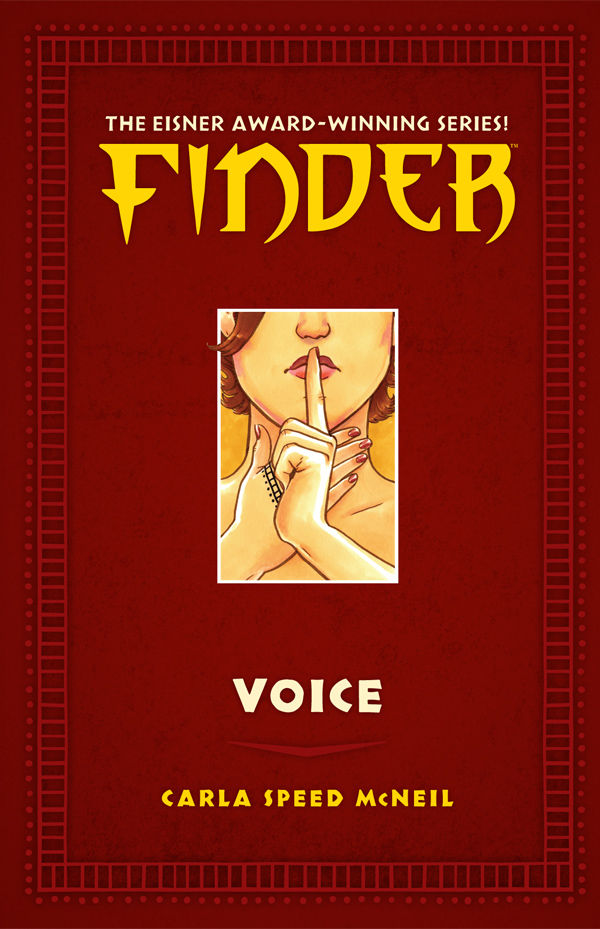
Click here to get truly and deeply lost in one of the best comics of the year!
Ghost Stories: Finding a Finder part 2
August 30th, 2011
Being: the second of three posts on Carla Speed McNeil’s “aboriginal science fiction” comic Finder…
He did not want to compose another Quixote —which is easy— but the Quixote itself. Needless to say, he never contemplated a mechanical transcription of the original; he did not propose to copy it. His admirable intention was to produce a few pages which would coincide—word for word and line for line—with those of Miguel de Cervantes.
“My intent is no more than astonishing,” he wrote me the 30th of September, 1934, from Bayonne. “The final term in a theological or metaphysical demonstration—the objective world, God, causality, the forms of the universe—is no less previous and common than my famed novel. The only difference is that the philosophers publish the intermediary stages of their labor in pleasant volumes and I have resolved to do away with those stages.” In truth, not one worksheet remains to bear witness to his years of effort.
You find yourself bored and lost in your local comics shop on a crisp Thursday afternoon. You’ve exhausted all your usual favourites, or at least, you’re pretty sure that you’re not paying that amount for that hardcover collection today. Thankfully whoever does the ordering for your local shop has anticipated your boredom, and has made sure that one of Carla Speed McNeil’s Finder comics is waiting there on the shelf for you.
You’ve read a lot about Finder and — your friend Cat’s admonition that you “like music that’s fun to read about instead of music that’s fun to listen to” still fresh in your ears — you have to admit that this counts for a lot for you.
The specific Finder comic that’s in front of you is Talisman:

You seem to remember that this is a particularly well-regarded volume. What was it Douglas Wolk said about it in his Reading Comics? Ah yes:
McNeil didn’t entirely hit her stride until the fourth Finder volume, Talisman, and it’s not a coincidence that it’s her most tightly focused story: it’s about a girl who falls in love with a book, loses it, and becomes a writer in her attempts to find it again.
Well, imagine that–a storyteller inspired by other people’s stories!
Aggregator aggravator
August 26th, 2011
SPECIAL “BAD TOUCH IN GOOD COMPANY” EDITION!!!
Like I said last time, it’s been a while since we did one of these, eh? Still, that’s alright – it’s not like there’s been another Royal Wedding I could have sniped at or anything!
Anyway, enough of that (You’re telling us! – Ed) – I want to put some filth in you . Best take your shots first, unless you actually want to catch something…

Sex/Violence/Other: Finding a Finder part 1
August 23rd, 2011
Being: the first of three posts about Carla Speed McNeil’s “aboriginal science fiction” series Finder…
Reading one of Carla Speed McNeil’s Finder comics is like wandering through a strange new city without a reliable guide. Or a map, for that matter, but maybe that’s better in the end. After all, sometimes maps can cause a different sort of trouble:
A map can organize the world according to almost any principle of order…. All classificatory grids are arbitrary. They have no necessary or absolute status. It does not matter what kind of grid is used on the map. Any system of lines or points of reference can be imposed to provide orientation, although different mappings may serve very different interests…. For those who inhabit particular mappings, they are likely to be viewed simply as reality.
(Geoff King, Mapping Reality – an Exploration of Cultural Cartographies – via Dylan Horrocks)
Forget maps for a minute. Let’s stick our head in there and see what we see…

Ah, well, as far as broad statements of intent go, that one’s as good a starting place as any for this post. You see, unlike that other master of anthropological science fiction, Ursula Le Guin, McNeil doesn’t pretend to build up her world up systematically in front of your eyes. Instead, find yourself discovering information about the cultures in Finder almost accidentally, by watching the characters interact and keeping your eye on some of the key sights. No wonder Kelly Sue DeConnick compared the book to a shotgun blast! Still, I’ll stick with my ‘strange city’ analogy, if only because of the comic’s pace.
Freshly re-released as part of this collected edition, Finder: Sin Eater is a brilliant, wandering introduction to a truly great comic book. It’s a twisted mess of a story, with family ties, military ties and cultural boundaries revealing themselves at a leisurely pace, all the better to fully appreciate the damaged contexts the cast of characters live in. McNeil’s art becomes more and less abstract as the story dictates, sometimes suggesting an expressionistic hybrid of Western alt-comics and manga tropes, at other points snapping into “realistic” focus to give us a better look at the thoroughly singular world she’s created.
Transformers: Toy Stories
July 4th, 2011
There are many, many reasons why I might be considered an idiot, but if you were going to make a list – and believe me, I’ve made a few such lists in my time – then I’ve got a fair idea of what the top three should look like.
I’ll spare you numbers one and two for now, but number three is easy. You see, I must be an idiot, because I don’t think I understood mortality until I watched Transformers: The Movie for the first time. Yeah, Transformers, “robots in disguise” that turned into planes and cars and tanks, and had their own crappy TV show. That was where my first intimation of mortality came from. Told you I was an idiot.
The realisation that all of this would one day stop had never sunk in at Sunday School, where the focus was more on old stories than on the possible absence of narrative. It hadn’t made any impression on me when various distant relatives had died – they had seemed like minor characters in my story, and their deaths didn’t truly register with me at the time. It didn’t even really occur to me in the early parts of Transformers: The Movie, despite the fact that whole planets were being destroyed and beloved characters were being gunned down like so many extras (with all weapons having been switched from tickle to mangle between TV series and movie, naturally). But OPTIMUS FUCKING PRIME, my favourite toy and childhood hero, dying on-screen, in an astonishingly drawn out manner? Yeah, I felt that, and it scared the living shit out of me.

See, here? One day your sentence will be up. Full stop. Story over. The end.
TALES FROM THE MILLARDROME: Monument to a Forgotten Future
June 14th, 2011
We’ll stop at nothing, you see. All the suffering and the death and the pain in your world is entertainment for us. Why does blood and torture and anguish still excite us?
We thought that by making your world more violent we would make it more “realistic,” more “adult.” God help us if that’s what it means.
Maybe, for once, we could try to be kind.
(Grant Morrison, Animal Man #26)
TALES FROM THE MILLARDROME, PART 1: Having spent a fair bit of time ripping the pish out of Marky “Mark” Millar while writing up my Kapow! experience, and having then heckled my way through a twitter argument about Mark Millar’s collaborations with Frank Quitely on The Authority, I felt an odd sense of duty to reread Millar’s breakthrough comic, to see if it still worked.
And you know what? Turns out Millar’s first story, ‘The Nativity’, is still really fucking good:

MINDLESS NEWS: Special “Alan Moore Knows the Score” Edition!
June 9th, 2011
DC’s September reboot might have dominated the week’s comics news, but while the rest of you were all wondering whether Grant Morrison would be writing Watchmen 2: The Curse of Ozymandias’ Gold, I was out exchanging inky handshakes with any number of shifty characters in order to bring you a real scoop!
Here it is, don’t say we’re not good to you!
MARVEL COMICS PROUDLY PRESENTS: ‘THE MAN WHOSE HEAD EXPANDED’, A TWELVE PART XORN MAXI-SERIES BY WATCHMEN AUTEUR AND BEARDED FANCYMAN ALAN MOORE!!!
EVER WONDER WHAT WAS REALLY GOING ON DURING THE XORNETO DEBACLE? YOU MIGHT THINK YOU KNOW THE ANSWER, BUT MUCH FANCIED WORD-BURBLER AND PART TIME SWAMP THING IMPRESSIONIST ALAN MOORE KNOWS OTHERWISE, AND NOW – FINALLY! – HE’S AGREED TO TELL THE REAL STORY IN THE MIGHTY MARVEL MANNER!!!!!
WHAT’S THE CONNECTION BETWEEN THE MAN WITH THE STAR FOR A HEAD, EVERYONE’S FAVOURITE LEATHERY NAZI-HUNTER, MARK E SMITH, AND A SINISTER GANG OF SCOTTISH SKINHEADS?!!?!! FIND OUT IN ‘THE MAN WHOSE HEAD EXPANDED’, A FIVE STAR RAVE-UP IN TWELVE SPECTACULAR ISSUES!!!!!!!!

ART BY FRANK QUITELY; COLOURS BY BRENDAN MCCARTHY/STEVE COOK.
STARTS 6th JUNE 2012
‘What Alan’s done here, and it’s quite clever, but basically he’s taken the idea – what if a man had a star for a head – and he’s sort of pointed out all the ways in which it doesn’t make sense. Because it doesn’t, really, when you think about it. A man with a star for a head. Ridiculous.’ — Stewart Lee, CLiNT Magazine
‘I’m dead me!’ — William Blake, Wizard’s Top Colourist, 2003-2005
‘Don’t worry Grant, I’ll probably only manage two or three issues this year! – Frank “the shank” Quitely, chin expert