Cerebus: High Society
June 5th, 2014
(Some of the images here are very blurred, but can be seen more clearly in the full-sized versions, viewable by clicking through the bandwidth-optimised ones used on this page)

We all think we could make a difference.
In 2008, Gorton North was held by the Liberal Democrats with 42.8% of the vote. In May 2014, the same council seat had the Liberal Democrats coming third, with 13.2% of the vote. The Liberal Democrats ended with no council seats in the whole of Manchester, which is now a one-party state.
The reason I mention this is because in the second of those elections, a week and a half ago as of this writing, I was the Liberal Democrat candidate. It would be pointless trying to write from a position of detachment about High Society, the second Cerebus phonebook, which is almost entirely based around an election campaign, so I’m not even going to try.
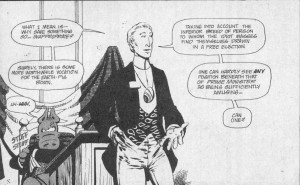
High Society is where, by common consensus, Cerebus really gets good. It’s a political satire, combining elements of the Marx brothers, Looney Tunes cartoons, and comic book culture, and it lasted for twenty-five issues — a ridiculous length back when a three-issue storyline in a superhero comic would be considered an “epic”.
It’s also, as many people have pointed out, almost completely incoherent when it comes to the actual politicking involved. Sim at this point clearly knew little or nothing about politics, and it’s clear that he had several conflicting aims — he wanted to show the rise and fall of Cerebus in the political arena, which had been established as existing at the whim of Lord Julius, an absolute dictator, and yet he also wanted to satirise the electoral process. So we get Cerebus arriving as “the ranking diplomatic representative from Palnu” — an appointed position, but then Elrod is nominated by Lord Julius as the new ranking diplomatic representative. However, rather than this leading to Elrod just taking on the role, there is instead an election — an election voted for not by the people of Palnu, but by the people of Iest, the state to which he is to be the representative.
This makes no sense on any level — even after Sim’s revelation in a chat on the Cerebus Yahoo group that Lord Julius (the dictator and Groucho Marx figure) is intended to be a plant working for the Illusionists (a group of drug-mystic anarchists who are one of the minor factions who are fighting in the background throughout the first two thirds of Cerebus) and so the political system is meant to be as confusing as possible. And it gets worse when the first of the political conventions portrayed is shown as a comic convention, with Cerebus and Elrod signing autographs and doing sketches for fans.
[ETA Michael Peterson has pointed out on Twitter that I don’t make it clear here that while the election starts as the election for ranking diplomatic representative, Cerebus ends up standing for Prime Minister]
What Sim appears to have done, in fact, is to read Hunter Thompson’s Fear and Loathing on the Campaign Trail (a classic account of the 1972 election campaign when George McGovern lost massively to Richard Nixon) and use that as the basis of his story, twisting it to fit the plot points he needed to hit in his grand narrative, and filling in the gaps with comic culture references and a kind of bargain-basement populist politician hatred, of the South Park/UKIP/Russell Brand variety.

And yet…and yet…
The feeling of the book will be utterly familiar to anyone who has taken any kind of active part in political campaigning. It feels like real politics — building up a coalition of diverse interests with nothing in common except that the candidate they support will get them some of what they want, desperately figuring out which interest group’s votes you can count on and which you can’t, negotiating policy positions…
In a situation like that it becomes very easy for the idealists to become obsessed with the machinery and lose sight of their ideals, but it also becomes easy for the egotists and machine politicians to get swept along with the enthusiasm for change. People have criticised the moment when Cerebus says “For a while there, Cerebus thought he could… make a difference…” as being unearned sentimentality — Cerebus only gets involved in the campaign at all for the same reasons he does anything, to get money, power, and an easy life, and he has no ideals at all, so for him to say he wanted to make a difference seems like the worst kind of mawkishness.
But in fact, it rings as true as anything in the book. For every idealist who loses sight of their principles as soon as they get a sniff of power, there’s a machine politician who, once they realise that the levers of power are theirs to pull, starts thinking “hang on, I could actually do something good here”. Everyone has a view of how the world should be, however incoherent, and when presented with the opportunity to reshape the world very few people will not have some ideas for improvement.
That makes High Society sound like it’s a serious political work, however, and it’s not. It is, in fact, as funny as Cerebus ever gets. While Sim is laying the groundwork for a much bigger, longer, story to come, he’s also working on a more sophisticated version of the joke that made up the very first issue of the comic.
Cerebus, at this stage, is all about genre clashes, and by this point Sim has got the clashing down to a fine art. Each of Sim’s characters belongs to one genre, is in a story of another genre, and quite often thinks they belong in a third genre. The prime example is Cerebus himself, a funny animal who thinks he’s a barbarian hero:

But there’s also Elrod, a Looney Tunes character who thinks he’s a high fantasy Moorcock character:

The Moon Roach (the character who was formerly the Batman parody The Cockroach and then Captain Cockroach has now become a multiple-personality parody of Moon Knight who drops enormous stone crescent moons on bankers while shouting “Unorthodox economic revenge!”) thinks he’s in a superhero story, and most of the supporting cast think they’re in a Regency novel.
Only Lord Julius, who remains somewhat in the background in this story, seems to have a clue what’s really going on — but then Groucho always did seem to be the only person in any of the Marx Brothers’ films who had any kind of genre awareness, at least if you don’t count his brothers, and while Bran Mak Muffin is here reconfigured as the Zeppo figure, a comic as writer-driven as Cerebus would never have had room for a character as visual as Harpo. And as for Chico — or “Duke Leonardi” — well…

Let’s just say that Duke Leonardi isn’t great at understanding things.
The result is that the narrative, while structured like a political campaign story in the same genre as Primary Colors or All The King’s Men, is driven entirely by characters working not just at cross-purposes, but towards purposes which none of the other characters can even comprehend.
As well as the All The King’s Men similarities (although Cerebus’ arc from ego-driven thug to principled leader is the opposite of that of Willie Stark), the obvious comparison is Being There, a film which had come out a little under two years before the High Society storyline started. Much like Chauncey Gardner, Cerebus is someone with so little in common with the political world that his plain-speaking stupidity is taken as great political wisdom (although unlike Gardner, Cerebus has a huge amount of cunning). This only works because everyone is talking past each other the entire time.
While Sim was, of course, to move away from this formula in later storylines, there is a hint of it in everything up to issue two hundred, in the games and counter-games, strategies and plots, that dominate Church and State and Mothers and Daughters and make up the background on which Cerebus’ life plays out. There’s a very thin line between politics and farce, as anyone who watches the news will attest, and in this genre clashing Sim has found the perfect engine to generate farcical political intrigue.
But part of the reason Sim couldn’t keep this kind of storytelling going indefinitely is that people — and aardvaarks — are changed by their environment, and realistically there was no way to keep Cerebus as a barbarian after two years of political intriguing in a setting whose culture is closer to the late eighteenth century than to Hyperborea. No matter how rough and uncultured Cerebus remained, there was no way he could go back to questing to defeat nameless demons and steal gold and jewels. Once he had a taste for politics, like many of us, Cerebus couldn’t turn back.
The story ends with Cerebus’ dreams of power crushed, his supporters dispersed or locked up, and his power-base gone, seemingly for good. Yet, as we shall see, he can’t stay out of politics now he’s been in it. Cerebus is down, but he’s not out.
Unfortunately, the same can’t be said of the more idealistic of his supporters. It’s revealed at the end that the hilariously inaccurate history of Cerebus’ abortive political movement, excerpts from which have been peppered throughout the story, is being written by a political prisoner, who despite everything is keeping alive the dream, even though it was a dream that his leaders didn’t share.
More than a few of us know how he feels…
SILENCE! #103
June 2nd, 2014
STRUGGLING IN THE VORTEX, WITH MY JACKET MADE OF GORETEX
Today, for you smiling meatsax, Disembodied Narratorbot X-15735 will consult the great oracle DESREE to find for you the meaning of life. Speak oh great one:
“I don’t want to see a ghost
It’s a sight that I fear most
I’d rather have a piece of toast
And watch the evening news
Life, oh life, oh life, oh life
Doo, doo doo doo
Life, oh life, oh life, oh life
Doo, doo doo doo”
Disembodied Narratorbot X-15735 agrees Desree, toast rather than ghost! ALWAYS! Who would want ghost? And Life IS doo doo doo isn’t it? You really nailed it. No more questions! ALL ANSWERED.
Now onto the latest edition of SILENCE! featuring 100% more The Beast Must Die, but with almost 100% less Bobsy. Same Gary Lactus content though. Just right, as Goldilocks said before she nicked all the porridge and those three vegetarian peace loving bears starved to death.
After a cursory admin session, The Beast talks about his upcoming Cindy & Biscuit art installation up in that bloody London. More details follow after the blurb.
[ITEM] The ‘lads’ answer some more listenoid quizzlers in their slackadaisical fashion. Worth the wait? YOU DECIDE! Amongst the answerage: Doop, bad comics by good creators, Grant Morrison’s Spawn, The Family Must Die, planet-shaped dinner, Heralds, Mighty Crusaders, The Secret Origin of Mindless Ones, Frank Miller, Give Me Liberty, Robo-Hunter, humorous comics, Saturday Night Live, 2000AD, The Studio, creating comics, How To Talk To Girls, drawing comics, Sklent, Greatest Stories Ever Told, Tharg’s Future Shocks, Terminus
[ITEM] A quick dip in the shimmering surf of the Reviewniverse with talk of Southern Bastards, Ordinary, Sparta USA, Titan Comics, MPH, Trees, Saga, Mighty Avengers, SILENCE! Shout out, Deadly Class, non-drowsy decongestants, Red Rover Charlie and a bit more too.
But wait…I have thought of another question.. all is not answered…do not forsake me oh Desree…ANSWER ME!!!!
Click to download SILENCE!#104
[AND NOW, A BONUS MESSAGE FROM THE BEAST]
Smiling friends

Click to download SILENCE!#101
Contact us:
[email protected]
@silencepod
@frasergeesin
@thebeastmustdie
This edition of SILENCE! is proudly sponsored by the greatest comics shop on the planet, DAVE’S COMICS of Brighton.
It’s also sponsored the greatest comics shop on the planet GOSH! Comics of London.

In The Foyer Now: JAWS 2
May 31st, 2014
These will be irregular posts (aren’t they all) about some of my favourite film posters. Not necessarily my favourite films, but the images used to promote them that I find alluring, striking and resonant.

NO BLUEBEARD: Reading Comics in Public, Grauniad Style!
May 30th, 2014
Audrey Niffenegger and Eddie Campbell – ‘Thursdays, Six to Eight p.m.’

Back at the end of April the Guardian ran an experiment to see what would happen if real writers were involved with comics, and the results were pretty much what you’d expect, ranging as they did from the mediocre (Dave “David” Eggers’ ponderous buffalo comic) to the merely gorgeous (Frazer Irving’s whatever the hell it was that Frazer Irving drew) by way of the profoundly functional (Dave Gibbons and Gillian Flynn’s clockwork deconstruction of vigilantism).
As a showcase for a variety of semi-respectable comics art styles it was a success, but as a pop culture moment it lacked a sense of novelty or excitement.
The exception was Thursdays, Six to Eight pm, a modern romance comic with a faint hint of the gothic to it. A man and woman are in love and they get married, but she can’t stop worrying about why he wants two hours to himself every Thursday night. For his part, he keeps quiet about the details, so Ellen does what we all do unless we’re sinister enough to work for the NSA already: she calls in some spies.
The result of a long-distance collaboration between Audrey Niffinegger (The Time Traveller’s Wife) and Eddie Campbell (all the best comics), this strip stood out from the others by virtue of the fact that both of the involved parties contributed to the art. Well, according to the contents page Dave “Dave” Eggers was “collaborating with himself” but this does no damage to my argument: the lines on Eggers’ pages were the work of only one artist, while the Campbell/Niffenegger strip bears the mark of two “primary” artists.
According to Niffeneger’s write-up, she drew the Charles – the guy doing the proposal in the above panel – and the two spies his wife hires to investigate him, while Campbell drew Ellen, the suspicious wife and protagonist on the right hand side of the same frame.
Even though Campbell apparently modified Niffenegger’s line work to make it look of a piece with his own, my eyes mostly confirms that these characters are not made out of the same materials. This plays into a classic romantic conceit, suggesting as it does that while these two characters may share their lives with each other they’ll always be fundamentally distant. Charles’ thin, defiantly two-dimensional features provide an impermeable barrier between the contents of his mind and the blown out, fuzzy world he lives in with Ellen – being an Eddie Campbell character, she is made out of the same fuzz and clutter as everything else.
The fact that Campbell was also responsible for the lettering and page layouts will be immediately obvious to anyone who is familiar with his autobiographical comics.
This comment from Niffenegger struck me so forcefully that it left me with a mental scar I’d now swear I was born with:
Eddie always begins with the lettering, so there was an early stage of panels and lettering but no images, which I found intriguing. He letters by hand, and already the pages looked like a true Eddie Campbell comic.
More than any other comics artist I can think of, Campbell makes a casual mockery of the idea that the manner in which comics combine words and pictures needs to be policed to maintain the purity of the form. While works such as Bacchus and From Hell shows that Campbell is perfectly comfortable telling a story visually, in a comic like Alec – how to be an artist the continuity of the narrative can be found in the prose, with the visuals reacting to and reiterating the words in exactly the way we’re told they shouldn’t.
SILENCE! #102
May 27th, 2014
GOD BLESS DONALD DUCK, VAUDEVILLE AND VARIETY
<ITEM> There’s no robot, we’re clear on that, OK?
<ITEM> The X won’t X itself, you learn, and so The Beast Must Die be gone for now. Fear his return, when the goose of the moon gets fine and fat.
<ITEM> Unforkunakely, Gary’s hunger for space rocks will not be satisfied by merely genuine good reasons0000000, and as per, bobsy has nothing else to do and dutifully hobbles by.
<ITEM> Tell us what you think of the The Making of the Making of Star Wars the Musical bit at the beginning. You can see that it’s all about the admittedly brilliant ‘intuitive/diminutive’ moment, but we’re really keen for feedback ahead of rollout do let us know what you think via the special survey.
<ITEM> There is some admin at the beginmin too, and a recap of the Bank Holiday weekend, when they watched the X-Men Dofp movie and had a barbecue at Zom’s and it was bobsy’s birthday. They talk about Hotel for Dogs during this podcast portion.
<ITEM> And then the Galaxy eater (a bit too sugary, and made by Nestle to boot, prob) and his mewling supper travel to the Reviewniverse, where they talk about…
<ITEM> Caliban, Elephantmen, Original Sin, Prophet, Batman Weakly, Uber, Julian Cope, Zero, Hypnotic Induction Technique, The Boy in Question, Copra and Adapt. Possibly some other stuff too, but they weren’t keeping very good notes.
<ITEM> You know the joke about the guy needing a microscope to see his own cock? Well, this podcast is respectfully – and resexfully – dedicated to Sir Darren of Oxon.
<ITEM> So listen to SILENCE! #102. There is nothing in your life nearly as important.

Click to download SILENCE!#102
Click to download SILENCE!#102
Kontak:
[email protected]
@silencepod
@frasergeesin
@thebeastmustdie
@bobsymindless
This edition of SILENCE! is proudly sponsored by the greatest comics shop on the planet, DAVE’S COMICS of Brighton.
It’s also sponsored the greatest comics shop on the planet GOSH! Comics of London.
The Wind Rises – Hayao Miyazaki, 2013

Before we start, a warning: this is probably not a fun night at the movies for your eight-year-old, unless said child is prematurely obsessed with flat-head screws. I mention this not out of a new-found commitment to providing consumer advice but because my friend Adam was frustrated by the apparent inability of movie reviewers to clarify this matter for him.
Studio Ghibili’s long standing trust in the ability of children to stay interested in quiet moments and make sense of the senseless is admirable, but The Wind Rises seems to have been made in a different spirit from, say, Howl’s Moving Castle (which combined frantic scene-shifting with portraits of stark devastation to great effect) or Princess Mononoke (which grew slowly, steadily monstrous in front of the patient viewer).
This film is realised with the lush, painterly attention to detail that characterises Hayao Miyazaki’s other movies, but this is definitely a film of and about our world. Its magic is not of the kind likely to intrigue a child into attentiveness: its wonders are the result of late night meetings as much as they are the product of dreams, and even its most hard won miracles taste of ashes.
Change the conversation: Mark unpacks Mad Men season 7
May 15th, 2014
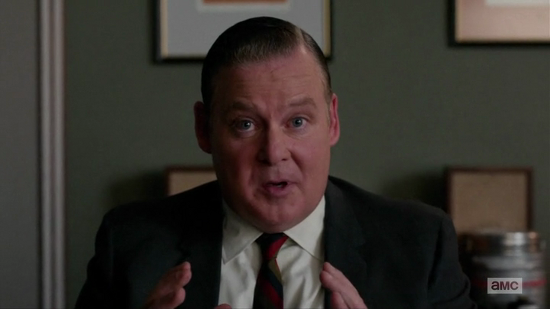
One thing that disappointed me about the commentary surrounding Time Zones was a general unwillingness on behalf of most critics to get stuck into not just Freddy’s pitch but the first scene generally. I understood why well enough, it was a depressing episode and seasoned fans have been well trained to mistrust the surface glamour of Mad Men’s premiers, which in the normal course of things turns to crap after the first half hour. But in the end that didn’t cut it for me, for two reasons. Firstly, because the opening pitch so often serves as the key to unlocking a season’s trajectory, and secondly, because Freddy’s first words, a confident and joyous starting gun on a gloomy story, were designed to nag.
“I want you to listen carefully. This is the beginning of something.”
The idea that these words heralded the beginning of the final season and nothing else seemed unlikely. Because, come on everyone, this is the final season. Every detail is important.
Initially the main effect of this nagging, this jarringly incongruous celebratory voice echoing across the ruins cheering the new day, was to force me to re-evaluate many of the scenes and plot beats most reviewers took for granted were evidence that things will never go right for Don. Then it got me thinking about the downward spiral of the season more generally, eventually concluding that this, like Don’s descent in six which led to that beautiful final scene, was probably a good thing too. I was listening, I was paying attention, and it occurred to me that the Something Terrible Don drew down with that first ad pitch in The Doorway probably wasn’t through with him yet. Megan leaving him to pursue her career in California and his getting fired was only the start of it. Things needed to get about as bad as they could before the pendulum would swing the other way.
Quite simply, I realised this season is about nothing less than the destruction of Don Draper.
Zadie Smith – The Autograph Man
For someone with my particular literary damage, reading this novel for the first time in 2014 was a lot like having the arguments of 2001 all over again. If literary critic James Wood’s attack on what he deemed “hysterical realism” has a fitting target it is this over-eager, initially likeable but ultimately tiresome second novel from Smith.
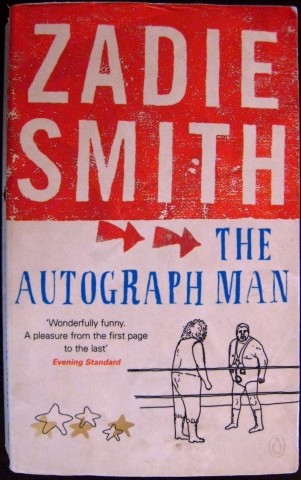
The story of “twenty-something Chinese-Jewish autograph dealer” Alex-Li Tandem’s frantic, free-wheeling attempts to lose himself in the search for his pop culture obsession, The Autograph Man spends its four hundred plus pages tilting after a curiously overdetermined sort of oblivion. To mangle a Samuel Johnston quote most boys of my age know by way of popular wise guy Hunter S. Thompson, Tandem acts in the belief that he who becomes his hobbies spares himself the pain of being a man. The novel follows suit, hence the ever-egressing framework of Kabbalistic associations, Zen progressions, verbal tics (“the popular” and “wise guy” chief among them), Rabbinical comedy routines and generally excessive detail. All of this by way of keeping Tandem from dealing with the world’s tendency towards impermanence and disorder: these events take place in the build-up to the tenth anniversary of his fathers’ death, and in the aftermath of a destructive trip that seems like it might cost Tandem most of his established relationships, and also his car.
The overlapping structures of this novel are all fine and sturdy, and have elsewhere proven themselves more than capable of supporting, variously: an Oscar Wilde aphorism, an essay by Walter Benjamin (“wise guy” and recipient of the novel’s worst punchline), the occult adventure comic Promethea, and an excellent graphic novel by Eddie Campbell. There’s nothing to say that they couldn’t provide the framework for an excellent Zadie Smith novel too, but the difference between The Autograph Man and all of the aforementioned works is that Smith’s imaginative scaffolding seems to exist around very little that was worth supporting in the first place.
The Winter Soldier: Captain America 2, reviewed!
May 7th, 2014
Captain America: The Winter Soldier, directed by Joe and Anthony Russo, starring Chris Evans, Scarlett Johansson and Anthony Mackie, brought to you by the power vested in me by the great state of Wyoming

While I will surprise approximately no one by saying that the action in this movie was nowhere near as inventive and exciting as the violence that gives The Raid 2 its reason to exist, this movie still confounded my expectations by impressing me more with competence than raw thrillpower.