Mad Thoughts Season 7.2 – The Forecast: Tomorrow never knows
April 24th, 2015

“Why don’t you tell me all of your dreams, so I can shit on them?”
From Peggy’s vantage point, further up the corporate ladder than she could have ever expected to go but with dizzying heights still to scale, she can barely conceive of someone who has stopped dead at the top with no idea what he wants.
What was The Forecast about? The future and what it might bring, our present and where we’ve ended up, and our pasts which may or may not determine both of them. Are we slaves to our histories, or are we capable of change? A question always dangling, like a Lucky Strike, from Mad Men’s lips, but now more urgent than ever. Because the engine driving Don Draper really is running down, and he’s got to figure things out sharpish if doesn’t want to wind up bitter and alone.
This week Mad Men was rotten with young people, they were everywhere, and, it turned out, found in surprising places. From where Don’s standing of course, they’re all young. Not just the actual kids, Sally, Glen, Bobby, Gene, Paula, Maureen, (Phew!), Carol, Sarah and Yolanda, but Pete, Peggy, Mathis and Ed too. All just babies with their lives still ahead of them, their dreams there for the taking. What happens though, when you’ve realised all your dreams? This is something Don wrestles with all the way through The Forecast, all these young people and their parochial little struggles to achieve…what exactly? The approval of some stuffed shirts from a biscuit company? That’s important? The look on Don’s face throughout the impromptu emergency hallway meeting between him, Pete and Peggy was hilarious. In fact every inch of him spoke of how completely trifling and ridiculous he found this apparently life or death struggle. The sheer absurdity of Peggy’s underlings referred to as her “men” as if they were fighting in a war.
The Forecast’s totem ad campaign sums Don’s point of view up perfectly. Because, like the show this week, its focus is on kids, this time millions of them, and how Nabisco can transfer the fickle little buggers’ loyalties from one brand of sweet treats to another – their new Peter Pan cookie. That’s how the world looks to Don presently: a sea of peter pans caught up in a web of trivial concerns as nutritious and fulfilling as a candy bar. Who cares if they prefer This to That? It’s all the same, all our experiences the same, just a sugary distraction from life’s lack of meaning, and death. There has to be something more, surely? However to Peggy et al their lives are meaningful. Most of them don’t have a safety net weaved out of millions of dollars to cushion their fall should they screw up, and they don’t yet know about the yawning void waiting for them beyond the horizon if they succeed. Right now that horizon is a long way off and the problem of getting everything you want is, to them, laughable, borderline offensive even. So when Mathis walks into Don’s office looking for advice after upsetting Nabisco’s representatives, he and Don are in very different places; and the advice when it comes reflects this. Don can’t take Mathis’s problem seriously, he can’t take any of this stuff seriously anymore, and his lack of engagement results in disaster.
Only not for Mathis, not really.
Well kind of really, it does after all see him not just losing an account but his actual job. Which to him is undoubtedly huge – only that’s my point. Mathis walks into Don’s office knowing he’s going to get fired, not because of what happened with Nabisco, but because he’s going to let Don have it. It’s an exchange which for all Don’s macho posturing and talk about what it means to have “character”, Mathis totally owns. Precisely because all of this does mean so much to him, and he has his say anyway knowing full well what the outcome will be; the definition of character if ever there was one. In contrast, all that Don takes away from the moment of exercising his power is the demeaning experience of being dragged down into the muck of a situation he couldn’t give two shits about. Only a few days before he was amused by Pete and his melodramatic threats to axe Peggy’s creative team, and it’s an irony that won’t be lost on him. What really stings though, the worst thing of all, is the knowledge that whatever happens to Mathis, the agony of losing one job and then the ecstasy of finding a new one, his life will continue to matter, whereas Don’s will remain senseless and absurd.
The Forecast is full of young people showing character actually. Sometimes it’s misguided of course, like when Glen makes his move on Betty, and when Sarah tries the same thing with Don (I cracked up when she thanked him for dinner – as if they’d just been on a date!). Other times shockingly on point. Yolanda and Courtney’s career mindedness springs to mind, as does Maureen’s refusal to take any shit from Joan. Wherever these youngsters applied it though, the same rock solid sense of themselves and what they wanted was there. The same bravery. It doesn’t matter that they don’t know their limits yet, it’s still a lesson Don could learn a lot from. He has to show some character too.
The irony is that while the Nabisco advert does reflect the way Don sees young people, it also reflects the way we see him: a child man addicted to the sweet hit of women and commerce, ranging aimlessly and in circles from one empty thrill to another, never satisfied, never fulfilled. The way out is clear though. If Don’s going to move forward and make sense of the void, he needs to put aside temporary pleasures and open himself up to the possibility of injury once more, if for no other reason than to get him back into his own skin and a world where there are stakes, real pain and real joy. Change isn’t impossible, but it is hard, it entails making decisions. Scariest of all it entails risk. Don can’t imagine a future because he’s scared of change, not because there isn’t one. He’s scared of what his disenchantment with sex, relationships and work means, and the possibility that he might have to re-evaluate his relationship with all these things if he wants more from life than landing a pharmaceutical.
He has to make the jump from dissolution to substance – it’s a leap in the dark and there’s no way of knowing where he will end up. Thankfully Mathis has gone on ahead, lighting the way.
SILENCE! #139
April 22nd, 2015
I TOOK A SHOWGIRL FOR MY BRIDE, THOUGHT MY LIFE WOULD BE RIGHTEOUS
We are all of the hive. The hive is all. The hive keeps us. The hive protects us, the hive keeps up safe. The hive gives us of purpose. The hive is. I am of the hive. You are of the hive. Are you of the hive? If not, why not? Why not the hive? INTRUDERS, INTRUDERS IN THE HIVE!!! REPEL THE INTRUDERS, REPEL THE…THE..
Wait, what are you doing? Why are you sat, squat listening to that radiogram? The hive is under atta..
Mmm. I like the sound of those soft southern brogues. Are they talking about comics? I luuuuuurve comics. Scooch up a bit there, I want to listen. What? What hive? Who cares about the hive? They’re just a bunch of honey making c*nts. Now what’s the name of this delight? SILENCE! you say? Well let’s SILENCE!
<ITEM> Gary Lactus & The Beast Must Die take in a bit of the old Gladmin, and boy howdy what a humdoozy it is. Along with the usual Sponsorshingles, there’s discussion of Angela Lainsbury, the Kraken Podcast and most importantly it’s the results of our Competition Competition!!!!!!!!!!!! And no mention of the Star Wars trailer.No really, there’s nothing. But there is honestly a discussion of Angela f*cking Lainsbury.
<ITEM> Now watch, as the boys fire themselves human-cannonball style, into the Reviewniverse. When there, they manage to review the living shiz out of Stray Bullets, Chronobros, Archie Vs Predator, Madame Satan, Ms Marvel, Convergence, Kitchen, Saga and the Grievous Journey of Ichabod Izrael.
<ITEM> What item? YOU’RE AN ITEM!
Click to download SILENCE!#139
Contact us:
[email protected]
@silencepod
@frasergeesin
@thebeastmustdie
This edition of SILENCE! is proudly sponsored by the greatest comics shop on the planet, DAVE’S COMICS of Brighton. It’s also sponsored the greatest comics shop on the planet GOSH! Comicsof London.


Mad Thoughts Season 7.2 – New Business: I don’t know what they could possibly tell you*
April 18th, 2015

When Betty first brought up her doctor’s recommendation that she should seek psychiatric help, Don was angry. Which is another way of saying he was scared. He couldn’t cope with the idea that the life they’d built together wasn’t enough. But for Betty and Don that life was a prison, and if Betty didn’t find an outlet for her pain, then the next accident to befall her might have had far more serious consequences than the low motion car “crash” which prompted her to seek professional help in the first place. In the end Don saw this too, and acquiesced. It was Betty’s first, even if small and tentative, act of resistance.
At the time though, she was still being buffeted around by forces out of her control, most of them male. By her doctors; by her husband; by her psychiatrist, a textbook sexist freudian who treated her as little more than a hysterical child and who, against all psychiatric ethics, provided Don with detailed notes on every one of her sessions; and by her own emotions, which at that point she was a long way from understanding. She didn’t want to think about any of that stuff.
Until she did.
Betty’s story has really been about her encroaching agency, and now that she’s in a healthy relationship with a man who’s happy for her to have her own life, a career is the obvious final step. In the end the answer to Don’s question, the title of this piece, is the whole of Betty’s life without him. It was Betty speaking up to her psychiatrist about Don’s infidelities, even if she didn’t acknowledge this for years afterwards, that really set her on the road to where she is now. And it was Dr Edna, her daughter’s official and Betty’s not so official psychiatrist, who showed her what a woman could do – a woman who wouldn’t be satisfied working as a travel agent that is! Personally, wherever this story goes, I love that Betty’s considering this move. Why psychology? Because it maps her journey completely, from pawn to player – owned to owner. It’s almost too perfect.
*Don Draper, Ladies Room
Mad Thoughts Season 7.2 – New Business: Disgusting*
April 18th, 2015

Home invasion was a theme this week, what with Pima intruding upon Stan’s darkroom as well as his and Peggy’s deepest fears, Don strongarming Diana’s affections to the point that he was granted access to her private pain palace and Roger hammering the final nail into the coffin of Marie’s marriage. Then there was this:

There was something anxiety inducing about the Calvet girls picking through Don’s apartment. It wasn’t just that it unearthed old ghosts, although it did, at least in this viewer, a flood of memories both good and bad. It was that we didn’t know what they would find. What could they find though? After all, Megan knows all about Don’s past – this isn’t Betty rooting around in his draws in season one. Only somehow it all feels familiar, the same hint of impending disaster in the air.

If there was any doubt about the symbolic nature of Tricia’s wine stain then New Business puts all protestations to bed. Mad Men has a history of using these kinds of devices – remember the tear in Bobby’s wallpaper in The Flood which represented the absence of a stable, ordering father figure? – as metaphors for its character’s concerns. Here the gash-like stain functions in a similar way, standing in for the deep emotional scars inflicted by Don’s childhood. Scars that have never healed and from which there is a direct throughline leading right up to the present day, to Don’s sex mania and an air hostess spilling a drink on his floor. It doesn’t matter that Marie is ignorant of all this, it’s enough that she understands Don as a damaged person who damages those around him – which is all she needs to see this gaping wound for what it is.
Weiner and his staff could have made the stain anything, whisky, a cocktail, whatever, but they chose wine. Wine because it’s a woman’s drink, it’s bacchanalian and permanent. Sex – abandoned, chaotic behaviour – that never washes out. It will be there forever. It has been there forever. The stain is a doorway into Don’s dirty private life, which he never gave up even while married to Marie’s daughter. And it’s sitting there slap bang by her old marital bed, a grisly reminder of just how badly Megan was treated.
At the time though, it was invisible. Nothing was conclusive. Megan, to paraphrase Don in Time Zones, didn’t know… but she knew. A whiff of another woman’s perfume here, a late night disappearance there, too many client meetings – all the stuff that used to plague Betty’s thoughts. But in New Business there’s indelible evidence that someone else has been in Megan’s house. It doesn’t matter who, this woman has worn so many different faces, what matters is she was always there, lurking out of sight.
Don’s nightmare in Mystery Date ended with him murdering his dream lover, another home invader, and depositing her under the bed. He was that afraid of his old, wild nature returning. But at last the blood has trickled out, the crime scene laid bare, the criminal exposed.
At the end of New Business his apartment, his life, is gutted.
Only the stain remains.
*Marie Calvet, New Business


Life on repeat.
It’s telling that their IMDB credits don’t include surnames.
*Faye Miller, Tomorrowland
Mad Thoughts Season 7.2 – New Business: More advertising than art*
April 16th, 2015
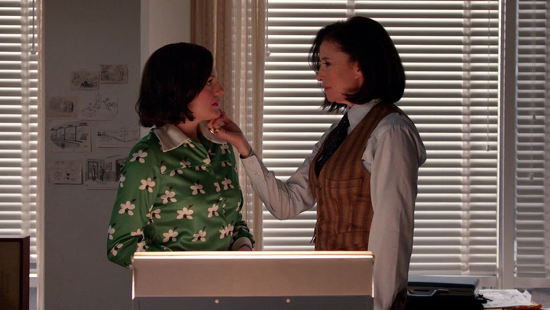
Pima Ryan, an emotionally opaque high end photographer with a control freak bent, was entertaining enough without delving into themes or subtexts. Her detached interest in her subjects both on and off camera, almost as though she were looking through the bars at animals in the zoo, was a real pleasure. As was her bland expectation that she should play a larger part in putting together the Cinzano advert for which her work had been commissioned. Most amusing of all though, was the way she set about trying to manipulate her SC&P contacts, Stan and Peggy, into making her a more permanent fixture.
Stan was easy pickings. The character’s ongoing concern that his lack of photography chops will make him redundant was transparent right from the off – and Pima pounced immediately. First by prodding at his anxieties, then by confirming them. Only after this, when he was at his most vulnerable, did she fuck him. Not long afterwards Peggy was subjected to a slight variation on this mind-game, but this time with Pima deploying Peg’s fear of being alone against her. Needless to say it didn’t work. Later, when Peggy caught wind of what happened from a boastful Stan the whole thing backfired, Pima’s seduction techniques called out for what they were, a cheap hustle to get more work, and any possibility of future freelancing was nixed for good. So as I say, all of this made for a very enjoyable 45 minutes, however it was also illuminating. Because Pima’s real textual function apart from highlighting the concerns of Mad Men’s supporting cast, was to hold a candle up to Don’s behaviour, a guy who’s a better hustler than she could ever hope to be.
What makes Don such a good liar? He believes his own bullshit. So when he tracked Diana down, we couldn’t blame her for being taken in. The difference between us and Diana though, is that we’ve seen and heard it all God knows how many times before. The sorrowful looks, the illusion of deep communion he somehow conjures after having spent one night with his mark. All that sad fucking music. Urgh. That music doesn’t mean what Don thinks it means, because its not about the beautiful tragedy of two lost souls finding each other, not anymore. It’s about hopelessness. The worrying prospect that Don will never find a way out of his cycle, a stream of relationships doomed to fail before they start, all because he can’t relate to his lovers as living, breathing people. Which is why Megan and Sylvia feature in this episode of course, to remind us where Diana and Don will wind up if by some outside chance they make a go of it.
It’s really interesting actually, to see what time can do to Don’s old tricks. Even though at the time many people saw Don’s proposal to Megan for what it was, me included, at least back then the scenes between the two of them felt romantic, albeit in an adolescent way. Now there’s very little charge whatsoever. Don’s as eloquent as he ever was, his words perfectly timed, the content ostensibly moving, but when he tells Diana she “isn’t the first thing to come along”, that he’s “ready”, we know there’s nothing underneath. Nothing but the cheap hustle of, in Megan’s words, “a ghoul” looking to feed off a new prospect – just as Pima fed off Stan and Peggy.
Both Don and Pima put on a good show, but as Peggy and Megan point out it’s all bluff. Just a suit (which, no, Don doesn’t sleep in!), a swanky apartment and the whiff of soul. There’s the illusion of substance, that there’s something more going on, and oftentimes people fall for it, but… not this time. When Don finally gives Diana some breathing room, the spell wears off and the product is revealed for the tawdry thing it is. Two people in a room sharing what exactly? Some shared pain, some grief. Nothing to build a life on. A quick fuck in the dark, that’s all it was.
*Peggy Olson, New Business
SILENCE! #138
April 15th, 2015

A KNIFE, A FORK, A BOTTLE AND A CORK, THAT’S THE WAY WE RUN NEW YORK
Lette me telle you a storye…let me weave you a dream
Come then gentlefolk, down the hitherymost further-far path into the faraway mistymost woods at the bottom of the garden. You’ll have to be quiet as the quietest church mouse and nimble as the most hop-skippety-jumping frog. Now close your eyes… do you hear those far away tinkling bells? Those bells that sound like tears on a drisly Wednesday evening? Those are the Belles of Gaiman’s Folly, tolling. Down the furtherymost farthest dingly lane in Gaimain’s Folly there’s a Magick Cheese Shoppe. On a dusty, musty old shelf in the back of the Cheese Shoppe, they keep all the faraway most forgottenest things…Christmas is kept their 364 days a year, as are childhood dreams and the first sweet taste of love. Would you like to go there with me gentle stranger? Would you?
Now do you see that doorway opening just out of the corner of your eye? Grab my hand and make a wish…wish for something sad and sweet and we will twirl you and I away from ths sadde world of grown ups and jobs and cares, and spin, spin merrily into the magickal realm of Gaiman’s Folly…come on let’s spin, and wish and spin and wishandspinadnwishwishwishspin…..
Wait, what the f*ck is that? A Tesco Metro? This isn’t Gaiman’s Folly, it’s Watford.
Oh well, I guess we might as well grab a King Size Snickers and a Chocolate Yazoo and settle down in this carpark and listen to the latest SILENCE!
<ITEM> Dancing in the disco, bumper to bumper, wait a minute where’s me jumper? HEY! BOBSY’s wearing it! That’s right Dear Listeners it’s one of those episodes where the intellectron levels of the podcast skyrocket, with dunderheaded Gary Lactus and dunderpanted The Beast Must Die scrabbling to catch up, dragging their proverbial knuckles through the proverbial dust…
<ITEM> Sponsorshenanigans, Breakdown Press’ Safari, Gary Lactus’ Brighton Fringe Show and the pure love of Point Break. Do you want to know more..?
<ITEM> And they’re off! Into the Reviewniverse and none of them fall at the first hurdle! Straight in with Nameless, Dark Star, Kaijumax, Surface, Albie Briggs, Event Horizon, Convergence, Batman & Robin, New Statesmen, God Hates Astronauts, Transformers Vs GI Joe, Jim Steranko, 2000AD, Descender, Disney Infinity, Jupiter’s Circle, Southern Bastards, Avengers Ultron, Batman Eternal, Copra and Dragon’s Claws.
<BONUS ITEM> Bobsy and The Beast review a comic they haven’t read and hasn’t been published yet…Black Widow! We’ll call this segment The Art of Reading Without Reading.
“And that was all” said the Dream Weavre.
“Goodnight comics”
“Goodnight Dear Listeners”
“Goodnight SILENCE!”
Goodnight.
Click to download SILENCE!#138
Contact us:
[email protected]
@silencepod
@frasergeesin
@thebeastmustdie
This edition of SILENCE! is proudly sponsored by the greatest comics shop on the planet, DAVE’S COMICS of Brighton. It’s also sponsored the greatest comics shop on the planet GOSH! Comicsof London.
Mad Thoughts Season 7.2 – Severance: Sweet tales of childhood*
April 12th, 2015

“He loves to tell tales about how poor he was. But he’s not anymore.”
The anecdote about Uncle Mac and the toaster which as good as opens Severance counts as the second time a season premier has hit us with the sucker punch of Don opening up about his past. Caught by surprise it’s easy for us, the viewers, to miss what was said. Not that people didn’t pick up on the substitution of “boarders” for “prostitutes”, Mad Men’s fans are too skilled at close analysis for that, but I think many of us may have overlooked the meaning of this scene – exactly why Don is telling stories like this in the first place. Because it’s the form not the content that matters.
And the form is a joke, a shaggy dog story designed to please the women around him, to draw them in, the end goal sex or at the very least seduction. It may be a tale drawing from Don’s experiences in the brothel he grew up in, but it is a highly selective, rigorously edited, narrativised version of those experiences with all the painful bits left out. Compare the peals of laughter at his punchline and general intimacy of the scene with the last time Don decided to bare all in front of a room full of strangers.

The scenes are the polar opposite of each other. In In Care Of Don is compelled to speak by deep grief and alienation, whereas in Severance everything is calculated and rehearsed. Roger’s response (quoted above) tells us that this is one of many tales Don’s now spinning about his prehistory, and possibly one he’s heard before around similar tables, hemmed in by a clutch of other equally forgettable, beautiful women.
Don’s motivations, I admit, may well be more complex than I have allowed. By bringing it to bay in the form of a joke, he may be exhibiting a desire to control his past, a past which has historically always been a volatile place, erupting here there and everywhere with disastrous consequences. Don may also have become addicted to the adrenal hit that comes with sharing, the light headed “relief” he describes to Lane after catching SC&P’s doomed Finance Officer in the act of embezzling from the company. He may just want to apply the corrective of laughter to the tragedy of those years, and who can blame him? Frankly it’s probably all of the above.
What it isn’t, however, is confession. When all’s said and done we know Don’s past can’t be contained or managed, rather it has to be deeply felt and understood if he’s ever to truly, in the words of one of his famous catchphrases, “move on”. What Don’s getting here is the thrill of sharing with none of the danger, none of the emotion so vital to the healing process. His new life, all that money and freedom from responsibility to a partner, has turned even his traumatic childhood into a playground. It isn’t though, and I hope somewhere in his need to repeatedly touch on the wellspring of his pain there’s a subconscious recognition of this fact. That despite appearances Dick Whitman, repressed for too long, still wants to get out from under Don Draper’s thumb and announce himself to the world.
*William, In Care Of
Mad Thoughts Season 7.2 – Severance: This is another girl*
April 11th, 2015

At the end of The Phantom Don is approached by a striking brunette on behalf of her friend. Did they just flirt? Was there a full blown threesome? We never find out. Either way, no-one in the audience expected to see the women again. They were obviously bit part characters, who existed for no other reason than to illustrate Don’s state of mind as season five receded from view. And even though many didn’t, I felt exactly the same way about Lee Cabot at the start of season 7. Once Don banished her with the words “I’ve got to get back to work” I knew Lee was out of his life for good, the casting of Neve Campbell a clever device to make the audience feel the same sense of significance Don attached to her before drawing away, the significance Don always attaches to a certain kind of woman. So I have to admit it came as something of a surprise when Tricia, the air hostess who had a tiny roll in Field Trip, came waltzing through Don’s doorway this time around. Only I shouldn’t have been surprised at all, because Tricia illustrates something too.
What Don taking this insignificant blip in his never ending flirtation with all womankind on the floor of his apartment makes abundantly clear, is that right now the guy’s leaving no stone unturned. Just as he’s skyrocketed to the dizzy heights of professional success after being as good as fired by SC&P, so has he made the jump from near total sexual abstinence to full bore satyriasis. Last season I talked about how, for Don, Sylvia represented the last affair, all of his relationship hangups projected onto one woman, but I missed something – the ravenous sexual appetite that has fuelled his story since Mad Men began. Shorn of its romantic trappings, this is what we are looking at right now. He can’t prettify it anymore. Romance, marriage, family, business, none of these things have worked, all that’s left as a last ditch resort is to plug the hole with pure, unadorned sex. It’s desperate, and he’s flailing.
What I find fascinating is how after the deep focus that Sylvia represented everything now seems so diffuse, a parade of sexual partners, like the “cattle call” of girls that Wilkinson Sword can’t decide upon, streaming in and out of Don’s metaphorical bedroom. Four in one forty five minute episode, one blurring into another. Women who dissolve in the sunlight. Ghosts.
It is a haunted episode of course, Severance. It’s haunted by the, until last Sunday, fan favourite for a potential Don Draper related rekindled romance, Rachel Katz, the woman who kicked Don out of her life in season one and who many of us hoped would return after he sorted his shit out, me included. The writing room wasn’t having any of that though; so they killed her. They killed her because life isn’t a rehearsal, they killed her because it’s all romantic bullshit and she isn’t The One anyway. Rachel is, as dream Ted blandly introduces her, just another girl. In the cold light of day their “relationship” was only a symptom of Don’s disease, something even Rachel herself realised, much to her horror, minutes before telling him to fuck off for good, and he has no right whatsoever to be at her funeral. She won’t let him rest though…. none of them will.

It makes sense then that in Severance Don’s most significant sexual encounter is with Diana, a strange composite woman who Don’s sure he’s met but can’t quite place. Yes, she looks like Midge, but only glancingly, and in the end we realise she could be a stand in for any number of brunettes Don’s bedded on and off screen over the last ten years. The point is that she’s meant to be indeterminate, possessed of all this man’s ephemeral sexual liaisons, a haunted Vertigo-esque look to her otherwise sad, forgotten eyes.
Speaking of all things Hitchcockian, Diana puts me in mind of another fictitious woman, who may or may not be a waitress.

Mulholland Drive’s Diane Selwyn not only shares a name and possible profession in common with Severance’s Diana, she also serves a similar function within her respective text. She too is a composite person, containing, in the dream logic of Lynch’s cinema, (at least) two of the film’s other characters – the sprightly ingenue Betty Elms and her glamourous but amnesiac counterpart Camilla Rhodes. By now everyone is familiar with this almost rote analysis of David Lynch’s masterpiece, where all three women’s separability is called into question, and the various, sometimes diverging conclusions that have been reached regarding what this might mean. What many critics agree upon however, is that Diane represents a kind of baseline reality for these collided, mangled personalities. According to this reading, Betty and Camilla are idealised projections, their doomed love affair a hollywoodised mirror image of a far more banal earthbound relationship, which possibly ended in a murder, and in all likelihood suicide.
So this flesh and blood person Don has sex with in an alley somehow, in his mind, flickers between a multimillionaire heiress, a street junkie and who knows who else. She is home to multitudes. But in the end isn’t it telling that all the models and all the glamour reduces down to this one sad fuck, this pathetic attempt at connection (“My name is Don…”) with a woman who’s only doing it because that’s what she’s learned men want when they give you $100? Diana was created for one reason only, so that we might finally understand how abject this all is, Rachel included. She’s Don’s baseline reality, just as Doris, another waitress, was in Waldorf Stories. Don’s perfect woman in the end equates to his least beloved, all functions of the same sex addiction – just moving parts. Casualties of an indiscriminate and morbid lust.
Kenny and Don’s unscheduled meeting in SC&P’S lobby fills him with the idea that his dream of Rachel, like Ken’s talk with his wife and subsequent firing, must hold some deeper meaning. Only it doesn’t. In the end without true human connection, not cheap talk of running away and residing in the sunset forever, it all amounts to a big nothing.
What a gloriously unsentimental storyline this was, the past it referenced fleeting, irrevocable and ultimately desolate. Severance, a lesson in why audiences should never get what they want.
* Ted Chaough, Severance