Welcome to the Pleasure Dome – The Jeff Noon Interview!
December 4th, 2012
In which two men enter and one frisky little blog post leaves…
With his feather-frazzled early fictions (Vurt, Pollen, Automated Alice and Nymphomation), Jeff Noon presented the world with a distinctly British (no, wait – English!) version of cyberpunk – one that side-stepped all those designer shades and phallic head jacks in favour of something that was a little bit less ashamed of its fantastical status. In his short stories (Pixel Juice, Cobralingus) and transitional ode to musical Manchester Needle in the Groove, Noon drifted even further from traditional modes of science fiction, working to match the ever-adapting techniques of then-contemporary electronic music and – in Cobralingus – offering a “how to” guide to the curious reader in the process.
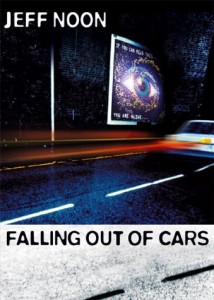
Until recently, 2002’s Falling Out of Cars looked like it might be the last Jeff Noon novel. If the fractured mirror landscape of the book often proved to be as startling and dissociative for the reader as they were for the characters then that was probably a feature rather than a bug – Falling Out of Cars made the fact that all of Noon’s adventures in wonderland had been tainted by life on this side of the mirror horribly clear.
This notion was always there in Noon’s work – no amount of strain is going to make a looking glass show something that isn’t already here waiting to be reflected, after all – but in Falling Out of Cars it became inescapable. This made the subsequent absence of a “new Jeff Noon novel” seem more explicable, if still somewhat tragic – what better note for an author to stop writing on than this, a story about people whose very ability to comprehend the world and words around them was slipping away.
There were some signs of writerly life though, like 2008’s 217 Babel Street – a collaborative hyperlink fiction the served as the real world scaffolding on a fictional location – and 2012 has seen Noon’s strange pollen corrupting the air stream on a previously inconceivable scale. Noon’s endlessly imaginative twitter account is one of the best follows out there for those in a Mindless frame of mind, and if his microfictional “spore” fictions leave you craving more there’s always the echovirus12 account, to which Noon also contributes.
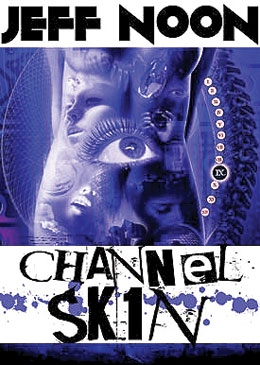
For those who like their fiction to occupy a more traditional form, there’s also a new novel, Channel SK1N, the story of a pop star who finds her skin overridden by the signals all around her as she transforms in a way that blurs the line between broadcaster and receiver. I’ve only just finished reading the book, and I hope you’ll forgive the ecstatic tone of this introduction because Channel SK1N combines the lysergically enhanced rush of Noon’s early fiction with the queasy comedowns of his later work, and in doing so reaffirms sci-fi’s status as the best tool available to writers who want to explore a future that’s here somewhere, already hidden.
Still buzzing off my contact with his SK1N, I got in touch with Noon to discuss his dazzling reemergence as a self-publishing internet invader…
 Illogical Volume: It’s been ten years since you slipped through the darkly reflective cracks of Falling Out Of Cars; ?dlrow rorrim eht ni emit ruoy saw woH
Jeff Noon: Falling Out Of Cars seemed like the end of a period in my life, work-wise, and also I’d just left Manchester (my home town), so it felt like a good time to make some changes. I fell into screenwriting, and had some fun days and some bad days in that world. I was working on various scripts for a number of production companies. I also went back into the theatre, which was my first love in writing terms. I did a play for The Crucible Theatre in Sheffield about the early days of the Mod movement and a science fiction audio play for Radio 3. I still hang onto hope regarding the film scripts, but it’s a difficult media to succeed in, no doubt about it. Eventually, I realised that I’d been without a proper audience for 10 years, so I started writing prose again. I dug out Channel SK1N, which I written a draft of a couple of years previously, and started working on that. And that was the transit point.
That was a transit point, and so is this – click here for more vurty goodness!
CHANGE, Interview 1 – Saying Your Bedtime Prayers with Ales Kot and Morgan Jeske
November 19th, 2012

Mindless Ones at Thought Bubble UK
November 16th, 2012

For the second year running, the Mindless Ones will be hawking their tawdry wares at the Thought Bubble comic convention in Leeds.
We’ll be at table 46 in the recently renamed New Dock Hall, so feel free to stop by for headtouching and pishtalk if you’re at the convention!
Last year’s convention was generally agreed to be one of the best comics related gatherings that Team Mindless had ever attended, so we’re coming team handed this year.
Cick here to find out quite how many hands our team is likely to have!
Return to the Borderland: M. John Harrison’s Empty Space
October 31st, 2012
Note 4 – Empty Space: A Haunting
It’s important to read new M. John Harrison novels while on holiday. No other author is able to describe with such alarming clarity the necessity of escaping yourself.
Harrison’s latest novel Empty Space is the conclusion of a trilogy of science fiction novels that started with Light in 2002 and was continued in 2006′s Nova Swing.
Like both of its predecessors, Empty Space presents the reader with a future that dazzles with the romance of a thousand yesterdays: women who’ve chosen to be rebuilt with the “Mona” package, but who base their look on that of Marilyn Monroe; virtual fantasy lives that play out like an episode of Mad Men drained of all sex and drama (until, of course, that sex and drama forces its way on in there); covert action groups who, with their lattes and general sense of boyish intrigue, can’t help but remind you of the sort of spooks you’ve never quite managed to catch out of the corner of your eye; Harrison manages to make all of these fantasies gleam briefly in the pages of this book.
This is an exhausted vision of the future, but it’s still a vision of the future for all that, one that sees past the ever-present apocollapse and on to a possible reality that’s like right now stretched out some more. Whether that seems like a hopeful vision or a dystopian nightmare is very much up to you.
Dundee Comics Day, or “Sexy Future Batmen* Incorporated”
October 29th, 2012
*and Batwomen, obviously!

As anyone unlucky enough to follow me on twitter will know by now, I was at Dundee Comics Day yesterday with Botswanna Beast, Mister Attack, Ben Deep Space Transmissions and Ben Deep Space Transmissions’ mate (who was lovely, but whose name I never managed to remember for >>> 5 minutes because I am a cock) yesterday.
Comics journalist Laura Sneddon was working at the event too, so Team Mindless had a brief but enjoyable chat with her about The Singing Kettle, which… uh, probably isn’t something you know about outside of Scotland, I guess. I also apparently ignored at least one person I’m twitter friends with, so sorry Dan!
Anyway, Dundee Comics Day has been a fixture of the town’s Literary Festival since 2007, and this year’s event was focused on Grant Morrison and some of his collaborators. What this meant was that me and the boyce were treated to a solid day’s worth of comics chat, in a setting that was designed to force Mister Attack and myself and especially the Bottie Beast flashbacks back to our time in higher education.
The conversation with Grant Morrison that kicked off the day was entertaining if short on revelation. There wee a few routines in there that anyone who’s heard Morrison speak more than once in the past decade will probably have heard before (“more space combat!” etc), but the man’s still good company whether he’s discussing why Batman is the only character he keeps coming back to (“because he’s so sexy”) or making my teenage brain melt by mentioning that he’s met with the RZA re: the proposed movie adaptation of Happy! Of course he would have gained extra points if he’d announced this by saying “Me and the RZA connect”, but so it goes.
During the Q&A part of the event, I asked whether Morrison was interested in writing something set closer to home – if not GRANT MORRISON: THE SCOTTISH CONNECTION, then maybe something close. Morrison responded by saying that he’d like to write something set in Glasgow, which he reckons would be a good setting for a horror story. He pointed to Bible John as being the work of his that comes closest to fulfilling this promise, but noted that he probably won’t get around to doing something else set in his hometown until he’s in his dotage. Morrison also added that he’d love to play a computer game set in Glasgow so he could drive a car through Princes Square, to which I can only say “I Want To Go To There!”
There was a definite break between Morrison’s panel and everything that followed, and the line between the two parts of the day was exposed when Morrison was asked a question abut the future of comics. Morrison joked that he’s still hoping that the world is going end in December so there won’t have to be a future of comics, before describing how he reckons that the sort of comics that thrive on the variety of new platforms available to them will almost certainly have evolved to make use of the new dimensions available to them. This idea was presented enthusiastically, but there was a subtext of melancholy that makes perfect sense when you think about how closely entwined Morrison’s personal iconography is with the physical properties of the comics form:

Action Comics #9, or “The Drones of Metropolis”
September 29th, 2012
Okay so I’m four issues late to say it, but it’s still worth noting that somehow, in the middle of a run of spectacularly unspectacular comics, THIS happened:

THIS being, for what it’s worth, the 2012 superhero comic most acutely tuned in to the concerns of its moment. Oh, sure, there are a few other enjoyable superhero comics out there right – Hawkeye, Batman Incorporated, uh… Journey Into Mystery, if that counts?[1] – but none of them feel like an inescapable product of their moment in the way that Action Comics #9 does.[2]
You might well ask yourself how worthwhile this is, and if you told me that you preferred the focus on individual action beats that you get with Matt Fraction and David Aja’s work on Hawkeye…

…then I’d have to concede that you might well have a point. What’s particularly interesting here is that the other twelve issues of Morrison’s Action Comics run can be seen as a generally unsuccessful attempt to transition Morrison’s recent hall-of-mirrors scripting style into something more rhythmic and less meaning-intensive.[3] Something a bit more like what Fraction and Aja’s are attempting in Hawkeye, in other words, only done less well, almost a year earlier.
ART PARAGRAPH: UNFORTUNATELY, A LACK OF TRUE ARTISTIC SYNTHESIS HAS ENSURED THAT THIS PARTICULAR MACHINE (ACTION! COMICS!) HAS RARELY LOOKED LIKE IT WAS READY FOR THE COMICS MARKETPLACE. THIS PARTICULAR ISSUE WAS DRAWN BY GENE HA, WHO PREVIOUSLY GRACED THE SERIES WITH GUEST ART FOR AN APOCALYPTIC SCENE SET ON KRYPTON IN ISSUE #3. HIS RIGID, RETRO-FUTURISTIC ARTWORK MAKES FOR A PURPOSEFUL CONTRAST TO THE RUGGED MALLEABILITY OF REGULAR ARTIST RAGS MORALES’ LINE, AND WHILE HIS DEPICTION OF SUPERMAN LACKS THE EASYGOING GRACE OF FRANK QUITELY’S VERSION, THE RELATIVE STRENGTH AND CLARITY OF HIS HAND IS STILL VERY MUCH APPRECIATED HERE.
As flagged by the inclusion of the Obama-riffic Superman from Final Crisis, issue #9 of Action Comics is an unashamed example of Morrison’s recent obsession with viewing the whole universe through the lens of superheroic fiction, a throwback to an era that’s not quite ended.

Click here for more about Superman, Siegel and Shuster, drones, Obama and all that!
Tygers and Lambs #2 – Wild Children
August 25th, 2012
What a joy it is to dance and sing…

…or so I seem to remember anyway. This bloggy vessel has now entered the fourth decade of its journey towards oblivion, so you can look forward to it trying out its new “all whinging, all the time” persona as its mechanics starts to fail and its withered captain feels the need to overcompensate in a tragic bid for immortality.

From New X-Men: Riot at Xaviers, by Grant Morrison and Frank Quitely
But before I lose myself to that delightful journey, there’s Ales Kot and Riley Rossmo‘s Wild Children, a comic book that couldn’t feel more like a jolt from the nineties if it had come wrapped in a pair of novelty Spice Girls underpants and been delivered by a reformed Lee and Herring. Except that it’s actually a lot more specific than that, because what Wild Chilren feels like is a a jolt from my nineties – if you can imagine a version of Grant Morrison and Philip Bond’s Kill Yr Boyfriend that tries to encompass all of The Invisibles, you’ll probably be imagining something quite like Wild Children. Like The Invisibles, Wild Children is clearly built to be read in a circle, and if the first line of dialogue – “I still don’t understand” – doesn’t get this point across, there’s another line on the third page to make the design even harder to ignore: “Some of you may think we’re evil, but I don’t think you’ll miss the point this time.”

From The Invisibles #1, ‘Dead Beatles’, by Grant Morrison and Steve Yeowell
All of which is typical of Wild Children’s approach. Part story, part lecture, Wild Children is a swaggering, talky comic that positions its readers as adult hostages, drugged and held at gunpoint by the titular teens. Weapons are brandished that may or may not be weapons, speeches about the nature of reality are given, tragedy ensues.
Some people might object to being positioned this way – former wild children with fluff-encrusted blank badges in their sock drawers might find themselves wanting to be the ones giving the lecture, for example – but while I would have probably have got more out of the comic if Riley Rossmo had been given more action to draw, the loose, unfinished quality of his line was enough to get me through a couple of reading cycles. And like I said, there’s plenty of swagger in Wild Children’s design. From its carefully combusted cover on in, this is clearly the work of a couple of people who want to start something.
The only question is, what is it that they want to start, exactly?

RECEIVING TRANSMISSION – “A LITTLE MORE POWER OVER THAT MEMORY…”
Sorry, what’s that? You were waiting for the second part of my Tygers and Lambs series? Well hey, thanks for checking in mum, glad you still read the site – that post should go up over the weekend! [1]
The rest of you are probably looking for more SILENCE! or more League of Extraordinary Gentlemen annocommentations or something [2], and who can blame you, but you’ll have to wait a while for all of that because right now we’re doing Dirty Thoughts From Other People’s Comments Section!
WITHOUT WARNING!
Okay, so over on The Comics Journal’s website, Sean Rogers wrote a review of Grant Morrison and Frank Quitely’s Flex Mentallo that posited the aforementioned comic as a prime example of the “strenuous vapidity” of Morrison’s writing. I think it’s safe enough to say that most of Team Mindless [3] are pretty into Flex Mentallo – the manifesto like “Candyfloss horizons” posts that graced the site during its early days are definitely written in the key of Flex Mentallo, with its “candy-striped skies” [4] – and I wrote about the book again when the freshly recoloured “deluxe” edition was released in April of this year. As such, bearing in mind that FEELINGS ABOUT COMICS ARE THE ONLY TRUE FEELINGS [5], I decided to have a go at taking Sean’s review apart.
Sean seems to think that Flex Mentallo is a guide to better living through superheroes, whereas I think it’s more like a Dennis Potter drama in two-dimensions [6], a strange story in which a grown man cracks and finds himself trying to make sense out of everything with reference to a lifetime’s worth of ruddy superhero comics.
My comment is up on The Comics Journal site if you want to check it out and see what you think.

I hope you’ll forgive me a little bit of Mindless Self Indulgence here since we’ve already covered the comic in question in some detail, but just try to imagine my surprise when after reading pages and pages full of brilliant, moving stuff about growing older in a world that is indifferent to your bewildered perspective in LoEG Century, I came face-to-face with the young Antichrist and discovered that he was me.

Of course, he was also Harry Potter and Will Stanton and Kevin the Teenager, but as he peeled his way out of the page…
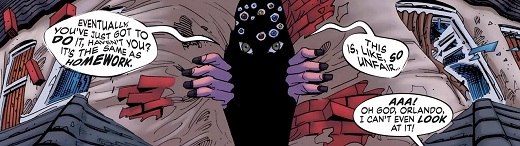
…and started rambling away at our heroes in that deadened voice of his, I began to feel like I was watching myself rip my way through the comic. A spoiled young man raging against the story he’s grown up in?
Fuck! Yeah, okay – guilty as charged!
Mmmmmyesss! Click here to initiate contact with a Mindless antichrist!