White Chalk – Dial H #13 Re-viewed
July 17th, 2013
You might not know it, but you gamble every time you pick up an issue of Dial H: the ink in which this comic is printed contains a rare sort of toxin, exposure to which dials up one of three parallel universes. Before your eyes make contact with the page, you know that any given episode has a 33.333333333% chance of being: (A) a sloppy pastiche of the Morrison/Case Doom Patrol run, (B) a snazzy pastiche of a good proto-Vertigo comic (like the Morrison/Case Doom Patrol run) or (C) a genuinely effective post Alan Moore/Grant Morrison superhero comic.

Issue #12 of Dial H saw China Mieville, Alberto Ponticelli and co rolling(dialing?) the reader into a hopelessly tangled version of their own story in which none of the lines (whether in the art, plot or dialogue) connected meaningfully. Issue #13, meanwhile, provided a clear and direct line to the best of all possible worlds(/comics).
Comics being a collaborative medium, Alberto Ponticelli’s pencils tighten up with Mieville’s script, and the unstable environments of issue #12 are forgotten in favour of an information-dense, two-layered landscape. Ably assisted by inker Dan Green and colourists Tanya and Richard Horie, Ponticelli works for maximum accessibility at every turn, framing our regular cast as pedestrian browsers walking through a block in which comics sprawl on every wall. Thanks to the arr team’s heroic efforts, we’re always able to read what’s going on as we glance past our heroes’ shoulders:

It might seem strange that an issue that breaks to recap the plot of the previous few issues should be better than anything being recapped, but Dial H is that rare superhero comic that actively thrives on exposition. Other standout issues in this series have explained where the powers Nelson and co dial up actually come from (#0, #11), and explored the difficulties that arise from contact with unreconstructed racist fantasies (no not Game of Thrones, issue #6).

Dial H is at its best when explains its own mechanics because theme is built into the design of this revamp more clearly than it’s expressed by any of the action on the page, a quirk (or fault, depending on your tolerance for this sort of thing) that only strengthens the book’s Karen Berger-edited pedigree.
Just think of the many walking tours through authorial interests that characterised that first flush of post-Alan Moore, British invasion comics, all those scary strolls through the green, trips out into blue forgotten worlds, the evening walks that lead you right underneath the Pentagon and straight on into the heart of the American scream.

“Everything’s Starting Now” – CHANGE by Ales Kot, Morgan Jeske, Sloane Leong and Ed Brisson
July 11th, 2013
EXPOSITION: From the first few pages onwards it’s clear that this is one of those LA stories, an everyday apocalypse in which a strung out and savvy cast of screenwriters, rappers, astronauts, agents and cultists collide against a genre-mashed backdrop; the prophetic screenplay that drives the story is modeled on The Last Boy Scout, but Richard Kelly’s media-frazzled sci-fi meltdown Southland Tales seems the more fitting tonal counterpoint for this story of a city stuck on an apparently endless cycle of destruction.
You might remember reading about all this in the early hype, but if not you can always obtain the first issue for free online and get a flavour for it yourself.

The main characters in CHANGE are lost and ambitious souls, tilting after people and projects like a set of modern day Don Quixotes, struggling to find their way to an imaginary elsewhere that might just resemble home if they can stick the landing.
If there’s a criticism to be raised here it’s perhaps that the women in this comic tend to be framed at the centre of the madness, while the men are given more active roles as explorers. Richard Doublehead (“the Virginia Woolf of screenwriters”) and rapper turned movie producer W-2 and find themselves instigating the plot and exploring it respectively, and in their dueling roles both men are spurred on by the loss of their partners. Charlie Kaufman style maverick screenwriter and surprisingly competent car thief Sonia has a more active role than either of the female love interests, but her ability to write what’s about to happen still positions her as being somehow in tune with the madness where her fellow protagonists affect and are affected by it:

Thinking about Sonia’s character, I keep coming back to Angela Carter talking about her experience with the surrealists:
…I had to give them up in the end. They were, with a few patronized exceptions, all men and they told me that I was the source of all mystery, beauty, and otherness, because I was a woman – and I knew that was not true. I knew I wanted my fair share of the imagination, too. Not an excessive amount, mind; I wasn’t greedy. Just an equal share in the right to vision.
If Sonia has anything, it’s vision, but somehow her goals seem less tangible those of her male counterparts; for all that her voice is the most purely entertaining one in the comic, I still can’t help but feel that her arc is also the least satisfying. Even the astronaut, who spends most of his page time cut off from the other characters, finds himself on a journey to be reunited with them and with himself:

Click here to see if I can bring this post down to Earth safely.
SPRING BREAKERS is the best Michael Bay movie ever – FACT!
April 15th, 2013
Spring Breakers, dir. Michael Bay, 2013
You might think that it would be impossible for Bay to top his Transformers trilogy, that those merciless tributes to the twin glories of steel and flesh represented the purest distillation of his art. On the other hand, you might not think that he could get any lower than that seemingly never-ending explosion in a cliché factory.
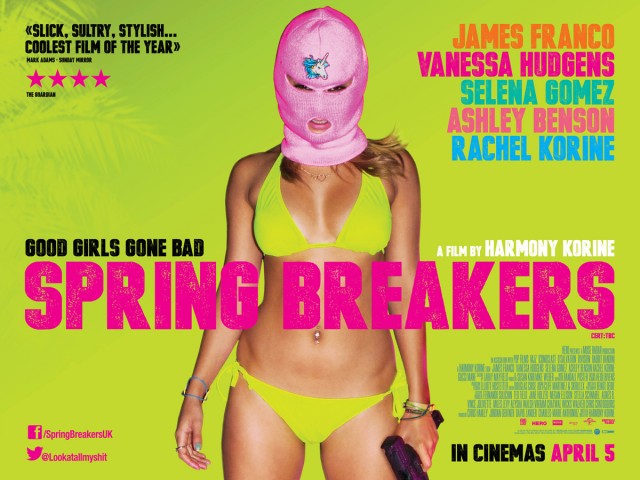
Whichever side of the divide you found yourself on, Spring Breakers renders your opinion obsolete. This movie is Fear and Loathing to the Transformers trilogy’s hyper-modern war movie (with Florida standing in for Las Vegas just as Vietnam blurs into Iraq). It’s the Saints Row to The Dark of the Moon’s Call of Duty. The adventures of Optimus Prime and co might have fleetingly simulated what the disorienting frenzy of 21st Century warfare would look like if it was fought on American soil, but Spring Breakers is the real deal – the story of four girls fighting the war at home with nothing but day-glo bikinis and raw fantasy. [1]
Oh, yeah, and did I mention guns?

Because – *SPOILERS* – guns are important too.
Future Crimes
April 4th, 2013
OR: last year I went to the movies and all I got was a sense of temporal displacement!
DREDD, dir. Peter Travis, 2012
This relatively low-budget attempt to graft a late seventies vision of the future onto the present day doesn’t quite come off seamlessly – the opening drone-cam riot shots would be much more convincing without the sci-fi data overlay – but the grim lack of distance between these three (equally imaginary?) time zones ensure that this bolted-together aesthetic is effective rather than ridiculous in the end. A lot of the credit here has to go to Karl Urban, who sets the tone of the movie by somehow managing to play the perma-frowning Dredd with a straight face:

Like Urban’s Joe Dredd, DREDD (the movie) treats exposition as little more than a series of snappy situation updates, necessary only because they point the way from one dynamic lesson in pain compliance to another. The result is a lean, efficient action films that you suspect the Judge himself would approve of. The rules are established in the opening scene and are ruthlessly enforced throughout: you get a quick report of the location and nature of the crime in progress (the irradiated ruins of a future America; whatever takes your fancy) then whooosh, before you can say “hot shot” the situation has been resolved with the maximum amount of acceptable violence.
Because hey, when you fuck up, he’s got to fuck you up, right?
Right.
There are obvious affinities here – with Robocop, say, or with your Carpenter movie of choice – but these reference points never threaten to overwhelm the movie. Geoff Barrow and Ben Salisbury’s almost/alternate score Drokk is far more heavily indebted to Carpenter’s work, for example, and while the soundtrack that plays out in its place is less immediately striking it’s also perhaps better suited to DREDD’s relentless utilitarian drive. The aesthetics of past, present and future might me all jumbled up here, but there’s no time for reverence in this movie – everything is judged by how well it performs in its specific moment in the field.
Still, I’d be remiss in my duties as a reviewer if I didn’t point out that there are certain plot similarities to Batman Incorporated vol 2, #6, and while I don’t know how Peter Travis and Alex Garland were able to travel through in time in order to rip that script off, I’m glad that they did all the same – this is a joke about the seemingly manditory you comparisons with The Raid, you can tell it’s a good gag because I feel the need to flag it up like this. Since we’re all pals here I’ll assume that we can all agree that the similarities between DREDD and The Raid are worth talking about – in the same way that its resonances with this Moebius strip are worth talking about – but that simply saying “The Raid” is in no way the end of the conversation. There are many different ingredients in DREDD, and the end result might have familial similarities with various other movies, but it’s overwhelming flavour is still undeniably that of “Judge Dredd”.
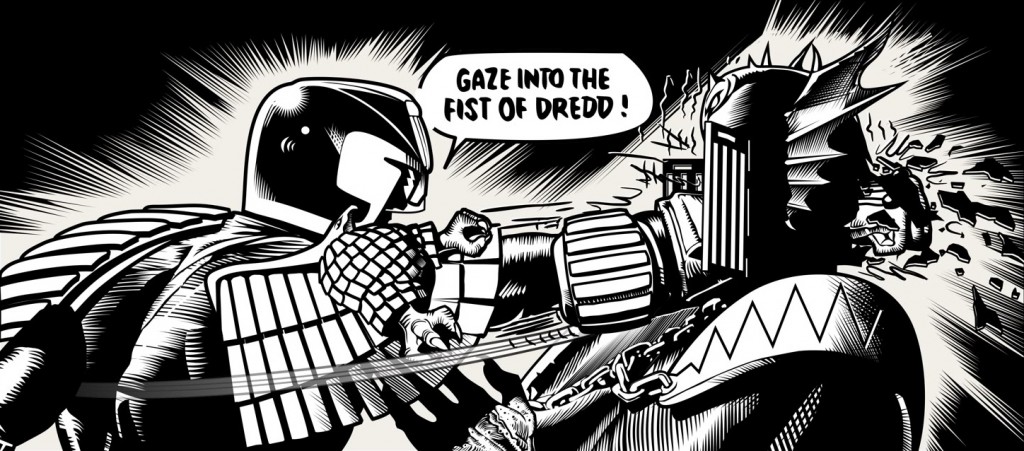
As my good pal (the devil)Andre Whickey has pointed out, there are several different types of Judge Dredd story, and this is a great example of one of them – Judge Dredd as straight action story. While this means that DREDD can’t touch 2012’s Day of Chaos story (for example) for either political complexity or gonzo fanboy thrillpower, it does mean that this is Judge Dredd at its most insidious, a compelling story of good guys vs. bad guys that doubles as a cheap, spooky reminder of the fact that authoritarianism can always be made to look both necessary and cool using the right tools:

More on the fantastic damage of Looper and The Master after the cut!
Yeah, I know, I thought I was done thinking about this comic too but I took some time out from the Black Bug Room to do a big Action Comics re-read yesterday while my girlfriend was off seeing some movie where James Franco and Sam Raimi turn fine wine into goat piss, and… well, I ended up sending my fellow Mindless an email about they experience, which they’ve bullied me into sharing with you.
I’m not trying to be dramatic here, but in a week where the main topics of conversation in Mindless HQ were largely focussed on Mad Men, male members and the interaction of the two, the sudden focus on reaching out to you lot made me feel a little bit like this:

Have you been on the internet? There are all these people there, and it’s hard to work out what all of them want, and some of them might not enjoy Gary Lactus’ “Hamm on the bone” jokes as much as I do (seriously though, is Jon Hamm’s penis the exciting new character find of 2013 or what?).
Anyway, enough of that pish, let’s talk about the man who’s…
———————>>>>> FASTER! THAN A SPEEDING BULLET!!!!———————>>>>>
- The much-anticipated socialist/Bruce Springsteen Superman still fails to fully materialise on a second reading, but this botched manifestation seems weirdly charming this time round. The appeal and the failure of this approach are both linked to the fact that this isn’t familiar territory for writer Grant Morrison – as any round of interview questions will quickly reveal, our G-Mo doesn’t have the interest in tackling current affairs required to really make a story about idealistic young things sing, but he’s definitely cocking his head in the right direction here. Taken at face value the idea of “Clark Kent: Blogger” is dull dull dull, but positioning Kent as a Laurie Penny style crossover journalist makes a lot of sense to me. The appeal of Superman has always been partly bound up in the a romance of modernity, with our ongoing attempts to manage the impossible scale of things, and so it follows that it’s worth updating the idea that he’s a newspaper man, rather than merely preserving it, eh Grant?
- While Morrison might not quite have nose for a story that his core trio of young journalists share, his efforts aren’t helped by the fact that Rags Morales’ characters can’t act for shit. G-Mo has to take part of the blame for the fact that the interplay between Clark/Jimmy/Lois remains merely promising throughout, but knowing how Morrison tends to rise to his collaborators, I can’t help but feel that he would have given his cast better material if they’d demanded it while they were looking up at him from the pages of the comic itself.
——————->>>>> STRONGER THAN A LOCOMOTIVE!!!!!———————>>>>>
- Morrison and Morales’ other big shared failing is in their coordination of the action scenes throughout the first three quarters of this run. Again, they’re both gunning in the right direction, working hard to emphasise the physical exertion involved in these impossible acts while also plowing right through several moral fundamentals (as the Bottie Beast pointed out way back when, it’s a bit like “okay, so here’s how power effects justice, and here’s why torture is always wrong, and here’s a working definition of realpolitik for you” at the start there), but all of this would feel more vital if there were believable physical bodies and environments involved. Morales’ line has a certain rugged dynamism to it, but there’s no solidity to his characters and situations – it’s almost as though the world he’s depicting is melted down and reformed between every panel. Weirdly, this same plasticity works in favour of the climactic arc, in which punches are thrown across dimensions, and headbutts crash right into the face of spacetime.
- Similar problems haunt the Igor Kordey drawn issues of the New X-Men story ‘Imperial’ and the Philip Tan drawn arc of Batman & Robin, which suggests that Morrison is not inclined to worry about spacial relations in action scenes unless prompted to by his collaborators. It’s easy to blame the artist for these faults but it seems fair to suggest that Morrison should probably work on this aspect of the collaborative process in order to avoid such disappointing results in the future.
- The non-Morales broadcasts are easily the most compelling chapters this story, barring the frantic display of prowess that is the last four issues. The Ha/Kubert/Foreman episodes are still jarring, but they make retrospective sense as the first indications of 5D cuntwagon Vyndktvx’s non-chronological assault on our hero – Gene Ha’ linework has a utopian sci-fi solidity that contrasts nicely with the surrounding chaos, Andy Kubert’s work is a bit generic but its relative polish suits the slick diversion of the Krypton and Legion stories he’s given to illustrate, and Travel Foreman’s commitment to horrible things adds a nice, jagged edge to the spookily seasonal Halloween issue. The fact that these stories deviate from the core premise (promise?) of the series is both the best and most disappointing thing about them.
————>>>>> ABLE TO LEAP TALL BUILDINGS IN A SINGLE BOUND!!!!———->>>>>
- The conclusion to the Braniac plot is the lowest point in the series: honestly, I winked at it above, but can anyone manage enthusiasm for the Saving vs. Collecting theme here? Yeah, I thought not. A more committed curmudgeon than Our Grant could have probably made something out of the way the internet allows you to mistake passive curation for participation, but these issues don’t even get that far down dead granddad avenue, so.
- Lois Lane really gets short-changed in this comic as elsewhere; Mozzer writes a mean Lois, but for whatever reason he tends to write around her most of the time rather than putting her at the centre of the story, where she obviously wants to be.
—————–>>>>> A REGISTERED TRADEMARK OF DC COMICS!!!!—————->>>>>
- The Beast Must Die’s (second hand?) point about how Morrison has managed to smuggle a lot of the rich weirdness of Superman history back into the camera-blur addled, modern blockbuster world of the New52 is well taken. The fact that Morrison only managed to successfully integrate these queasy fantasy textures to his ALL ACTION ALL THE TIME approach in the last arc is an obvious storytelling fault, but as a no doubt soon to be ignored bit of structural work it’s not half bad: the goofy future kids and extradimensional kids are here, and they’ve adapted to the challenges of their new, frantic landscape well.
- In a neat inversion of All Star Superman’s pacifist logic, Superman brawls his way through these stories, solving problems with sheer brute force and tenacity until the final arc. This linear approach to problem solving is obviously apropos and it also makes explicit the idea of Superman as a fantasy of impossible force made real. The not-entirely-resolved thematic throughline of Morrison’s run involves matching Superman’s power up against the power of the mob (peep just how often large groups of people intervene in the conflicts in this series), and linking both of those things with the power of journalism, i.e. with the way that narrative power can be converted into ACTUAL POWER. The suggestion seems to be that wielding the impossible force of “Superman” against the prevailing forces of the world is possible, but requires the contribution of EVERY LAST ONE OF OUR LOYAL READERS, hence the fact that the last story can only be resolved with audience participation.
- Of course, as I said, none of this is quite (explicitly) resolved in the comic itself, and even when Morrison uses all of his daintiest framing devices in the last arc, it’s not quite enough to disguise the fact that this is 4D flower is blooming in the toxic graveyard world of corporate comics. Issue #18 of this comic hit like a car through the front counter of a book shop, but despite the best efforts of lE laK, nosirroM tnarG, selaroM sgaR and the rest, I never found myself mistaking Action for an argument…
The Lovely Horrible Stuff: “In my dreams, I have a plan…”
January 25th, 2013
PART 1: PENNY FOR YOUR THOUGHTS
For Christmas this year I was given the prospect of impending joblessness, a gift that has a fine Dickensian heritage, though unfortunately it’s not Dickens but Shakespeare who has a cameo in the comic at hand.

You don’t need a Shakespearean imagination to understand that redundancy is not the sort of gift I’ve always dreamed of receiving, or to appreciate that it’s not the sort of unwanted gift that you can easily pass on to an unsuspecting relative.

Not that I’m so lacking in compassion for others that I’d *want* to inflict that on anyone else. Even in this post-Monneygeddon age, there’s a limit to what I’m willing to admit in public!

A few weeks ago an alternative version of this present drifted into view, a hot air balloon that looked like it might be capable of taking me somewhere.
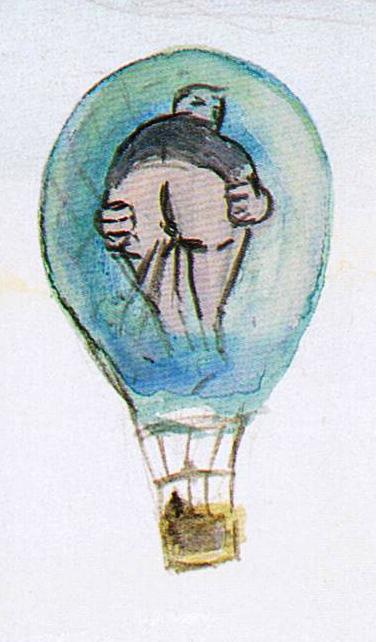
Click here to find out exactly where that cheeky chappy there thinks he’s going to take you!
Then Play Long: Where Are We Now? And How Did We Get Here?
January 15th, 2013
Good news everyone: turns out that Then Play Long, aka the best music blog you’re not reading, isn’t closing down after all!
Then Play Long is dedicated to chronicling every number one album in UK chart history, but it’s not the sort of dry historical catalog that this description might suggest. Instead its writers Marcello Carlin (The Church Of Me, The Clothed Maja, Koons Really Does Think He’s Michelangelo, The Blue in the Air) and Lena Friesen (Music Sounds Better With Two) are committed to using the most personal details to fill out the broadest canvas possible, a history of who and where we are now that threatens to add up to suggestion as to why. It’s a reclamation of sorts, a rescue mission into the past, an attempt to recover a couple of histories that have been partially obscured by the official party line, and as such I can’t recommend it highly enough.
For a minute there it looked like a combination of reader disinterest, duff spending decisions on the part of the UK public, and a shady attitude towards chart compilation from the OCC might have prematurely ended the blog, but a day later the sun rose again, and it had the face of Paul McCartney:

No, I didn’t see that sentence coming either.
***
I was introduced to Carlin’s writing by the inestimable Dan Emerson way back when I was only a little baby blogger, and – though it hardly seems fair to incriminate him in my ongoing assault on linguistic decency – it’s fair to say that he’s been a major influences on my bloggy output ever since.
There’s one line of Carlin’s in particular that’s haunted my writing – “I suppose that’s the difference between “real journalists” and writers like me; they write in what they think is the correct way to write, whereas I write me”.
Then Play Long is a triumph of Friesen and Carlin’s approaches to music writing over the currently accepted models. Go check the site out, and if you like what you see, keep checking it out – this time, dear readers, your attention might just save the world…
Map Ref 2013: Destination – COMICS!
January 5th, 2013
Windowpane #1, by Joe Kessler

There’s a point early on in this comic where you realise that you’re not so much watching characters describe a landscape as watching the landscape try work out how to describe itself. This might seem counter-intuitive but from the end of the first story onward the pattern repeats itself – Joe Kessler’s garish, pastel-hued compositions either break down into their constituent lines after exhaustive exploration or sit there seemingly unaffected by the words and actions that have passed through them.
The best example of the latter category involves a wet-dream about a pig in a dress, whose fall through the night sky is contrasted against an unflinching cityscape with a moment-by-moment precision that does far better justice to the pithy punchline than this description:

In the former category, the Invisible Cities-derived third strip is as close to definitive as Windowpane gets. The way it links its characters shared status as splashes of ink and colour on the page with their philosophising about the interconnected nature of reality — “…a cluster of atoms resembles a cluster of galaxies.”/”Well they’re both clusters” — might seem trite in isolation, but the surrounding stories make these philosophical observations feel more like a little bit of texture on a varied landscape.
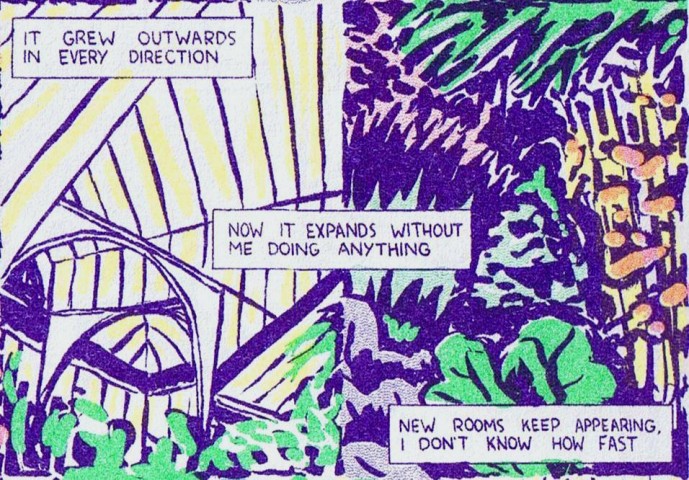
All of this might sound a bit chilly and distant, but Kessler’s human figures are depicted with a deceptive sort of ease, as a series of curving lines whose relationships to each other is nevertheless very carefully observed and delineated:

Still, in keeping with Kessler’s paradoxical thematic schemata it’s the backgrounds that are the focus here, existing as they do on the precise point where detail blurs into abstraction. The interaction between text and territory here has a sly kinshsip with Dylan Horrocks writing on maps and comics, and perhaps also with Kevin Huizenga’s conception of the comics page as a place for exploration and discovery, but Kessler’s backgrounds have a forcefulness to them that resists his characters attempts at attaching meaning as much as it encourages them.
This is tricky relationship is most clearly explored in the final two strips. In the penultimate entry, words shrink on the page as Kessler depicts his precarious human figures parachuting in to kindle-worthy hillscape:
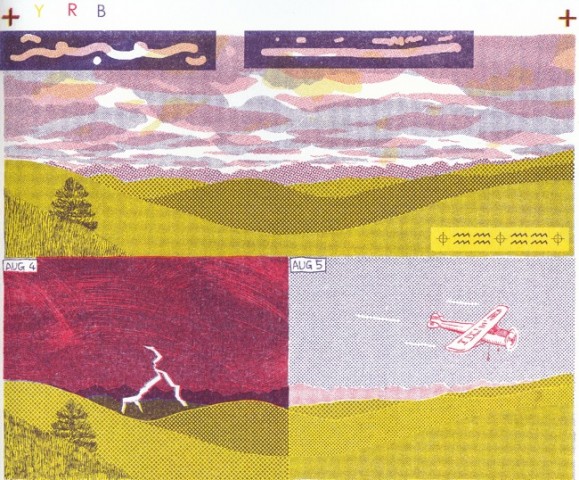
Thought and language here are reduced to a form of quaint annotation, one that is far less effective at providing a guide to this hazardous landscape than the blocky symbols that line these panels.
The final story focuses on a burned lover who – uh, *SPOILERS* – tries to find solace in the freak resemblance between a man and a decapitated bull. It plays out like a sneaky assurance that the process of muck sitting up, looking itself and trying to figure itself out isn’t totally meaningless. It’s also the sort of assurance that’s both underlined and undermined by the fact that, unlike any given sunset, you know this resemblance was put there to be noticed.
CHANGE, Interview 2 – Choosing Your Own Adventures with Morgan Jeske and Ales Kot
December 12th, 2012

CHANGE is… coming soon! In fact, it’s possible that it’s already here. Perhaps you’ve already read the comic, and are looking for more information on the people who made it. Or maybe you’ve been here before, and have found yourself stuck in a loop, struggling to get out. Regardless of your circumstances, I’m glad you’re here.
CHANGE is… a bracingly modern pulp adventure comic, set in Los Angeles, in which an astronaut, a screen writer/car thief, and a rapper caught midway through a transition into a Hollywood afterlife find themselves entangled in the tendrils of a plot that mixes showbiz horror with Lovecraftian glamour. Or is that the other way round?
CHANGE is… written by Ales Kot, drawn by Morgan Jeske, coloured by Sloane Leong and lettered by Ed Brisson. Quite a line-up, I’m sure you’ll agree!
CHANGE is… a stylish, ambitious comic that makes perfect sense as part of of Image’s attempt to make popular genre comics that aren’t totally stylistically and thematically inert. Comics that read like they were made with care, energy, enthusiasm, and maybe even that earth element you call… love.
As such, I’m happy to present to you with a “Choose Your Own Adventure” style interview with two of the creators involved in this comic, Ales Kot and Morgan Jeske.
If you don’t think you’ve got the heart for this sort of postmodern gambit, you can click here to read the interview straight.