MINDLESS COMMUNICATION – Tom Humberstone
June 28th, 2025
Writer/artist, Suzanne (2022), I’m A Luddite (And So Can You!) (2023), Introduction to Charts (with Chrissy Williams, 2024). His Grave Offerings newsletter is gorgeously illustrated and sharply written; you might go so far as to say it’s ELITE.

What can you tell us about the similarities between comics and poetry?
There’s a quote in Alan Moore’s Writing For Comics where he discusses comics that try to mimic film techniques that has always stayed with me:
“In the final analysis you will be left with a film that has neither movement nor a soundtrack […] Rather than seizing upon the superficial similarities between comics and films or comics and books in the hope that some of the respectability of those media will rub off upon us, wouldn’t it be more constructive to focus our attention upon those ideas where comics are special and unique?”
Too many people, I think, see comics as storyboards for film projects or view the page as a series of shots rather than a collection of panels. It’s always struck me that we were looking to the wrong medium for inspiration. Comics, for me, have always been much closer to poetry. And thinking of them that way allows a creator to do so much more lateral and abstract thinking about how to approach a page’s layout and composition. You stop thinking in terms of shots and think more holistically about the page itself. That’s not to say I don’t look to film for inspiration – I’m always reading about what cinematographers have to say about depth of field, shot compositions, lighting and colour. But we should, as comics creators, be looking to every medium to help us understand what our own does so well.
Chrissy Williams and I co-edited a book about poetry comics and came up with a list of statements that could be true of poetry and comics:
- economy of line is paramount
- each panel and page must be carefully constructed
- consider how much will fit on the page
- put everything in its right place
- choose whether to prioritise ideas or form
- juxtaposition is an important tool
- composition is not linear, but a whole system of architecture
- the reading process is one of interpretation rather than perception
- the reader is inextricable from the art
- all the right notes, not necessarily in the right order
- what happens off the page is as important as what happens on it
- the impossible can be made possible
What can you tell us about the differences between comics and poetry?
Ultimately, I think it comes back to that Moore quote about trying to focus on what makes comics special and unique. You can draw parallels to and inspiration from other mediums, but as a comics artist, I think it’s also worth coming back to asking yourself: “Why should I communicate this idea/story/feeling in the comics medium instead of all the others?” Sometimes the answer to that question can be as simple as: “Because I know how to make comics.” But it’s worth thinking about all the same. Comics can do things that other mediums can’t and can’t do things other mediums can – we have to find ways to play into their strengths.
Read the rest of this entry »Map Ref 2013: Destination – COMICS!
January 5th, 2013
Windowpane #1, by Joe Kessler

There’s a point early on in this comic where you realise that you’re not so much watching characters describe a landscape as watching the landscape try work out how to describe itself. This might seem counter-intuitive but from the end of the first story onward the pattern repeats itself – Joe Kessler’s garish, pastel-hued compositions either break down into their constituent lines after exhaustive exploration or sit there seemingly unaffected by the words and actions that have passed through them.
The best example of the latter category involves a wet-dream about a pig in a dress, whose fall through the night sky is contrasted against an unflinching cityscape with a moment-by-moment precision that does far better justice to the pithy punchline than this description:

In the former category, the Invisible Cities-derived third strip is as close to definitive as Windowpane gets. The way it links its characters shared status as splashes of ink and colour on the page with their philosophising about the interconnected nature of reality — “…a cluster of atoms resembles a cluster of galaxies.”/”Well they’re both clusters” — might seem trite in isolation, but the surrounding stories make these philosophical observations feel more like a little bit of texture on a varied landscape.
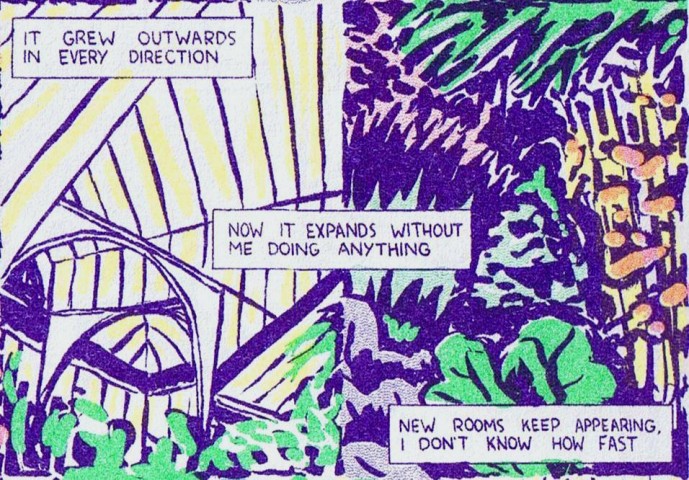
All of this might sound a bit chilly and distant, but Kessler’s human figures are depicted with a deceptive sort of ease, as a series of curving lines whose relationships to each other is nevertheless very carefully observed and delineated:

Still, in keeping with Kessler’s paradoxical thematic schemata it’s the backgrounds that are the focus here, existing as they do on the precise point where detail blurs into abstraction. The interaction between text and territory here has a sly kinshsip with Dylan Horrocks writing on maps and comics, and perhaps also with Kevin Huizenga’s conception of the comics page as a place for exploration and discovery, but Kessler’s backgrounds have a forcefulness to them that resists his characters attempts at attaching meaning as much as it encourages them.
This is tricky relationship is most clearly explored in the final two strips. In the penultimate entry, words shrink on the page as Kessler depicts his precarious human figures parachuting in to kindle-worthy hillscape:
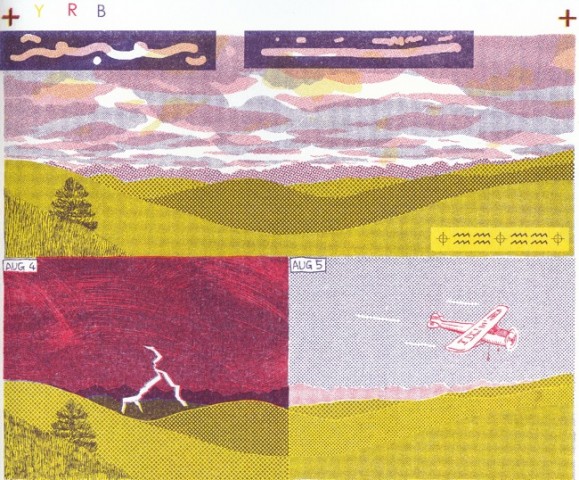
Thought and language here are reduced to a form of quaint annotation, one that is far less effective at providing a guide to this hazardous landscape than the blocky symbols that line these panels.
The final story focuses on a burned lover who – uh, *SPOILERS* – tries to find solace in the freak resemblance between a man and a decapitated bull. It plays out like a sneaky assurance that the process of muck sitting up, looking itself and trying to figure itself out isn’t totally meaningless. It’s also the sort of assurance that’s both underlined and undermined by the fact that, unlike any given sunset, you know this resemblance was put there to be noticed.
The Amusing Brothers, Andrew and Steven.
May 9th, 2010
A weekly strip by Fraser Geesin

The book Dream Date by Tim Leopard and Fraser Geesin is available from Running Water Press or from Amazon.
Gary Lactus’ Vault of Tymbus #7
June 1st, 2009

Everyone loves Jack Kirby, right? Come listen now as I, Gary Lactus discuss with that corpulent comic critic, Tymbus, The Losers from DC Comics. Originally published in Our Fighting Forces, this podcast deals with the recently collected hardback. We also try an experiment in which I use the sound effects from the book to generate some Dadaist sound poetry.
Click to download Vault of Tymbus #7
[audio:https://mindlessones.com/wp-content/uploads/2009/06/vaultoftymbus7.mp3]