Aggregator, see you later! —> Linkblogging, December 2013
December 18th, 2013
Special “Two years late and several thousand Bitcoins short” Edition!
People still do linkblogging, right? I mean not here, not recently, but elsewhere. Feels like a holdover from the “internet as big magazine” approach to broadcasting into the void, and given that I’m too scare to commit myself to any other model that suits me just fine!
EMBARRASSING ENTHUSIASM DEPT: You read it somewhere else first, but we’re in a celebratory mood in Mindless HQ anyway, so fuck it – STRAY BULLETS IS COMING BACK!
It’s too early in the day for me to get totally shameless on this, so you’ll have to go read that interview to find out about the massive collected edition of the first forty issues, the continuation of the old series, and the launch of a new one. Suffice it to say that Stray Bullets is the best, most unsettling crime comic out there, and that we’re glad all those kittens weren’t sacrificed in vain.
If you’ve not red the series before, issues #1-4 are apparently free to download right now, and Zom (or “Ad Mindless as he now likes to be called) wrote a piece about issue#1 that should set the scene just nicely:

A car speeding into the night, a lonely county road, as an establishing shot it’s hardly setting a precedent. But the first panel in SB #1 transcends its over familiarity by actually saying something meaningful about the book and all that follows it. This is a story that will make good on the panel’s familiar metaphorical properties. What we need to keep in mind here is that this road is black, to see anything we’re going to need a torch, and that things probably lurk in those woods. For that matter, things probably lurk in that car – what’s it doing out there in the dark, anyway? The world of Stray Bullets is a dangerous place, and the road travels on until you die.
We should also consider the notion that Lapham doesn’t want to simply transcend cliché, that he’s keen to set-up certain expectations in the reader. So later, when the tires on the car blow out and that familiar scene with the cop and the dead body in the trunk rears it’s head, we shouldn’t be surprised at the lack of novelty on offer. What’s interesting about all these little genre ticks is that, by issue 2, you could be forgiven for forgetting you were reading a crime comic in the first place, and that’s a recurring pattern throughout the series. The effect being that just when you think you know where you are Lapham pulls something entirely unexpected out of the hat, and suddenly definitions like ‘crime fiction’ start to feel inadequate or in serious needs of revision. If I was hunting around for words to describe Stray Bullets #1 I’d eschew genre definitions and settle on adjectives like macabre and gothic.
MISSING PERSONS DEPT: Free Batman/set Batman free.

For serious though: this is the best(/most horrible) Batman comic I’ve read all year, the tactically deployed evil of Batman Incorporated notwithstanding. Twitter account here, if you’re interested.
DECADENCE: Munching on Neptune’s Fungi for Fun and Prophet
December 10th, 2013
A thought occurs to me as I drag my sickly drunk head back to Glasgow from the Thought Bubble convention in Leeds: aren’t DECADENCE comics all a bit super-boyish in the end?
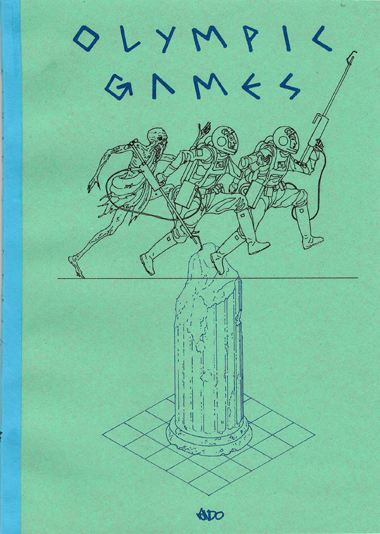
My throat too hoarse to speak with due to Saturday night shouting and Sunday con hustle, my brain so detached from its immediate environment that at one point I have to croak at Mister Attack to ask if we are in fact going backwards, the only thing I am able to do properly is comics. And so, I read through Lando’s Olympic Games, taking in page after page of landscapes that look as bare and arid as my larynx feels, squinting at the characters in survival suits, loving every second of it but questioning myself all the same.
“He’s just ridiculously on, isn’t he?” Mister Attack says.
I wince my agreement and keep on flicking.

It’s the survival suits that give me pause. As I shift out of Olympic Games and into a couple of comics by Stathis Tsemberlidis, Neptune’s Fungi and Epicurean Paradox, my drunken brain starts to worry that the spacesuits are emblematic of an attempt to build a stylish fictional identity, a barrier between person and world. My earlier thoughts about this aesthetic being “super-boyish” already seems glib and reductive to me, even if I can see where this thought came from. Something about the collision of cool influences, the sense that you’re reading the works of people who read only right comics from France and Japan, combined with a knee-jerk panic that aesthetics this good must in some way be suspect.
Where did I get the idea that comics could be cool? That they could communicate with the world while seeming at ease in it? From Brandon Graham, maybe, or perhaps just from The Internet.
Why would an encounter with these values provoke scrutiny? Perhaps because these comics do not reflect the values associated with my own formative experiences of the medium, bound up as they are with alt-comics and (sub-)superhero stories that mirror my own awkward, convoluted brand of self-reflection a little bit too clearly.
Comics scholars more erudite than me can argue about which specific artists have influenced Lando, Stathis and co, and armchair psychiatrists can deal with my issues at some later date – in this moment, my bleary brain is only capable of tracking where the lines on my face are going, rather than where they come from.
Thankfully, the view of the future they provide is expansive.
LOOKING GLASS HEIGHTS
November 30th, 2013
Fresh from Thought Bubble 2013, it’s the zine full of comics and essays about suicide, hubris and social housing that everyone – well, at least one person! – is talking about, Looking Glass Heights!

This first issue features:
- THE BLOWNDOWN OF BARRY BROWN – a comic about a man who goes up a a building then comes back down again, though whether the man or the building are the same in the end is up to you to decide.
- REALITY WAR – US vs. THEM – an essay on social housing and the customer service reflex.
- FLOWERS IN A FOREGROUND – another essay on Frank Miller, Eddie Campbell, and art vs. reality.
- BREAKDOWN OF A BLOWDOWN – a deconstruction of the method used to create the art for Looking Glass Heights #1 (“a comic drawn by someone who can’t really draw, using a tool that wasn’t meant for the job”).
“…made me feel thing with a limited size and toolkit” – Twitter’s own James Baker
UK & Europe £2.00 + £1.50 postage & packing:
DEEP FRIED JAM SANDWICH: Jupiter’s Legacy and the rammy on the hill…
November 27th, 2013
Jupiter’s Legacy #1-3, by Marky “Mark” Millar, Frank Quitely and Pete Doherty

Forgive me for the somewhat less than timely review, but fuck me – three issues in this is still a startlingly uninteresting book, from pig (Millar) to lipstick (Quitely) and beyond (???).
It should go without saying that this response is merely a product of the reaction between the lines on the page and those etched into my long-suffering brain, but that in no way makes this a good or even halfway entertaining comic. So while it’s true that both Millar and Quitely have thwarted all expectations here by failing to irritate and innovate respectively, the only real problem experience poses for Jupiter’s Chegacy is that a lifetime of reading and watching stories will train you to spot a tired duffer like this miles off.
Familiarity itself isn’t the issue here, per se: the old power/responsibility theme could easily survive yet another regeneration, and there’s no reason why a story about the famous children of rich superheroes couldn’t be made timely and interesting. It’s the old world vs. the new, the people who made the world vs. those who have to limit in it, and surely that’s an easy sell in this post moneygeddon landscape? The problem, at least so far as this cynical critic is concerned, is more that no one involved in this comic seems particularly interested in how they’re saying anything:

Page after page of dialogue mounts up to little effect, with passionate arguments sitting on the page like undeveloped notes from the plot breakdown, lacking either the vanity of realism or the courage of true artifice. This is a comic full of gestures, which would be forgivable if we were dealing with the mangled mitts and marvelous manifestations of Ditko-era Doctor Strange. Instead, Jupiter’s Children nods absently towards a half-busy suburban street in the daylight, hoping that you’ll find something interesting there and mistake dumb luck for careful planning.
Head of Iron, Arse of Steel – A very Mindless trip to the movies
November 25th, 2013
Iron Man 3
Dir. by Kiss Kiss, starring Bang Bang, written by the pretty drones of north america
It’s important to remember that everything that happens in this film takes place while Tony Stark is trapped in the wormhole in The Avengers. All of that talk about demons in the opening voice-over? Not metaphorical. This is the story of a man whose self has been shattered, trying to work out which shards to save and which ones to cast away. That’s why none of the characters feel real, except from Tony – they’re all figments, fragments of his essence, their nature and actions defined purely by the gaps in his form.
Having touched heaven, Our Hero sees the way back down to Earth, and realises that it’s angels and demons all the way down:

The kid represents true self love, while Pepper represents tough self love, and having embraced these twin fictions and annihilated his monstrous reflections Stark is free to imagine himself to be healed.
The movie? Oh, it’s a decent enough post-Iron Man action movie, better than the second film, probably just about as good as the first, and if you find yourself wondering how a movie that gleefully burlesques the absurdity of The War Against Terror (lol TWAT! lol foreigns! shout outs to Ben Kingsley!) can also rel on the redemptive power of drones for its ending, just watch old Droney Starks as he swans off into the sunset, wrapped in his latest and most impressive invention – a suit of armour made out of a microscopically thin layer of lies. That should tell you everything you need to know.
Much Ado About Nothing
Dir. by Captain America, starring your special friends, adapted for the screen by the reanimated head of William Shakespeare

Joss Whedon and co’s Much Ado About Nothing is a goofy, enjoyable movie that’s made just that little big bit sexier by the absence of what you might call Mouse Muscle. Don’t get me wrong, Whedon organised all of the Mouse Muscle at his disposal well in The Avengers – he even managed to keep yon blockheeded cock who plays Hawkeye out the way for the most part! – but it was always clear who and what was being serviced.
The priorities are different in Much Ado About Nothing, a luxurious indulgence in which Whedon services the script, cast and audience equally. One of those is you, and another is yours, if you want it to be, and it’s hard not to be flattered in such generous company, but let’s not act like everyone has access to the friends and production values that Whedon makes use of here because the lush setting gives lie to that notion. Whedon’s house is big, and the shadows it casts are long and dark, so by filling this setting with crisp suits and gun holsters and presenting it in black and white, Whedon successfully dresses up this screwball romance in noir clothing.

Amy Acker’s Beatrice is the main draw here, though Fran Kranz deserves props for managing to make top creeper Claudio’s sudden swings from infatuation to rage seem like the product of a genuine (if unstable) consciousness, and the duo of Tom Lenk and Nathon Fillion deliver the shaky comedy double act of Dogberry and Verges with admirably steady hands. This story is still Beatrice’s if it’s anyone’s though, and Acker plays her like someone whose “merry” manner is a tightrope, a thin line of barbed jibes from which she cannot imagine herself departing. It’s her role to poke fun at the conventions of the compound she lives in, and also to make the violence that underwrites her existence obvious, to draw it back into the foreground when she feels her cousin wronged. Alexis Denisof’s Benedict might make the transition from striking hero to total goof in record time, but note how quick he is to agree to violence when Beatrice demands it of him and try to remember that this is a movie about what spooks do on their time off.

Of course, having made it explicit that she lives in a world full of merry killers (a grand house that, like this whole project, has been made possible by the brute force of The Mouse and The Fox and other such creatures) Beatrice then allows herself to be tricked into a happy ending.
Ask yourself, in all honesty: would you do any less?
Mindless Ones at Thought Bubble 2013
November 22nd, 2013

For the third year running Team Mindless will be in (almost) full effect at the Thought Bubble comics convention in Leeds. I’ll be there trying to shake off my current Brendan McCarthy inspired appearance in front of my adoring public, and I believe Andre Whickey, Bobsy, Gary Lactus, Mister Attack and The Beast Must Die will also be in attendance on Saturday and Sunday.
If you fancy stopping by for a chat or buying our wares, we’ll be at Tables 21-22 in Allied London Hall for the duration of the weekend.
Fans of word/face combinations should note that the beautiful mugs behind our SILENCE! podcast will be performing SILENCE! Live (in 3D) at 11.40am on Saturday morning at the Speech Bubble Panel Arena in Armories Square. As if the prospect of matching face to voice wasn’t exciting enough, Mssrs Beast and Lactus will be joined by comics’ own Kieron Gillen, Brandon Graham, Al Ewing, and Ales Kot as they discuss love, life, and (obviously) comics in bottom-wetting detail.
Back in Allied London Hall, those of you lucky enough to have pennies in your pocket will be able to exchange them for the following shiny treats!
In his secret identity as “Fraser Geesin,” Britain’s Next Top Cosmic Apocalypse Gary Lactus will be glad to take your Earth currency in exchange for…
Headrust – a collection of 20 years worth of family strips
The Cleaner #1 – about a true hero of our times
Knights of the Realm – as serialised on this very website!
The Amusing Brothers Collection – as featured in your least haunting dreams
Scott “Mister Attack” Mackattack (Sorry, I’m a dick – Scott McAllister, that’s his name. This is his website. Go show him some love!) will be selling the first two collections of his Wake Up Screaming comic (Everyone’s Felt Like This Once and A Head Full of Maybes) alongside Points on a Graph, his new comic about the growing crossover between post-human entities and customer service work.
He’ll also be giving away samples of his new Webcomic, The Weegie Board, as written by some prick called David Allison.
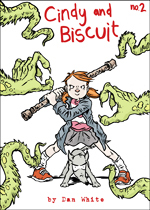
The Beast Must Die might have had to pretend to be a mere mortal called Dan White in order to have his Cindy and Biscuit nominated for Young People’s Comic Award at this year’s BCAs, but that doesn’t lesson his achievements at all.
Cindy and Biscuit is one of the best comics around. Check it out:

When pressed for details as to what its host body would be selling this weekend, Andrew Hickey‘s beard made the following statement out of its many gorgeous tendrils:
I will have the first ten copies ever printed of my collection of essays about Doctor Who, Fifty Stories For Fifty Years, available — it comes out tomorrow, the day of the anniversary itself (I haven’t even looked at the copies myself yet, so they’re unproofed — caveat lector). I will also have copies of my book about Grant Morrison’s Seven Soldiers, An Incomprehensible Condition, and my essays about comics and Doctor Who, Sci-Ence! Justice Leak!, as well as my short story collection Ideas And Entities. I may have one or two copies of my music books as well if I have any left over from last year (I haven’t checked). I will also scribble in the books if you wish.
Bit weird how the beard thinks it’s in charge, but I’m not brave enough to contradict it so we’ll let that pass for now.
Finally, I’ll be there with copies of Cut-Out Witch (a book full of melancholy ghosts and lo-fi monster magic, as drawn by my friend Lynne Henderson and captured in caption by my good self) and issue #1 of Looking Glass Heights, a mix of comics and essays on a set of common themes (housing, hubris, reality, the weather):

There might be a few other tricks and treats for you if you stop by over the weekend, but I won’t ruin them for you by spoiling them now.
Thought Bubble is easily the best comics convention I’ve ever been to, and if you can make it to Leeds this weekend I’d urge you to attend even if you don’t want to have to look at us/give us money/touch our many gorgeous heads.
Excelsior?
Flashback to Fever: Brendan McCarthy, race, and not seeing what’s in front of your face
November 9th, 2013
One of the strange blessings of the internet is its ability to serve as an external memory system. Thoughts that would once have been lost to time if they were even lucky enough to have made it out of your head are now preserved for an indefinite eternity in places over which you have little to no control.
For example, if I want to know how I felt about Brendan McCarthy’s Doctor Strange/Spider-Man comic Fever after the first issue came out in 2010, a quick google search will turn up this flouncing defense of the book, written in response to a review by Sean Collins:
Say it Vibrational Match style: Where you see “inert physicality”, I see a Spider-Man who’s all harsh angles and elbows being squashed, flattened out, and a Doc Strange who’s at home with the harsh geometrics McCarthy conjures up.
Where you read flat pastiche, I read Spider-Man as a jerk who gets shut the hell up by the story (his words like jutting elbows –> drooping limbs), and Doc Strange as a badass who can turn exposition into information with the right gestures (verbal, physical).
Also: the mystic spider dialogue is genuinely fucking creepy, for reals, when combined with the images, yes?
In lesser hands this would be mere set-up, but this issue had a whole lot of “?something else?” working for it — that creepy wee arachnid bastard, crawling up the Vulture’s back, fr’instance! Like something from Seven Soldiers, only (yes!) far more unsettling.
I saw the biggest, most bulbous-assed spider of the year last night, sitting on my windowsill. I’m a bit of a wuss when it comes to these wee beasties, but last night, after having read Fever? I tell you, I wanted to kiss the wee fucker!
The “hey, I’m a black guy!” dialogue was a bit cringey though, pastiche or no.
Looking at the book this week, I find myself agreeing with every point but the last one.
It’s not that I don’t find the dialogue McCarthy gave to the African-American comedy character cringe-inducing anymore – I do! – but that Brendan McCarthy’s recent Facebook comments on race make me feel ashamed the structure supporting that final sentence.
Sure, I agreed with Sean Collins’ assessment of the embarrassing nature of McCarthy’s throwback characterisation, but I did so in a tossed off, casual way, after five paragraphs of flame flecked enthusiasm. The implicit message being that everyone should just chill out about this racist after taste and enjoy the “septic salsa” of the comic itself.
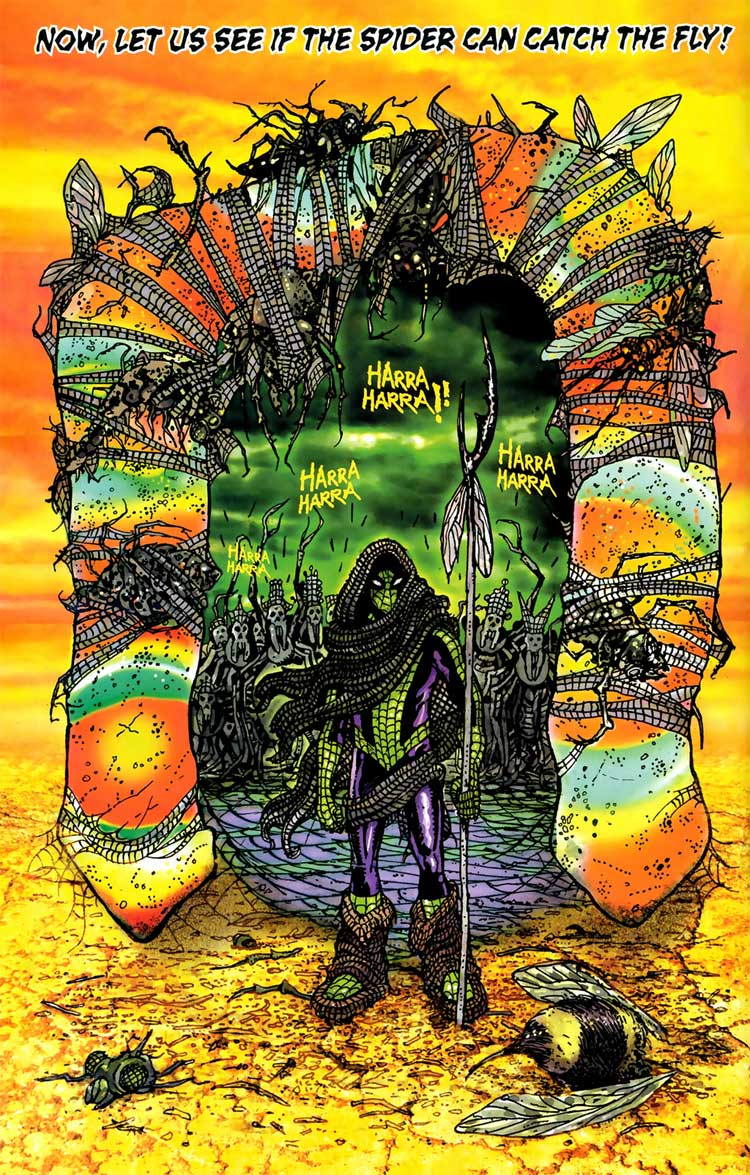
In 2010, the story of McCarthy was that he was that of the hero freshly returned from the wasteland, ready to save the kingdom from itself. His new work confirmed his status as a trinity of psych-pop ghosts, the faces of Brit comics past, present and future combined. What interest could a couple of dodgy panels hold against all that? Solo #12 remains McCarthy’s late period masterpiece, but even in lesser books like Fever there are moments of astonishing beauty. The scene in the second issue where Spider-Man steps through a portal and into a crunchy insect killing field still burns bright in the light of its own toxic logic:
Comics: An Imaginary Pursuit
September 11th, 2013
The Comics Journal Website is composed of a number of phantasmagorical pages, some of them ordered as blog posts, others as columns or interviews or features, all of them dedicated to an art of uncertain value.
Wars have been fought over the best way to define this paper-thin phenomenon, many of them on previous incarnation of the Comics Journal site. On quiet Sunday afternoons in the early 2000s gangs of rabid comics scholars could often be found tossing verbal molotovs back and forth: are comics sequential art, made compelling by the gaps between images, or is any attempt to define a medium based on what it *doesn’t* contain doomed to folly? Does this alleged art form have its roots in ancient tapestry or arcane graffiti? Are stories that strain to make childhood fantasies relevant for adult consumers really that much worse than stories that are at pains to distance themselves from the same fantasies?
Which is to say: Do you prefer Dan Clowes or the Sex-Men?

Mickey Maus or Krazy Kat?

You could catch many notions while trawling the endlessly, depthless sea of these online arguments, but no matter how long and hard you toiled you would be hard pressed to find a convincing definition of comics that didn’t fall back on the tautological – no one knows what comics are, but everyone trusts that they will know them when they see them.
First off, the word “muslim” is never implied. Second, the terrorists aren’t real. They are cartoons based loosely on the fact that there are people on this planet who will kill you because you don’t believe in their imaginary god. Again, they are CARTOONS. It’s complete fantasy. So, your last line about “justification for the depiction of terrorists” really makes no sense. Are you a censor? Depiction of what exactly? They aren’t real to begin with. The key phrase in your ridiculously reactionary statement is “having not read it”.
Indie cartoonist Jason Karns there, responding to a question about whether or not his small press comic Fukitor was as “insanely racist” as it looked. Here we see Karns displaying a sort of thinking that transcends Keats’ “negative capability”, tending instead towards a sort of unfathomable emptiness – the ability to hold a jumble of seemingly contradictory ideas in one’s head without grasping the implications of any of them.
And what sort of work does such an ability lead to?
Work that looks a little bit like this, apparently:

Bat-(Panel)Madness: Sticking the Landing
August 15th, 2013
If the first volume of Batman Incorporated exploded out of the gloom and propelled the character back towards life, then the second iteration of this latest re-branding was a far different proposition.
Every stage of Morrison’s Batman has followed a similar trajectory, starting off light-hearted and energetic before eventually plunging right back into the overarching mega-plot, and with it, the grand absence that unifies the whole run:

In the previous two iterations this has entailed an increase of complexity, either in the form of the deconstructionist absurdity of Batman RIP or in the twinned conclusions to Batman and Robin and The Return of Bruce Wayne. Batman Incorporated 2.0 represents a different approach. This final flourish of Batman comics represents the ultimate reduction of all that had come before, with the stresses of the plot compressing these twelve issues down to the barest element as it plays out to its logical conclusion: a man in a cape punching people in the face forever.