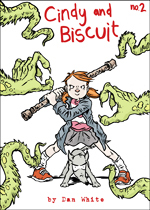
To do a Kick Ass 2 review
September 6th, 2010
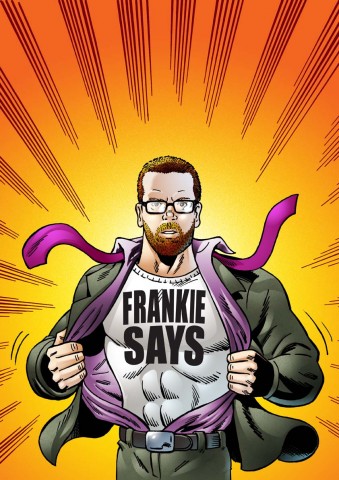
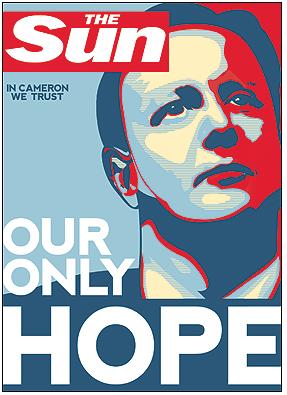
Clint was found, after a little befuddled craning and turning while doing that exaggerated ‘I am looking for something’ look, not beside the sci-fi/movie/comic mags that the cover tries to pass itself off as, but a whole shelf over, next to the lads mags and Madgadget Monthly. Is this a local thing, slip of shelfstacker’s wrist, or deliberate placement, on WHSmiths’ no-doubt nationally co-ordinated layout plans? This seemed at first like a straight up simple mistake – word with someone in sales, get it sorted for the next issue. But after a read of the Great British boys’ comic’s best last hope… maybe not so sure.
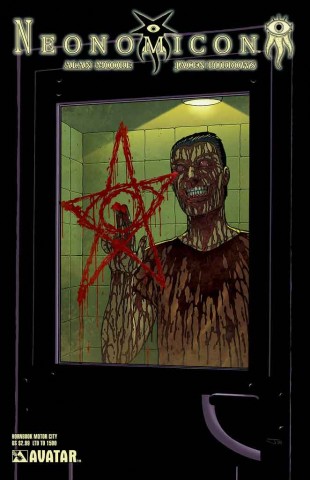
The neonomicon rereviewed via Swamp Thing
September 1st, 2010
the sleep of cthulhu, aeons deep.

i’m not sure this is a really straight ahead argument, so much as it is a series of reflections and ruminations, and i’m sorry it’s all in lower case. it’s a bad habit, one of which zom, probably quite rightly, does not approve.
Early? That’s new- it’s the Tuesday Review
August 23rd, 2010

Of course, neither myself nor anyone writing inside the walls of this blog are going to have a problem with nonsense, be it outright nonsense, stupid nonsense, or nonsense for nonsense’s sake. It’s a Marvel comic, nonsense is what it does best, and it is the best there is at what it does. But what about nonsense mad enough to think it’s Important? Or nonsense sane and brittle enough to knows it’s nonsense but try to pass itself off as Important? Are both of those things not high art crimes?
Tues reviews: M’n’M and M (& M)
July 27th, 2010
M is the British comic creator’s surname initial par excellence.
You are nine months into the nineties revival! Do not let these pamphlets decieve you!
 Shield 2 by Jonathan Hickman & Michael Angelo
I was very headwrong when reading SHIELD 2 and my memory of the first issue had been totally erased. I thought it was great, the height of pointless shouting and cosmo-drama in the Mighty Marvel Manner. It made no sense whatsoever to me but the scope of the action and the renaissance era Kirby design, all worked very well to leave me thrilled and confused. It was well mental though. A more sober reread last night made the whole thing seem a bit boring and studied. The NY kid was no longer a translucent standin for the universal recipient freak radioactive accident that used to empower us so, but a Parker clone (not literally) whose dad did something awful and amazing once. I remembered that the MIBs were Tony Stark and Reed Richards’ dads, which is crap (whatever happened to the Mighty Marvel Meritocracy? Why am I reading about aristocratic lineages? It’s un-American, da mit!)
 Nemesis 2 by Millar & McNiven
I take back my recent sniffiness on this one. The action scenes were basically perfect, the straightforward stacks of widescreen panels hiding an octopoidal magpie at the heart of the story, reaching out from the panel borders into movies and manga to snag and squeeze their best bits dry. I still think the seam of ‘politico/economic consequences of the president’s kidnap’ would be a good thing to work into it – ‘Nemesis brings world to its knees’ kinda thing… A few screaming headlines or talky-head TV screens would ground it all a bit more, though in turn they might distract from the guilty, gleeful joy that this comic runs on – the bits with the main characters going ’Aha, I fooled you!/’No, I fooled you/’No, I foooooo’ etc., the tacit acknowledgement and disregard for the manufactured falseness of these narratalogical shifts, were priceless. I am already thinking of an excuse to drag the wife to watch Nemesis at the movies, and am already thinking about what I will say when the credits roll. ‘The action was a lot tighter in the comic…’
Pnshrmx 9 by Aaron & Dillon
Panmox was good – no fight, no big fight anyway, but it does have a nice dramatic pace nevertheless, and the plotting is so freaky and over-the-top that the pages almost seem to turn themselves. Good, tense scenes of Frank going too far, the Kingpin battling his deadliest enemy, and a never-better Bullseye messing with the freaky violence mojo (it looks likes like he’s kind of inviting the Punisher-spirit from Born to take up residence, which is probably not a smart move on his part.) The feeling is beginning to seep in that Aaron’s wilder, splattery grindhouse sensibility could amount to a Bold New Way to do the Punisher, somewhere free of the Ennis ghost, different to his successful comedic and ultrablack incarnations, but equally legitimate. The NY rooftops and shrill tone keep making me think of Larry Cohen, with the Kingpin, Bulls and my man Frank all battling to be the winged serpent…
 Irredeemable 14 by Waid & Someone
The sense of menace, of bad decisions being made and of the consequences piling up in the future like a dozen car crashes, really sustains this comic. Even if they win, they lose, and they’re probably not even going to win. You can see bits of the past start to leak in – the Angel character has cut his own wings off, and you can see everyone thinking ‘Some razor sharp metal ones would probably help with this awful new age we seem to be stuck in’. The tarnish is all but come off the silver age shine, and the characters are consciously registering the shifts in their lives. It’s strangely touching, seeing these poor, small fictions, their made-up memories and selfless selves, visibly buckle under the stress of the sharp and nasty story Waid has plugged them into. These are our heroes, and they are dying off. Despite its costy pedigree and often deceptive packaging (Krause’s stiff but fitting art now slowly morphing in other guy’s hands into some steroidal, Liefeldian nightmare) Irredeemable is a bleak and bitter book, and every few issues a page or two snikts at you and cuts you on the eyelid to remind you of the pain it’s in.
Review! Oooh! Hellblazer #267
May 25th, 2010
 Hellblazer #267 by Peter Milligan and Stefan Camuncoli
There is a pointed alchemical pseudo-mcguffin at the beginning, where a silver sliver of redemptive light presents itself, that we might beg to come back to later. There is a weakness in the reader, a clearly mistaken belief that despite the dimly-remembered arguments of 20 years ago the ‘anti-’ bit of ‘anti-hero’ should basically be swapped out to form ‘grumpyhero’. That every chain-swinging, chain-smoking, cheyne-stoking gritmeister from the last generation’s reboot of the comicbook protagonist is a mere modern gloss on the Gawainian pureheart formula. As was frequently reiterated even in Garth Ennis’ last, ultra-black run on the character, even the type’s posterboy Frank (in my house we call him Frank because ‘The Punisher’ is not a word that you want coming out of the mouth of a three year old girl) is basically a well-intentioned softy, dealing with a very nasty case of PTSD but whose faith in the innocence of sweet children is strong and clear enough to drag him back from the edge of brain damage every six issues or so.
Walk a mile in my shoes, THEN talk to me about Tues Reviews: SHIELD, Jack Staff, Sparta USA
April 13th, 2010
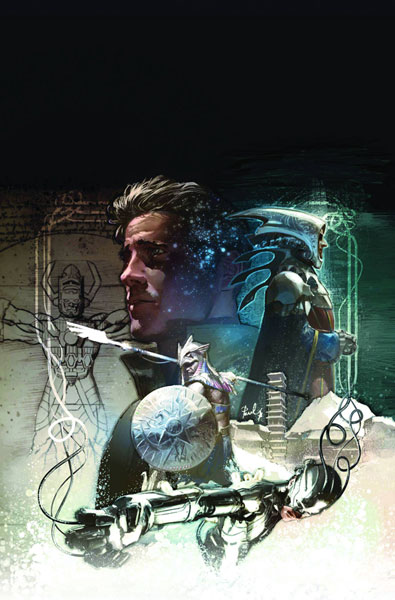
SHIELD no.1 Marvel Jonathan Hickman & Dustin Weaver
The high concept of this series is basically that SHIELD has always existed as an agency to protect humanity from super-powered and cosmic threat, and that our best and brightest minds have worked for SHIELD throughout history, a roster that includes Galileo and Leonardo DaVinci. Pretty spiffy really, and the scope for fun and hi-jinks is readily apparent. Writer Jonathan Hickman has given himself a wonderfully large palette to play with.
And it’s pretty fun. It’s hard not to like a comic that features Galileo aiming a large magnifying glass cannon at Galactus, or Leonardo DaVinci in a time-travelling flight suit. Hickman knows what makes a certain kind of comic fan tick, and provides moments guaranteed to raise a broad smile on the face of even the most jaded spandex-fan.
The main narrative strand concerns Leonid, the latest recruit in the 1950’s incarnation of SHIELD, and his whistle-stop induction into the organisation allows Hickman to bounce merrily through time giving us Celestials, ancient Egypt and Renaissance cosmic weaponry. Narratively this is a bit clunky – the dry intonation of the SHIELD elders is a tad portentous and, one suspects, empty of real content. But the comic whips along at a cracking pace and can’t be faulted for it’s lack of ambition. It’s the latest in a line of superhero comics that Marvel is producing, along with Fraction’s Iron Fist and Aaron’s Ghost Rider that aim for the crazed intensity of Steve Gerber and Jack Kirby’s finest hours, with a healthy dose of post-modern nous and widescreen operatics.
Now I’m pretty divorced from both Marvel and DCU comics at the moment, so I’m not sure whether the comic is loaded with references to Dark Reign and all that other stuff, but the comic reads pretty succinctly on it’s own. Which for a first issue is pretty much a must. Recent launches like Paul Cornell’s Captain Britain were, to my mind, totally hamstrung by their incorporation in a larger story-line. It’s constricting, limiting and doesn’t allow a comic time to establish it’s own voice or identity. SHIELD is a comic that’s certainly steeped deep in Marvel mythology and continuity, but more importantly it’s a big, fun, and intriguing comic that you can pick up blind and still appreciate. Hickman holds enough of his cards close to his chest so that we can’t be entirely sure who to trust from the outset, and provides some lashings of mystery in the peculiar figure of Leonid’s errant father and his morally fuzzy agenda.
As an aside – not entirely sure whether Agent’s Richards and Stark are supposed to be the father’s of their similarly named contemporary Marvelites, but it might just be a bit too pat if that’s the case. One of the many lessons learned from the mistakes made by George Lucas in his St* W*rs prequels was an obsessive need to tie everything together to a frankly ludicrous degree, with the effect that a huge universe becomes small and piffling. I don’t particularly need Iron man and Mr Fantastic’s destinies to have been always intertwined – I like the idea that it’s a random cataclysm that causes these weird and disparate figures to come tumbling into being. But that’s a minor gripe. For now SHIELD remains a fun boisterous read with extremely attractive artwork from Dustin Weaver. His fluid detailed art is adept at depicting the wonders of a Celestial in ancient China, or a zero gravity gunfight in SHIELD HQ. There’s an appealing European grace to some of his line-work. I’d prefer a bit more gee-whizz colour, but that just isn’t the case in Marvel’s current ‘black-ops’ palette it would seem.
I award this comic 4 brains out of 5.

With irony so thick you can spread it on toast, Paul Grist’s latest editorial in Jack Staff bemoans the dour samey-ness of most superhero comic covers while simultaneously sporting an extremely generic cover by perennial un-favourite Ian Churchill. For shame! Part of Jack Staff’s appeal is the fact that it’s all guided by Grist’s unique and strong design sense. There’s something deeply wrong about seeing a beefy spandex version of JS on the cover with a pouting busty Becky Burdock. Boo!
That aside, it’s another issue of Jack Staff. Which means some of the most delightfully idiosyncratic comic art on the racks, stellar page layout, and yet more overly convoluted storylines and temporal hop scotching. I think I get what Grist is aiming for with the latest incarnation of JS, a kind of intertwined multipart story that utilises the ‘boys weekly’ format so beloved of the UK comics industry. Each segment is part of its own ongoing narrative that feeds into a larger overall storyline. And it sometimes works very well. Grist uses logos and splash pages to great effect and manages a great job of building up and juggling an expanding universe in the guise of a continuing story. But the problems, as have been noted before on the Mindless Ones, lie in the fact that there’s this strange feeling of lots going on whilst nothing happens at all. The fact that it comes out relatively sporadically doesn’t help, meaning that the comics themselves occupy a strangely static space, whilst still being extremely enjoyable as a comics reading experience.
Grousing about Grist’s undoubtedly excellent comic feels mean spirited to say the least – Jack Staff is a great and unique thing in the comics world: a vibrant, original British comic that pays homage to a virtually hidden UK comics heritage without lapsing into cosy nostalgia and in-jokes. But there’s no side-stepping the fact that it can be a slightly dissatisfying read. It’s so near to being amazing that it’s minor failings seem all the more disappointing.
But look. The fact is that you should be buying this. It looks great, Grist’s flat out one of the greatest comics artists working today – Mignola level good – and Jack Staff is basically tonnes of fun. Once again, you should be buying this.
4 brains out of 5.
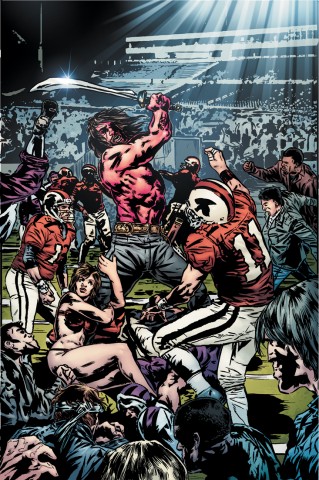
If there’s one thing that Sparta USA is, it’s unique. It’s also pretty batshit crazy, but then I think after the tour de force of gonzoid apeshittery that was Young Liars, that was to be expected. As with the first issues, this poses more questions than it answers, and delves deep into the mystery of Godfrey MacLaine, the Maestro and the bizarre football worshipping town of Sparta.
It’s difficult to know what Lapham’s aiming for with Sparta USA. It seems to occupy the same queasy twilight unreality of Young Liars, where the only thing the reader can be sure of is that something isn’t right. It’s satirical in tone, but it’s not a simple allegory. It reminds me somewhat of Joe Lansdale’s Drive-In novels in it’s broad parodic version of twisted Americana, and more surprisingly has echoes of Michael Chabon’s children’s book, Summerland. That novel mashed together baseball and fantasy to present an engagingly contemporary children’s adventure, and while Sparta USA is most definitely not that, there’s a strangely similar tone. This is a comic where the return of an errant Quarterback legend as a giant red barbarian is not greeted with too much surprise by the inhabitants of the titular town. They just don’t want anything to interrupt the football.
It’s suitably trashy, definitely bizarre and basically a pretty unique read but it is sadly hampered by the art of Johnny Timmons. While notionally attractive, his clumsy photo-referencing and figurative stiffness get in the way of what the script is telling us. For example when we are told that Godfrey received ‘the beating of his life that night, we instead get a rather confused mish-mash of brawling figures with Godfrey posing like Conan in the middle of it all. Facial expressions are unclear and awkward and the effect can be disjointing, and not in a good way. The fact is that Lapham is best served when writing and drawing his own comics. He’s one of the most unfussy, clear storytellers in the business – one only needs to imagine how badly YL could have been de-railed by using a less capable artist. I don’t want to run down Timmons too much – he’s by no means terrible, (and it’s not like he’s alone in this crime – stand up Bryan Hitch) but nonetheless there’s something desperately unappealing about being reminded of Colin Farrell when reading a comic.
I suspect that a comic like Sparta USA is probably selling dick all – partly because it’s such an oddball proposition, and partly because Wildstorm has become a graveyard for low selling comics. This is a shame, as anything that Lapham puts out tends to be more interesting than a whole lot of other comics, especially weird creator owned stuff like this. And there’s something truly appealing about a comic where you really don’t have a clue where it’s headed. So I’ll be sticking with it, and I think you should too.
3.5 brains out of 5
A totally Kick Ass (the movie) review!
April 7th, 2010
I haven’t read much of the comic as there’s only so much misanthropy and homophobia that I can take, so this won’t be an exercise in comparing texts. Actually, unless your name’s Charlie Kauffman I’m not sure anyone should bother overmuch with that sort of thing. Personally I’m much more concerned with the question of whether or not the thing in front of me has anything going for it than whether the thing in front of me has anything in common with some other thing that isn’t in front of me.
So was this particular thing good? The further I get away from it the more I’m inclined to go with not so much. Don’t get me wrong, it is entertaining up to a point but it’s also rather irritating in retrospect and much of what I enjoyed I’m not sure would do it for me on a second viewing. To begin with Kick Ass sets the audience up with expectations that it just doesn’t deliver on. You start off thinking you’re watching a comedy intent on skewering the whole idea of superheroics, but what you get is Superbad meets The Punisher. We’re told by actual fer real characters and actual fer real plot events that superheroing isn’t just physically impossible it’s practically unfeasible and the province of the psychologically disturbed, and you know what? It’s pretty hard to disagree. If anything I’d go further and add a clause about ethics and morality, but ya know this is a popcorn flick based on a Mark Millar comic so you can’t have everything.
Had the film stopped at turning a rather definitive statement about the physical impossibility of superheroics into what amounts to the part of the origin story where the hero gains (admittedly very rubbish) superpowers I probably wouldn’t be of a mind to complain. It’s a kind of thematic and intellectual betrayal but it’s a reasonably fun idea and for a minute there it looked as if the movie might have had something vaguely interesting to say about our culture of voyeurism and its relationship to our unwillingness to intervene when we see wrongs being committed. Sadly the film has nothing to say that’s worth saying about any of that and the powering up of Kick Ass turns out to be a direction of travel that culminates in the very definite assertion that being a superhero isn’t just possible, it completely fucking a-one awesome! Kick ass, dude!
In fact if the movie has anything to say at all it’s that in the real world you’d have to do superheroics with firearms and that you’d have to kill people (but hey that’s completely awesome too), that being a comic geek is really cool, and that being a gay is totally gay. Yes along the way we get to meet Hit Girl and yes she steals the film, and yes some of it is quite funny, and I’m sure teenagers will love the flick. The teenagers in the cinema with me sure as fuck did. But in the end there’s only so much nerd wet dream I need in my life.
As a side note about the action sequences, it struck me that Vaughn’s film, in common with the vast majority of modern action movies, is a prisoner of its own stylisation. The hackneyed John Woo-esque action-balletics which have come to own contemporary cinema just couldn’t exist in a film which was really concerned with bringing any kind of realism to superheroing. Had they decided to remove those stylistic elements they would have ended up with a very different and perhaps far better movie.
I award Kick Ass two brains out of five.