Did bobsy get his groove back? The final Phonogram
February 6th, 2011
- Phonogram Book Two: The Singles Club #7. By Keiron Gillen, Jamie Mckelvie, and Matt Wilson.
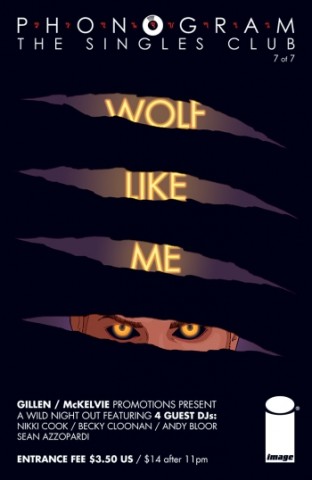
- Getting this post done is probably the only New Year’s Resolution I will stick to. Shame then that I haven’t, crucially you might think, thought of anything good to say or interesting to add* to the established critical consensus, let alone a structured, witty overview, analysis and pithy summation of Phonogram. (Which was a great, perfectly imperfect comic that lived in the zeroes and died in 2010, and whose passing should be marked.)
- In the absence of trifling little entities like Form and Content, we will therefore be going with the randomish bulletpoints format again, fire up a few bad jokes, misapplied anecdotes, predictable gimmicks, attic junk, and creepy sextalk, and see if anyone makes it to the end.
- There’s not a prize or anything.
- *Like really I haven’t, this comic’s been out for so long, it’s pathetic I haven’t thought of anything good to say about it by now. But we proceed – Singer’s Law be hanged bedad!
- Oh but, I’ve just read it back to myself and by god this is probably the most annoying, which is to say @@nnnnyyoyyyeeeeiiiiinnnnnnnnnnnnnng, review of a sweet, innocent little comic book that you will have ever read, so if you’ve the guts to go on, be warned – it gets a little unreadable out there.
Morning Glories #1-4 reviewed
January 6th, 2011
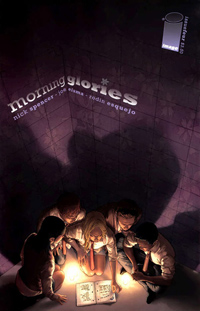 Nick Spencer and Joe Eisma
Late to this party but so, probably, are a lot of you.
Like the fella on the Internet says, Morning Glories is very much of the Lost school of storytelling where mystery is all. Four issues down and everything is still pretty much up for grabs at Morning Glory Academy: who are these kids? Why do they all have the same birthday? Why on Earth are the faculty terrorising them? How the heck are they going to get out? Cultists!?! Who’s gonna do it with who? Morning Glories is one big question mark that keeps getting bigger and that’s it’s primary appeal. Not to say that Nick Spencer – a writer who seemed to come out of nowhere last year but has since thoroughly stormed DC ramparts with his work on Jimmy Olsen, T.H.U.N.D.E.R Agents and Supergirl – doesn’t make the comic work in other ways, the characterisation is whedonesque in it’s clarity, the plot is multi-laced but easy to follow, and the book is surprisingly fast paced, action packed, compelling and dramatic for a title where interpersonal dynamics (i.e. talking heads) are front and centre.
“Pain is Funny”: Deadpool Max #1-3 Reviewed!
December 24th, 2010
ALTERNATIVE TITLE: WHO WILL SURVIVE IN AMERICA?!
Here’s the soundtrack. You know what to do.
So, Deadpool Max then. Kyle Baker does the art, David Lapham’s on script duties. Never mind the fact that Deadpool is a Rob “Fucking!” Liefeld character turned comedy Wolverine turned corporate ubiquity – is the comic any good?
Bloody right it is!

(Yeah, okay, it’s a little bit late to write about these books as if they’re a fresh discovery, I know. As Marc Singer once said, “if you’re going to review a new-release comic two weeks after it was a new release, you’d damn well better have something to talk about” – so, hey, just imagine how great this must be if I’m still willing to post it now! On Christmas Eve!)
Find out what other secrets are stuffed in Santa’s sack! You know you want to!
5 Things I liked about comics in 2010
December 23rd, 2010
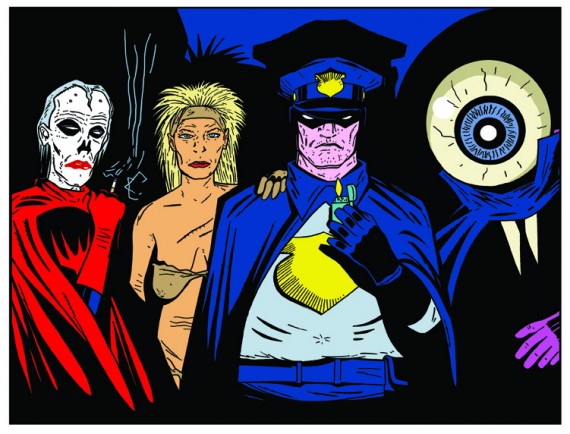
Teenage Wasteland
December 19th, 2010

You know you’re living in some kind of pop-cultural saturation point when you find yourself reviewing a coffee table Slasher book…
Little Big Numbers
November 16th, 2010
OR: Alec – How to be an Artist, and why some stories are just too fucking massive not to be told
Another thing I remembered, and I don’t think I ever mentioned it to Alan, but I always felt a certain resentment that Billy the Sink got Big Numbers and blew it while i was stuck drawing Jack the bloody Ripper for ten years (I once described it as a penny dreadful that costs thirty five bucks). I stand by my opinion that Big Numbers was the superior idea and would have been Alan’s masterpiece. Of course it is also true that Sienkiewicz is a world class illustrator and there’s no way I could have done a job that complicated in 1992. I could have taken a crack at it later (post-Birth Caul/Snakes and Ladders), and offered, but Alan wasn’t up for that. I love the ease with which Bill shifts from photographic mode to outright loony tunes. The separated Gathercoles remembering their courtship and early marriage is a masterstroke (pages 19-21). That’s an odd note at the bottom of page 29 where he slips back into his Moon Knight style.
(Eddie Campbell on Alan Moore and Bill Sinkiewicz’s Big Numbers)
The first time you read Eddie Campbell’s Alec – How to be an Artist, you might find yourself wondering why Campbell spends so much time on the story of how Alan Moore and Bill Sinkiewicz’s proposed masterpiece, Big Numbers, never added up to much in the end.
I mean sure, it’s a good story – the fact that a project so well conceived with so much talent behind it could not come together for more than three issues (only two of which were published!) is just plain baffling. More than that, it’s good gossip!
More on Alec – How to be an Artist/more fun with fractals after the cut!
Etched Headplate
October 24th, 2010
OR: Riding The Bulletproof Coffin With Shaky Kane & David Hine!
When it comes to comics, The Bulletproof Coffin has annihilated the competition in 2010. This is fitting, because The Bulletproof Coffin is all about the creepy, destructive power of your (my?) favourite medium. Like the vehicle of the book’s title, comics are a fun thing to bury yourself in, but whatever way you look at it you’re still getting buried, right?
For those who came in late… well, if you’re allergic to plot synopses (which is to say: if you’re a reasonably functional human being!), go read the first issue for free then come back. If overexposure to the Internet has left you with a high tolerance for such nonsense, then the book’s about Steve Neuman, a “void contractor” who stumbles onto an idiot’s bounty of comics, toys and collectible crap in a dead man’s house. As per an arrangement he has with his boss, he takes this stuff home, and the ever porous borders between real life and fantasy start to let stuff filter through just like you’d expect they would.
All of this seems a little simplistic when described, but this is a far more precise and specific piece of work than I’ve made it sound. It’s all about points of impact – between the gnarled, blocky shapes Kane sets up on the page, between one unsavoury colour and another and between pulp fantasy and pulped reality. Like so:

Knight and Squire #1 review
October 18th, 2010
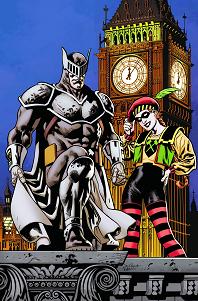 Paul Cornell and Jimmy Broxton
As a British fan of Morrison’s bat-run I was always going to pick this up, and on the whole I’m glad I did. Much has been made of the over-abundance of British cultural references and idiomatic turns of phrase by my American chums, which comes as no surprise given that Cornell’s attempts to paint DC-UK as exotic even forced me to stop and think about some of the dialogue, and that’s despite the glossary at the back of the book. To some extent I feel for those who struggled, this self-evidently isn’t a comic for everyone. If you’re not an anglophile or a Brit who’s prepared to weather what could reasonably described as Cornell’s heavy handed approach to British cultural representation then this isn’t the comic for you. This first issue also isn’t a book for those who want a lot in the way of plot, and what little there is it at least as concerned with servicing Cornell’s primary aim, introducing a milieu, as it is with moving the Knight and Squire’s story forward.
With the above caveats in mind, it’s as an exercise in world building that the book worked for me. I liked the pub where Britain’s super-community meet, as a concept I think it has the scope to stretch out beyond its soapy roots (the British pub sits at the heart of the UK’s two favourite soaps, EastEnders and Coronation Street), and in this issue it served both as an efficient means of condensing the DC-UK fictional landscape and setting the light-hearted tone. I enjoyed the humorous character introductions even if I thought they lacked the creative electricity that a Moore or a Morrison would have imbued them with. Captain Cornwall made me chuckle (the very idea), and I particularly liked the Milk Man, who as a concept managed to straddle the line between being silly, cosily familiar and a bit weird in a satisfyingly pythonesque way (an adjective which could start to wear thin if we’re still trotting it out in two issues time, I grant you). I was also happy to see that Cornell, like Moore before him, is capable of using the more trainspottery elements to bolster his efforts. To have Jarvis Poker ‘the [Great] British Joker’ speak briefly in Polari brought the character to life in one panel thanks to the strong association between comedy, that opaque language of 50s gay culture and the shade of Kenneth Williams.
Broxton’s art, while failing to clearly communicate the mayhem and action towards the end of the book was articulate enough to convey everything that Cornell needed to get across, and managed to be just cartoony enough to reinforce the book’s general feeling of warmth. It’s tricky to do a bar-room brawl and it’s tricky to design and draw a comic that’s heaving at the gutters with new characters. If that sounds like I’m damning him with faint praise that because to some extent I am, but I’m also prepared to give him the benefit of the doubt at this very early stage. As I’ve noted above, this wasn’t a remotely plot heavy issue, and was mainly built from panels introducing new characters and concepts, as a consequence we’ll see how Broxton fairs when he needs to push the story uphill rather than link up a bunch of largely disparate elements in an anarchic pub.
If I have any big worries for this book they’re around the idea that “moderation” is a concept on which to build a superhero comic. Cornell goes to great pains to set-up this idea: the very notion that supervillains and superheroes would share the same drinking establishment requires it*, as does the woolly subplot where a young turk has to choose which side of the hero/villain divide he will stand, as if he were choosing between apples and oranges. While I think moderation has its virtues, and I can see why someone might want to sell it to an American audience (sorry, Americans), moderation isn’t the bedrock of entertaining popular fiction, quite the opposite, and as a guiding principle it runs the risk of feeling very forced. This first issue could afford to be quite self-aware, in fact it benefitted from it, but the same approach might become more of a problem down the road, especially if the plot is unduly effected by such meta-texual concerns, and particularly if those concerns are antithetical to drama.
*At least it does in so far as Cornell’s vision for the pub goes.
I hereby award this comic three brains out of five
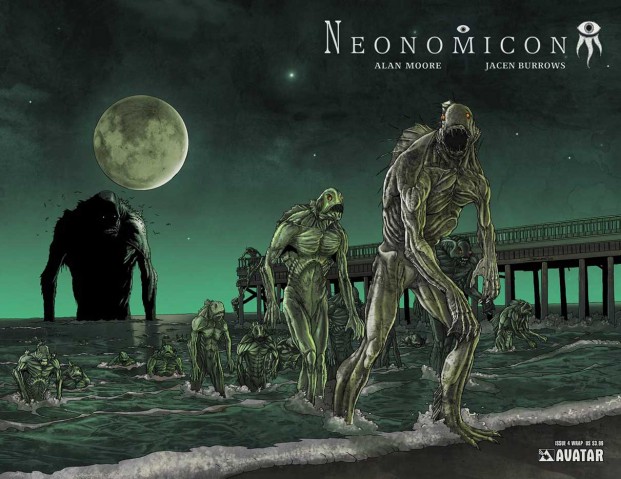
The Mashless Ones on Neonomicon #2
October 15th, 2010
As part of our commitment to ensuring nothing that occurs on this blog could ever be construed as ‘journalism’, what follows is a scrambled and unattributed sample of snippets – only very slightly tweaked to make a semblance of sense – of recent backroom chatter by all (or nearly all) the Mindless Ones on Alan Moore and Jacen Burrows’ recent cockpunk horrorbook Neonomicon #2. Some extracts may be recognised from other websites and/or previous publications. Nothing agrees with anything. All opinions are rubbish.
“By refusing to exclude rape from his depictions of violence and power in action in my view Moore is fulfilling an important function. While ninety nine percent of popular fictions are happy to present us with a picture of violence that excludes most of the troubling bits, a violence that is fundamentally fun and entertaining, Moore is prepared to go to much more uncomfortable places and thank God.”