Late on Tues, it’s our reviews: Green Lantern #52
March 30th, 2010
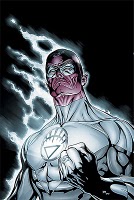 Green Lantern #52, Geoffrey Johns, Doug Mahnke and Christian Alamy
So a white light entity created the universe starting with Earth and on that Earth the first emotional beings were born and through them emotional energy was unleashed upon the rest of the universe (which evolved after Earth, naturally). And some of that energy became special beings like the Predator (made from love, naturally), and Ion (made from the emotion we call willpower, naturally), and Parallax (made from fear, or should that be other people’s fear? Whatever, dude). And then came the Guardians who harnessed that energy and made the Green Lanterns.
Amen
But did you know that Adam and Eve and the story of Cain and Abel and probably all that religious shit to do with Jesus and Buddha was tied into this stuff? It makes sense if you think about it. It all fits. It all comes back to Green Lantern and it’s all getting laid out and resolved in the pages of Blackest Night by these guys.

Fair enough Final Crisis had the Earth as the gods’ battleground, as a kind of notional universal center, but Morrison had so much other stuff going on that it would be silly to accuse him of geocentrism. His Earth was the center of the universe because it’s the center of the fictional construct (the DCU) that was the meta-textual concern of his very meta-textual story, and he went to great pains to get us to understand that that was where he was coming from. If Final Crisis is a story about DCU stories, which it undeniably is, then of course Earth is the most important place in the universe. Also, whether or not you like Final Crisis, whether or not the series succeeds, Morrison was undoubtedly trying to say interesting stuff with his mythological noodlings: about genre conventions, about art and about life. It’s striving to be bigger than the sum of its parts, and at the very least provides us with some fun, internally consistent, higher order game playing.
Johns on the other hand, he’s not saying anything that isn’t written on the tin and what’s written on the tin is genuinely weird*. The Green Lantern concept allows Johns to quite literally reify just about anything he likes and so he has: Life? Check. Death? Check. Avarice? Check. Rage? Yup. Everything is reduced to spandex and glowing energy. In that way he’s not entirely unlike Kirby or indeed any number of other writers, but unlike some of those writers Johns has none of Kirby’s wild creative energy, add that to the very particular world view that comes through in his comics (love=the Predator remember) and the overall deficit of broader, non-DCU, non Green Lantern orientated concerns gives Johns’ mythology a parochial and bizarrely concrete feel. It seems to me that unlike Morrison Johns can’t easily sidestep questions about how his new mythology relates to the physical history of the universe. Morrison doesn’t need to worry over much about things like physics because he understands and he wants you to understand – as he explicitly demonstrates in Final Crisis – that the history of the DCU is the history of a fiction, and within fiction things are more flexible, ambiguous and open to interpretation. Johns mythology is modelled rather more on the history of real places, it’s an unambiguously physical history of life the universe and everything. The consequence being that the reader – even the reader disinterested in big C Continuity – is tempted if not quite compelled to start asking really awkward questions like: is DCU Earth older than the Sun? What about all those other ancient DCU civilisations? What about evolution? How does this fit in with all that other DCU mythology?
That all this is rolled up in the continuity of the writer’s favourite character and you have a comic that makes me struggle for words. Johns’ vision is so personal and odd, what he seems to be saying about the world so strange (if he actually thinks love=the Predator is a good fit he’s not talking a language I understand, if he doesn’t but just thinks the idea is cool then I’m happy to be a dweeb), his focus so narrow, that I’m just left scratching my head.
Jarvis Cocker once made a TV series about American folk-artists and their eccentric, obsessive work, and there’s a sense in which Johns reminds me of one of those guys and I want to like his work more than I do because of it. Johns is an original: there’s no-one out there doing what he does, no-one else who would feel it important to explain the historical significance of Ion, and that’s probably a big part of why he’s so successful. But where others see awesomeness, I see comics that are fixated on comics and nothing but comics – Green Lantern comics in particular. I suppose there’s a kind of awesomeness to that, but it’s not a variety that I enjoy.
I award this comic 5 anti-brains
*I know I’ve condemned the word “weird” as a short cut to thinking before now, but if anything ever qualified it’s this.
The Weird World of a short Tuesday review
March 9th, 2010
The Weird World of Jack Staff #1, by Paul Grist (Image)

Chew tues reviews: Dark Avengers #14 & Punisher Max #4
February 23rd, 2010
 Dark Avengers #14 by Brian Bendis, Mike Deodato & Rain Beredo
The characters demonstrate the expected dialogue ticks, the speech balloons are bloated fit to burst, and the most powerful people on the planet don’t kick anyone in the face or blow up any universes, but instead sit around having Important Conversations About Themselves. If you asked someone who didn’t like Bendis’s work to describe one of his comics this is exactly the sort of thing they would come up with. A move away from what the genre supposedly does best – ideas, iconography, adventure, action, scale – towards character psychology, character motivation, and character relationships. Read the rest of this entry »
Tuesday microreview
February 16th, 2010
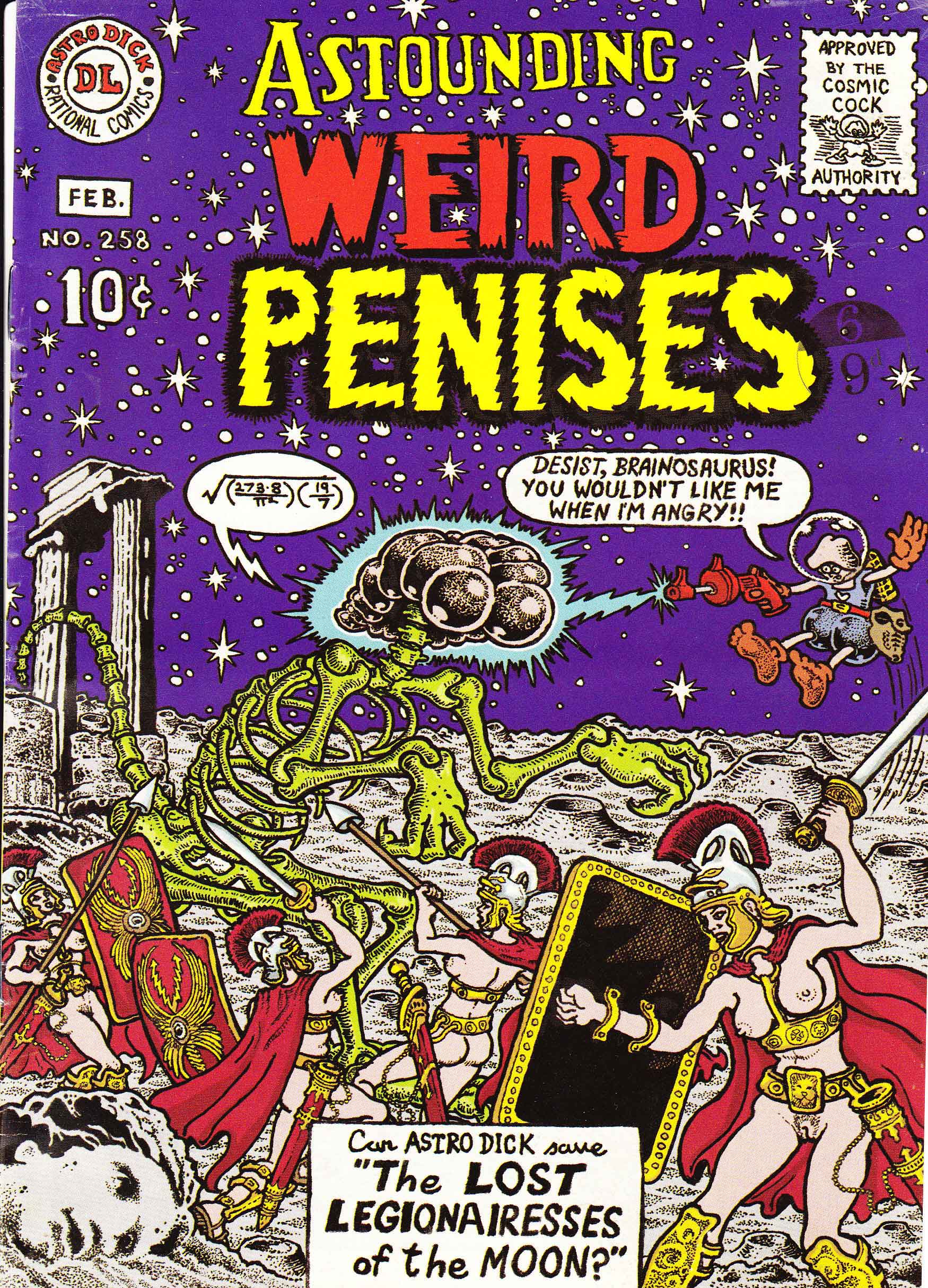
Astounding Weird Penises 258
by Alan Moore, Rational Comics/Dodgem Logic
Because of course the comic’s primal ancestor isn’t cave art – stop being so pompous – it’s the bored schoolboy’s notebook, the dirty little doodle hiding between the sums and spelling notes.
La-Tues reviews: Starman #81, Amazing Spider-Man #618
January 26th, 2010
In the dying light of the comic week…
 Starman #81 by James Robinson, Fernando Dagnino, Bill Sienkewicz & Matt Hollingsworth
First up, art sentence: the art looks fucking doss, because it’s drawn – inked, but whatever (no-one survives a Sink-ink, except John Paul Leon) – by Bill Sienkewicz and therefore looks like Bill Sienkewicz, which is fucking doss, and also Matt Hollingsworth colours it and he is the best colourist, especially at the murkier end of the palette.
(Seriously, if you want to say a Bill Sink comic, any one of them – if you want to say “hhm, not sure about the art” or, I don’t know, it doesn’t matter, fact is: if you want to say something like that you are making a dick of yourself.)
Right! Comic-reviewing credentials, I think you’ll agree, well established this is a pretty interesting one; I pre-reviewed it as “James Robinson pisses his final chips, probably”. The chips being his credibility as a once-capable, fan-favourite writer. The chips being a casino metaphor. The chips being how I – in my opinion which is valueless (beyond or beneath, you the reader may interact and decide, it’s the new format) – how I feel about James Robinson. As a human being. What his worth. To me.
Is?
And actually, to my surprise, James Robinson did not piss his final chips but instead turned in a thoroughly decent comic for probably the first time since he last wrote an issue of Starman, eight-and-a-half years ago. I say probably, I’ve not read all of them – six or so, it felt like infinity, of the most time-dilatingly dull Superman comics of all time, which considering the average standard of dullness in Superman comic [fucking dull, broseph] is likely an achievement of some moment and an eight-issue run on Batman as a lead-in to Morrison taking over the title, something I hyped myself into believing was half-decent due to overexcitement, and then I quite reasonably stopped reading them, the James Robinson comics, but man o! Some people read them for me. Others showed me pictures. And I don’t want to, look – I’ll be out the door before we turn into scans_daily or you can put me in the crosshair, aim-for-the-heart – I don’t think it’s necessarily fair to take things out of context and rudely and roundly condemn, but I’m pretty certain nothing else in the latter Justice League issue could conceivably make up for murky-depthy chats with Zombie Doctor Rapelight. It would take a bit of doing, over several comics, to redress that little soulquake.
So, but this is okay, this comic? It’s pretty okay, I would give it three to three-and-a-half brains; yeah, call it a 3.5er for the art. It is, it transpires, a welcome return to Opal City, it got me to reread Starman #80 for research (Research! You must always do research if you wish to be a critic on the comics blogosphere) and that was… I totally loved doing that. That hit just about every right note that a DC superhero comic should or could upon closing, it has a touching tribute to Archie Goodwin in the back, it’s really quite an emotional experience, I got quite Mist-y. This ain’t colour-of-nostalgia speaking; I was quite bloody miserable in 2001, and understandably concerned the years might have taken a sheen off somewhat, but not excessively, treasured memories of Starman, the original series, sections of which had already proven trialsome to go back and reread. Batman/Hellboy/Starman – you’d be right to expect that to rule, how could it conceivably not, but it’s bollocks.
This issue (whose contents I am going to discuss not at all, except to say for a more authentic feel there should have been a lot more misplaced boldface stresses) proved that, to some degree, James Dale Robinson can still write a comic. So why isn’t he? I think he – and bear in mind, if it need be said, that this is wholly supposition, I know not how a sausage is made nor the sausagemakers – like Brian Azzarello writing Doctor Thirteen, was not really a fan of – not in love with – superhero comics, but rather of the past and of antiquities, and like Azz utilising obscure, pointless bands that he loved anyway to write obscure, pointless superheroes that someone presumably feels likewise about… basically that was what that was about, Starman. That was an actual asset, not to be in love. The past, its ochre, its eternally dissipating hue, and it worked for the most part; it was was informed by this, there was its foundation. With the other DC books, it’s like – there’s no ‘there’ there, as they say, nothing underlies them, and they read like editorial-driven shitfests, they really did. As if script-notes have come back saying “make more odious“/”not enough tedium“/”I didn’t feel ruined as a person by this experience, can you juice up the miasm of despair a bit?“, etc. It’s a confluence of knowing popular American comics are writer-driven at the top-end and a desperate drive to continually rebrand the subsidiary’s sole assets that’s led to this end; it isn’t working in this case, just as it never does with Peter Milligan, who can at least turn in a half-decent, no more, no less, Batman comic. James Robinson wrote Leave it to Chance. James Robinson wrote London’s Dark. I can only imagine he is doing a lot better out of comics these days, and this issue just about earned it for the first time in a long time. (BB)
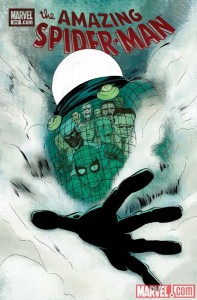 Amazing Spider-Man #618 by Dan Slott, Marcos Martin & Javier Rodriguez
When does a comic stop dealing in long standing conventions and veer headlong into a brickwall made of pastiche? That’s the question I found myself pondering after reading Amazing Spider-Man #618.
I’ve enjoyed much of what I’ve read of the new Spider-line, but I have to question whether it’s appeal is particularly healthy. The focus on new new villains and new old villains, the bubbly soap-operatics, the densely packed panels and incident filled issues. The spider-quips, love triangles, the Daily Bugle and Aunt May in peril. That right there is Spider-Man, and I’m absolutely certain that that’s what the line’s heavily editorially controlled creators want me to think.
In #618 we get a slew of baddies, multiple-returns from the dead including the return of two classic villains, evil Aunt May, yep that ever trusty love triangle (that includes the Black Cat), and more angst tha you could shake a stick at. Not only that but the art team treat us to Ditko-esque layouts, panel constructions, and line work, topped off with a sombre pastel colour scheme not entirely unreminiscent of the late sixties colour palette.
It’s true to say that none of this amounts to full-blown pastiche. A heavily diluted modern sensibility informs the book and provides much of the humour, but it does so at the expense of the verisimilitude. The book as a whole is just too knowing, too aware of the conventions on which it is built to be truly entertaining. There’s a fun of a sort to be had in recognising how the traditions of the spider-comic are being deployed and toyed with here, but it’s, if anything, a guilty kind of fun.
But despite these gripes they’re is something undeniably refreshing about this comic. Some of the cliched storytelling techniques on display couldn’t be more at odds with Marvel’s current focus on pseudo-realist psychology and emphasis on plot over incident. Soap opera and melodrama aren’t without their faults but they’re not without their pleasures either, and the sheer imaginative brio embodied by the line’s spider-foes is commendable in and of itself.
So while this line of books and the hoary cliches on which it is built could teach other Marvel titles a thing or two about entertainment ultimately its role certainly isn’t pedagogical, and it’s hard to imagine reading something this beholden to its past on a regular basis. (Z)
Tuesviews: Neonomicon, PunisherMAX
January 20th, 2010
Neonomicon Hornbook by Alan Moore, Jacen Burrows, Avatar
New Moore, but is it MOAR Moore? Seeing as this is a 9 page preview (plus script) you’d hope that it was. It would be failing somewhat in its job if it wasn’t, eh? So the good news is that yes I wanted MOAR but only because Al’ is so good at this stuff. His (spoilers) set up could have been phoned in: two FBI agents – an uptight plain Jane and a handsome go-getter – visit the looniest of murderous loonies who is currently imprisoned in a maximum security blah blah to get his insights into blah blah horribleness. This being the sequel to Moore’s The Courtyard (a prose story previously given the oxygen of publication by Avatar) the Cthulhu Mythos has been carefully kneaded into the mix, but that will come as no surprise to any of the readership.
This being Moore it shines just bright enough in the details to pique your interest, and we are left with the distinct impression that Alan’s take on the Cthulhu Mythos probably will be at least half as fun as we’d expect it to be which is considerably more fun than most comics littering the racks. I don’t want to speak much more about the specifics because, given the slightness of this demi-issue, to do would spoil absolutely everything for you.
Art paras: Jacen Burrows is currently the darling of Avatar and one of the go-to guys if you’ve got horror in mind. His work here is fine, just expressive enough to handle the dialogue heavy script, and the pivotal interview with the maniac, and on the strength of his work on Ennis’s Crossed we know that his gore cred has been earned, but at heart I suspect Burrows is strictly a body horror kind of guy. I certainly haven’t seen any work of his that would suggest his range stretches far past naturalism and stock monsterous forms, and that worries me because ideally I’d want to see an artist tackle the Outer Gods who was just as at home with the abstract as the everyday. Someone who could take visions of the hackneyed Cthulhu mythos to new and surprising places.
Perhaps I’m underestimating Burrows, and if there was a ever a creative partner who had it in him to stretch a guy it’s Moore. Unfortunately another possible outcome is an artist overwhelmed by the talent of his collaborator. Certainly the current lack of synergy between the inking and the digital colouring isn’t working in Jacen’s favour. We’ll just have to wait – 8 months – and see how it turns out.

My go.
PunisherMAX 3
by Jason Aaron & Steve Dillon
The last two issues of this had been really quite good – a superhero plot cleverly thrown into naturalistic lighting, a big fat threat coming up strong, while Frank goes about his dreary business, killing for the Kingpin without really realising it. The art was cool and controlled, seeming to promise an imminent break from its self-imposed limitations, like it was itching to get some blood in the ink as soon as the story would let it. Wise heads seemed to be in control. The odd rapey Millarism aside, all was going great guns. Was this title actually going to get back to its former glory?
It should have been so straightforward. Straight as a laser, the plot of the Punmax’s first (and ideally, only) Kingpin story should have been very simple indeed – four and a half issues of Wilson Fisk’s terrifying ascent to the top of the gangster tree, with Frank, largely absent, slowly circling closer while realising the enormity – lets not be coy: the fatness of what he’s dealing with. Half way through issue five they come face to face, and the next issue and a half is Manhattan in flames as they go at each other, finally getting down to a fists-and-teeth fight to the finish in Fisk’s office penthouse. Just as Frank has finally won and is about to cap the deal, Fisk is all like, if anything happens to me then my men will kill three innocent families etc., so Frank begrudgingly lets him live, just, in his ivory tower. ‘This ain’t over, Kingpin…’
So obviously, I don’t know what I’m talking about, and just because I am a simple man yearning for simple comics to reflect simple times. The introduction of The Mennonite (which is a cool name for a super assassin) was, though I live to be proved wrong on these things, an unnecessary fork in the road. The past two issues have successfully established big Willy Fisk as a force to be reckoned with, the great white shark of the underworld kingdom. That would have been enough really – the remainder of the plot could have been carried along under that momentum, the PunMax equivalent of the game-changing moment in Gyo where the shark heads into the beach and does-not-stop. The dramatic tension should have just built and built onto itself, stretching the readers nerves to snapping point. Instead, The Mennonite’s arrival deflects the tension – ‘You thought the Kingpin was scary? Wait til you meet this guy!!’ No. tell me more abot the Kingpin. ‘Killer Amish’ is a fine idea on its own, I guess, but it can wait for another day. Tell me more about the Kingpin. Tell me more about why his existence is such an affront to Frank’s history.
This seems like such a clear point, such an obvious narrative mis-step, that it does incline me to think that there may be a very clever plan at work here, and that’s enough to keep me reading for now, to see if that suspicion is borne out. The uncertainty surrounding The Mennonite, whether he will be gunning for Frank or Fisk, puts the former into an interesting position. Can he kill The Mennonite without becoming the thing he hates most? But again, are these not issues that the Kingpin’s family would have made Frank confront equally well? Why the doubling up, the waste? This comic is about steel, not butter. The Mennonite feels like a good character, on any other day, anywhere else, but here it’s threatening going to overstuff the compellingly lean narrative that had been established earlier. Never forget – MAX whatever, but this is still Marvel Comics, where rubbish things can and do happen without a whisper of warning…
In this issue, sadly, some rubbish things definitely did happen, even aside from the questionable, if intriguing, introduction of a new Big Bad. Frank and Fisk come face to face (you would normally say ‘finally come face to face’, if the episode wasn’t so thoughtlessly structured) in a scene that is completely undercut by some really ill-timed and juvenile, faintly misogynistic ‘humour’. It’s the sort of gag that Ennis does sometimes, though never in this title, and in that regard it is probably supposed to be a homage of some kind, but it falls completely flat, sacrificing the tension of the scene itself and retroactively reaching back into the previous two issues and deflating their impact as well. The two main players then do a bit of stagey, knockabout fighting that completely doesn’t get across how lethal they are, and generally the main line of the entire plot is sacrificed, with all of the effort and interest in the issue going into the maybe-significant arrival of the previously completely untelegraphed The Mennonite. (The Mennonite is a very satisfying thing both to type and to say over in your head – I really hope that’s not why he’s suddenly the most important character in the Punisher book.)
Art Para: A naked centenarian. A fat bloke. A crazy old vet. Some other stuff. None of it connects. Dude who did this art used to be the best in the game when it came to meat and impact, but it all feels a bit like sacks of spuds strapped onto dodgems. The word ‘meh’ was invented for art like this.
It’s almost like… mmm, not sure where I’m going with this… but by introducing the Kingpin and opening the Max Punisher up to influences from the mainstream Marvel U (it had been its own hermetically sealed universe herotofore, with Nick Fury being the only other pre-existing character to follow Frank in the leap between universes, though even that was the Ennis-verse Fury Fury, not the traditional 616 version), it’s almost as if the PMXU can’t survive on its own logic any more, and extra elements are required, shipped in from across the galaxies, to make the internal logic of the comic balance. Hands up who wasn’t thinking ‘Daredevil’ when they saw The Mennonite originally (tough, Christian-conflicted, family pressures, ginger)? The Kingpin graft tore a Murdock-shaped hole in the story, and this is how you fill it. Didn’t the scenes with his wife in her sickbed make you think of Matt in the convent in Born Again? Rationally, and if handled with care, there’s no reason that the MAXiverse shouldn’t be able to support its own weight, even if we are going to have mainstream guest stars. Is there the craft here for it, though? Do people think this book is about naked grannies with shotguns, that that was all there was to it? This is after all Punisher MAX we’re talking about. This book matters. With this issue it took another step towards making itself irrelevant, again.
Team up review? It must be Tue (a.k.a the threeway)
January 12th, 2010
It’s a slow one for us, so we have joined forces like Voltron, whatever Voltron is (I know what Voltron is because I bought a very cheap Voltron DVD the other week. It was a ripoff – Voltron is a load of old shit). This could get more like one of those old Sugarhill Gang tracks that goes on for ever actually, on eof those ones where they’re just talking about their socks, what they had for dinner, and, most rivetingly, about how their neighbourhood has got, like, a really cool bridge or some shit like that…

These are the comics that have hit us in our brainless brains this week.
Paying dues: Tuesday reviews
January 6th, 2010
What’s that, crow-like Carnevale mask? There’re going to follow a plural of what?

Stolen from here, btw, in the interests of credit due. Creepy fucking buddy. Fifteen apparitions have I seen/The worst a coat on a coat-hanger
& babble on & on & on & on
December 24th, 2009
Articles of the Shame of a Common Man ~ #1 ~ Things I’m Glad No-one Knows About
A long time ago Laura, who I mentioned in the review of Phonogram 2.1 a year ago and is in no way like the character who once reminded me of her so, set me a challenge to which I was too weak to rise. She said: ‘If you love Dexys Midnight Runners so fucking much, come into our trendy metropolitan university one morning dressed as one of them circa Come On Eileen. Dungarees, kerchief, hat, the lot. And I will give you fifty English pounds.’ Scared stupid, and unwilling to give her the satisfaction of pissing herself laughing at me while I got stabbed by less tolerant fellow students, I declined, without so much as a too-rye-aye.

Smirking lke a Cheshire cat, she christens me. ‘Your Phonogram name will be, ‘ she says (except she didn’t of course, it’s just how this could have played out if you were writing the scene like that now… The bit about the bet’s true though, and the name:)