Hamlet was a Dinobot too
July 15th, 2025
To be, or not to be. That is the question. These comics I hold… Are they a record of what will be, or only of what may? For if the future is indeed immutably foretold in these short reviews… then my demise is but moments from that confirmation.
Worms: Book The First – Erika Price

Last time I talked about Erika’s work on here I just about got the sense of it over – “It’ll get under your skin. You’ll want it there.”
What this doesn’t quite capture is how her work feels once it’s worked its way past your psychic barriers. A line from this issue presents itself: “That night rippled through the whole city.” I knew this comic was the real stuff, the best stuff, by the third page, when the backdrop to a confession seemed to writhe and twist in front of my eyes across three rancid panels.

Erika’s comics have always been warped formal marvels, with carefully worried lines stacked on top of each other in patterns both intricate and suggestive of some sort of deeper unravelling, but there’s a mounting sense of dread to Worms that might just surpass anything she’s done before. Topical stuff, really – a conclave and its aftermath. Dark intimations about the new leader. Stuttering guilt, barked theories, recrimination. Writing to match the art, check the sequence where an internal monologue is put through the shredder while Eulogiuseley sits in front of knife and fork, lost in lost thoughts, feast not yet in front of him: “Have you ever woken up one morning to find your whole world, nay, your whole reality, is rotting away beneath your feet?”
Ripples within ripples within ripples. The whole city. The night. “Have you ever woken up one morning to find your whole world, nay, your whole reality, is rotting away beneath your feet?” There’s a mounting sense of dread to Worms that might just surpass anything Erika’s done before. Did I say that already, before the feast?
Detective Comics Annual 2025 – John McCrea (art), Stefano Raffaele (art), Fico Ossio (art), Al Ewing (script), Lee Loughridge (colours), Triona Farrell (colours), Ulises Arreola (colours), Tom Napolitano (letters)

We famously love a gonzo Bat-epic around here, but do you know what’s a wee bit undervalued in the post four dimensional Bat-squid era? A nice done-in-one mystery with Batman in it. “Detective Comics” they’re calling it, over on whatever cursed platform they’re using to propagate new sales pitches these days.
This annual is a perfect example of the form. Starts with a locked room murder and works its way to a big face-off with the perpetrator by way of a scenic trip to York. Vivid scene setting across its locales, from the hermetic rich man’s world where we begin to the very English churchyard where things get weird. Three artists for three sections so the “art jam” aspect of it doesn’t get too grating. John McCrae’s chapter is the clear stand-out, his work a welcome break from the impacted gothic house style. McCrae’s pages are full of bright pink light and well kent cop faces, all characters drawn with a bit of spring in their limbs, all backdrops rendered like unusually convincing film sets.

The panel above gives the trick away: even when writing a functional Bat-mystery, Al Ewing finds away to bring the uncanny into the story. The Bat’s solid but flexible, y’see – it can solve a crime, beat a magician at his own game, and incorporate Ewing’s current thematic occupation with unfathomable tech fuckery along the way. That’s why it’s the McCrae sequence that really sings. For a few pages in the middle there, the art is clearly every bit as adaptable as the guy with the big cape and the bulging toolkit.
As for computers, “Sophisticated idiots–they do only as they’re told.”
The Return & other short comics – K.Briggs

Already reviewed in a recent issue of the Mindless Ones newsletter – subscribe today if you haven’t already – and now available to order! To borrow some words that aren’t my own:
Briggs doesn’t really make comics like anyone else I know, I think there’s probably a “high Vertigo” ‘95ish influence but it’s not… they are never really narrative driven, I think they are ponderous if you can imagine that not being used pejoratively; a synonym of meditative but that has implications that I find sort of annoying, there’s a strong fine art sensibility that I only know enough about to vaguely recognise and can’t perform any disquisition on really, but I always find the work moving and connecting in ways that are… essentially I think what is done here with colour and collage drawing the eye across simple, diaristic blank verse – everything is everything remember & this is closer to ee cummings than it is to 95%(?) of comics – is what we have always been trying to write about, the art of life, these intercuts and disjunctions are essentially omnipresent in my own experience but to read a story – per my earlier post-Gaiman misgivings about “story” – or even biographical account, it’s incredibly rare to find something that matches the abstruse mind(/less) in action; M John Harrison’s writing about writing anti-biography Wish I Was Here is probably the closest to authentically being inside someone’s head I have chosen to be…
The comic in part is about having things in your head that other people have put there, I awoke with the dreamlike phrase “You have disconnected yourself from your real self” the other day – about my latest sexual frustration probably – it is a feeling or sensation I know and see mirrored here… all the stupid presets folk wanted to put on you, well they were wrong because how the fuck would they know better; the process of building the right life is long, hard, onerous and you will have to be so strong, and the haters and losers can waylay you… here is a pathfinder, though
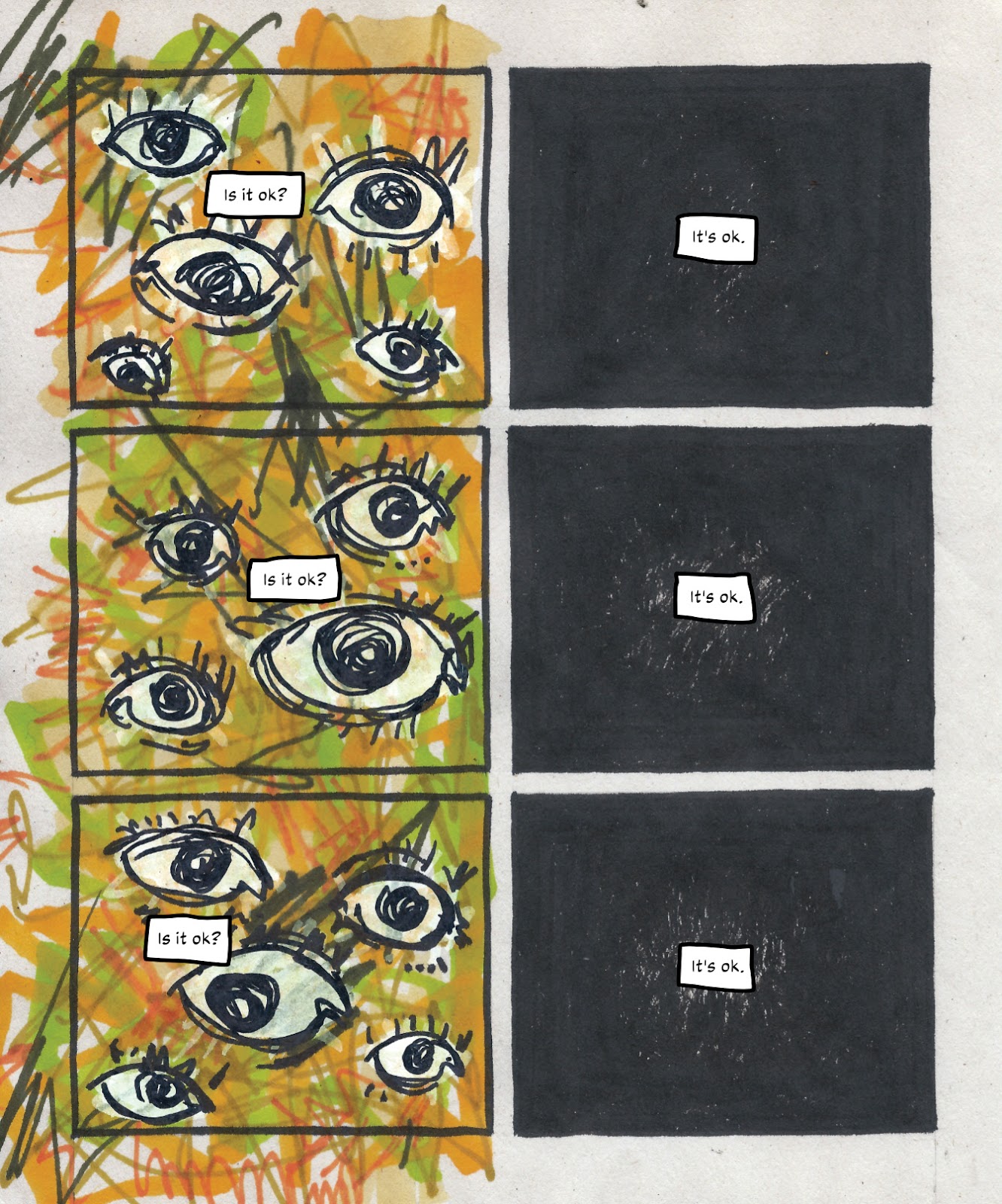
I’m feeling too close to the page to add much to that right now. What I will say is that the fine art element is in full effect here, as it always has been with Briggs comics, but that The Return is their most immediate experiment in autobiography so far. The tactile aspect that’s always been there in their use of collage matched here by the immediacy of the line, the shape making more urgent than ever; reading all of these strips in one go, it’s possible to feel like the art is streaming directly into your brain.
Read the rest of this entry »La-Tues reviews: Starman #81, Amazing Spider-Man #618
January 26th, 2010
In the dying light of the comic week…
 Starman #81 by James Robinson, Fernando Dagnino, Bill Sienkewicz & Matt Hollingsworth
First up, art sentence: the art looks fucking doss, because it’s drawn – inked, but whatever (no-one survives a Sink-ink, except John Paul Leon) – by Bill Sienkewicz and therefore looks like Bill Sienkewicz, which is fucking doss, and also Matt Hollingsworth colours it and he is the best colourist, especially at the murkier end of the palette.
(Seriously, if you want to say a Bill Sink comic, any one of them – if you want to say “hhm, not sure about the art” or, I don’t know, it doesn’t matter, fact is: if you want to say something like that you are making a dick of yourself.)
Right! Comic-reviewing credentials, I think you’ll agree, well established this is a pretty interesting one; I pre-reviewed it as “James Robinson pisses his final chips, probably”. The chips being his credibility as a once-capable, fan-favourite writer. The chips being a casino metaphor. The chips being how I – in my opinion which is valueless (beyond or beneath, you the reader may interact and decide, it’s the new format) – how I feel about James Robinson. As a human being. What his worth. To me.
Is?
And actually, to my surprise, James Robinson did not piss his final chips but instead turned in a thoroughly decent comic for probably the first time since he last wrote an issue of Starman, eight-and-a-half years ago. I say probably, I’ve not read all of them – six or so, it felt like infinity, of the most time-dilatingly dull Superman comics of all time, which considering the average standard of dullness in Superman comic [fucking dull, broseph] is likely an achievement of some moment and an eight-issue run on Batman as a lead-in to Morrison taking over the title, something I hyped myself into believing was half-decent due to overexcitement, and then I quite reasonably stopped reading them, the James Robinson comics, but man o! Some people read them for me. Others showed me pictures. And I don’t want to, look – I’ll be out the door before we turn into scans_daily or you can put me in the crosshair, aim-for-the-heart – I don’t think it’s necessarily fair to take things out of context and rudely and roundly condemn, but I’m pretty certain nothing else in the latter Justice League issue could conceivably make up for murky-depthy chats with Zombie Doctor Rapelight. It would take a bit of doing, over several comics, to redress that little soulquake.
So, but this is okay, this comic? It’s pretty okay, I would give it three to three-and-a-half brains; yeah, call it a 3.5er for the art. It is, it transpires, a welcome return to Opal City, it got me to reread Starman #80 for research (Research! You must always do research if you wish to be a critic on the comics blogosphere) and that was… I totally loved doing that. That hit just about every right note that a DC superhero comic should or could upon closing, it has a touching tribute to Archie Goodwin in the back, it’s really quite an emotional experience, I got quite Mist-y. This ain’t colour-of-nostalgia speaking; I was quite bloody miserable in 2001, and understandably concerned the years might have taken a sheen off somewhat, but not excessively, treasured memories of Starman, the original series, sections of which had already proven trialsome to go back and reread. Batman/Hellboy/Starman – you’d be right to expect that to rule, how could it conceivably not, but it’s bollocks.
This issue (whose contents I am going to discuss not at all, except to say for a more authentic feel there should have been a lot more misplaced boldface stresses) proved that, to some degree, James Dale Robinson can still write a comic. So why isn’t he? I think he – and bear in mind, if it need be said, that this is wholly supposition, I know not how a sausage is made nor the sausagemakers – like Brian Azzarello writing Doctor Thirteen, was not really a fan of – not in love with – superhero comics, but rather of the past and of antiquities, and like Azz utilising obscure, pointless bands that he loved anyway to write obscure, pointless superheroes that someone presumably feels likewise about… basically that was what that was about, Starman. That was an actual asset, not to be in love. The past, its ochre, its eternally dissipating hue, and it worked for the most part; it was was informed by this, there was its foundation. With the other DC books, it’s like – there’s no ‘there’ there, as they say, nothing underlies them, and they read like editorial-driven shitfests, they really did. As if script-notes have come back saying “make more odious“/”not enough tedium“/”I didn’t feel ruined as a person by this experience, can you juice up the miasm of despair a bit?“, etc. It’s a confluence of knowing popular American comics are writer-driven at the top-end and a desperate drive to continually rebrand the subsidiary’s sole assets that’s led to this end; it isn’t working in this case, just as it never does with Peter Milligan, who can at least turn in a half-decent, no more, no less, Batman comic. James Robinson wrote Leave it to Chance. James Robinson wrote London’s Dark. I can only imagine he is doing a lot better out of comics these days, and this issue just about earned it for the first time in a long time. (BB)
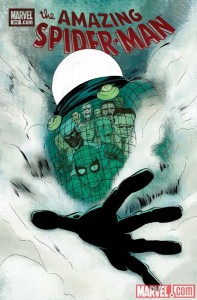 Amazing Spider-Man #618 by Dan Slott, Marcos Martin & Javier Rodriguez
When does a comic stop dealing in long standing conventions and veer headlong into a brickwall made of pastiche? That’s the question I found myself pondering after reading Amazing Spider-Man #618.
I’ve enjoyed much of what I’ve read of the new Spider-line, but I have to question whether it’s appeal is particularly healthy. The focus on new new villains and new old villains, the bubbly soap-operatics, the densely packed panels and incident filled issues. The spider-quips, love triangles, the Daily Bugle and Aunt May in peril. That right there is Spider-Man, and I’m absolutely certain that that’s what the line’s heavily editorially controlled creators want me to think.
In #618 we get a slew of baddies, multiple-returns from the dead including the return of two classic villains, evil Aunt May, yep that ever trusty love triangle (that includes the Black Cat), and more angst tha you could shake a stick at. Not only that but the art team treat us to Ditko-esque layouts, panel constructions, and line work, topped off with a sombre pastel colour scheme not entirely unreminiscent of the late sixties colour palette.
It’s true to say that none of this amounts to full-blown pastiche. A heavily diluted modern sensibility informs the book and provides much of the humour, but it does so at the expense of the verisimilitude. The book as a whole is just too knowing, too aware of the conventions on which it is built to be truly entertaining. There’s a fun of a sort to be had in recognising how the traditions of the spider-comic are being deployed and toyed with here, but it’s, if anything, a guilty kind of fun.
But despite these gripes they’re is something undeniably refreshing about this comic. Some of the cliched storytelling techniques on display couldn’t be more at odds with Marvel’s current focus on pseudo-realist psychology and emphasis on plot over incident. Soap opera and melodrama aren’t without their faults but they’re not without their pleasures either, and the sheer imaginative brio embodied by the line’s spider-foes is commendable in and of itself.
So while this line of books and the hoary cliches on which it is built could teach other Marvel titles a thing or two about entertainment ultimately its role certainly isn’t pedagogical, and it’s hard to imagine reading something this beholden to its past on a regular basis. (Z)