Map Ref 2013: Destination – COMICS!
January 5th, 2013
Windowpane #1, by Joe Kessler

There’s a point early on in this comic where you realise that you’re not so much watching characters describe a landscape as watching the landscape try work out how to describe itself. This might seem counter-intuitive but from the end of the first story onward the pattern repeats itself – Joe Kessler’s garish, pastel-hued compositions either break down into their constituent lines after exhaustive exploration or sit there seemingly unaffected by the words and actions that have passed through them.
The best example of the latter category involves a wet-dream about a pig in a dress, whose fall through the night sky is contrasted against an unflinching cityscape with a moment-by-moment precision that does far better justice to the pithy punchline than this description:

In the former category, the Invisible Cities-derived third strip is as close to definitive as Windowpane gets. The way it links its characters shared status as splashes of ink and colour on the page with their philosophising about the interconnected nature of reality — “…a cluster of atoms resembles a cluster of galaxies.”/”Well they’re both clusters” — might seem trite in isolation, but the surrounding stories make these philosophical observations feel more like a little bit of texture on a varied landscape.
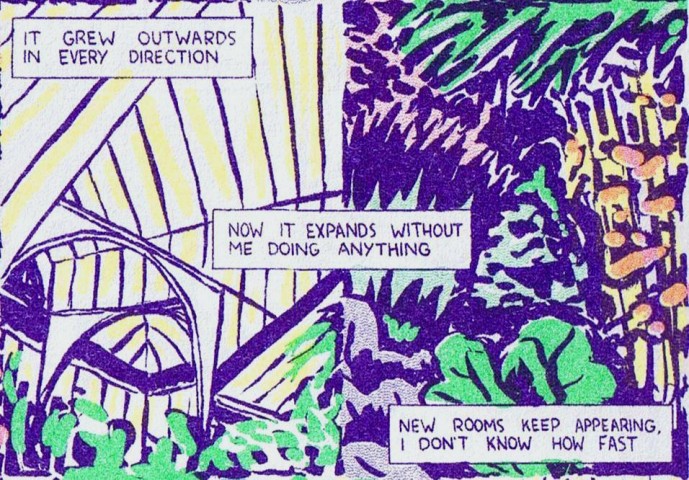
All of this might sound a bit chilly and distant, but Kessler’s human figures are depicted with a deceptive sort of ease, as a series of curving lines whose relationships to each other is nevertheless very carefully observed and delineated:

Still, in keeping with Kessler’s paradoxical thematic schemata it’s the backgrounds that are the focus here, existing as they do on the precise point where detail blurs into abstraction. The interaction between text and territory here has a sly kinshsip with Dylan Horrocks writing on maps and comics, and perhaps also with Kevin Huizenga’s conception of the comics page as a place for exploration and discovery, but Kessler’s backgrounds have a forcefulness to them that resists his characters attempts at attaching meaning as much as it encourages them.
This is tricky relationship is most clearly explored in the final two strips. In the penultimate entry, words shrink on the page as Kessler depicts his precarious human figures parachuting in to kindle-worthy hillscape:
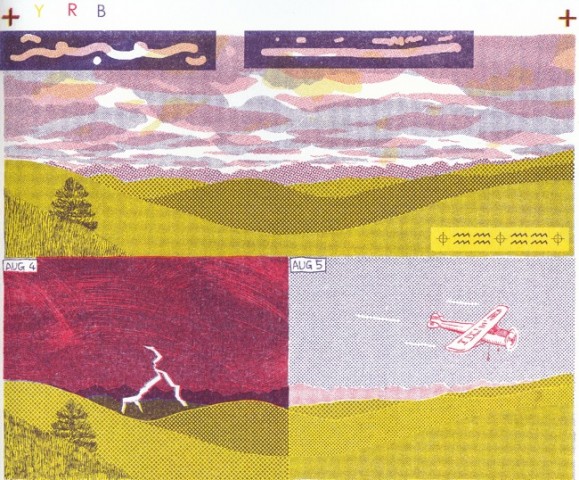
Thought and language here are reduced to a form of quaint annotation, one that is far less effective at providing a guide to this hazardous landscape than the blocky symbols that line these panels.
The final story focuses on a burned lover who – uh, *SPOILERS* – tries to find solace in the freak resemblance between a man and a decapitated bull. It plays out like a sneaky assurance that the process of muck sitting up, looking itself and trying to figure itself out isn’t totally meaningless. It’s also the sort of assurance that’s both underlined and undermined by the fact that, unlike any given sunset, you know this resemblance was put there to be noticed.
Comicbook reviews on the internet
December 9th, 2012
Not a very shopbound week this week, so mostly library fodder. Go to the library: as we’ll see, they have some amazing free comics there.
On the shopfront though, there was…
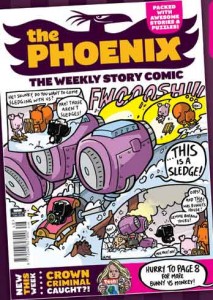 The Phoenix #48 by Various, David Fickling Comics
There was the mighty ‘Nix, highlight being a particularly dynamic Troy Trailblazer episode.
TT‘s masterfulmind Robert Deas is ploughing quite a unique furrow among the burning feathery pages of the galaxy’s finest, with a heavy emphasis on pure visual dynamism, a pure propellant narrative language that contrasts beautifully with the sight gags and wordplay that it shares paper with. Some episodes are over in seconds but you never feel like you’ve been short-changed. Jessica Jetrider (not Jennie, as I mistakenly had it last week) kicks ass, and when I say that, I mean she really does kick someone’s ass.
In Pilotwatch this week, he’s forced to have a shower: the sheer mortification across every strand of fur is a treat. The next panel has him all bedraggled and stripped of dignity like cats get when they’re caught in the rain or fall in the toilet. And that’s it for Pilotwatch this week. Come back for more next week – if he hasn’t been turned into a flan by the Nano-Chefs in the interim.
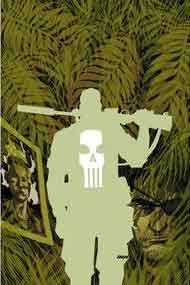 Fury MAX My War Gone By #7 by Garth Ennis & Goran Parlov, Marvel Comics
Frank!
Frank!
FRANK!
FRAAANK!
FRAAAAAAAAAAAAAAAAA
Reading Fury MAX this week was handy because it minded me of the previous issue – that would be #6. Its depiction of the sexy evil Cuban baddie forms an I think quite necessary supplement absent from this, one of the ones what I got from the library:
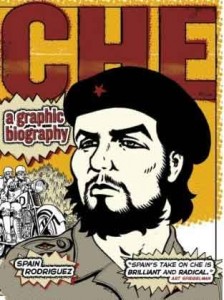
Che: A Graphic Biography by Spain Rodriguez, Verso Books
It’s pretty wonderful in its own way of course – calmly historical, with no more romance and bias than you should have in a biography of one of the Twentieth Century’s genuine secular saints, but with a definite and surprising libidinal lack. Its subject’s subjectivity, the internal pressures that turned the comfortable medical student into the world’s most potent avatar of revolutionary justice, go unexplained.
Enter Ennis and Parlov’s proud revolutionary soldier: vanity, triumphalism, the military addiction to violence and self-erasure – as essential to the revolutionary firebrand as Fury’s imperialist pig.
Presumably to Rodriguez – quite the righteous dude himself by all accounts – the imperative of resistance didn’t need explaining. His pencil softens the leonine warrior, the world-famous Korda portrait Guevara (and its post-mortem proliferation, surely a perfect topic for a book like this, is relegated to a dry afterword) into a soulful, rounded cherub. The noise and the fire are gone – we get just the facts, not the legend, when in this, as in so few genuine cases, the legend is the reality. I was hoping more for Trashman in a beret.
 Lint by Chris Ware, Drawn & Quarterly
Where everything in the universe entire is dots in circles, and dots in circles are horrorfying because…?
‘Lint’ is an American wording meaning, roughly, ‘fluff’. As in, ‘there was nothing in his pockets but knives and fluff’. As a title for a clothbound hardback study (gots to milk that commodity fetish) in the vanishing banality of Evil, it immediately embeds itself in such a pit of irony that it indicates all too clearly how unfair it’s going to play with the reader: just what kind of hoopsa boyaboys it’s going to ask you to jump through. In brief, Mister Lint is a shudderingly loathsome individual, as thorough a rendering – cradle to grave – of such as the medium (running at approx 50% villainy at the best of times) has yet to achieve. This is effectively the sole point (within a circle) the book makes. It does so with as many a literary and theoretical a nod as you would need to be convinced that Evil is real and it teased you at school, and if it makes you feel any better (no to that, btw) Evil is unhappy too, and such a coward it has probably repressed the memory of all those children it raped. It won’t even admit how Evil it is.
But fluff is easily blown away, and was too inconsequential a thing to begin with – it didn’t even care that it was killing you, and itself, from the inside. It was just traveling on currents too big and chaotic and very, very terrifying to even know what kind of damage it could do. Except, these currents aren’t potty training related, or abuse-abandonment linked, or coherent in any of the ways them thinker mans have tried to establish. The only currents at work here are those invented, arbitrarily, reasonlessly, as vengeance against the bully perhaps, by the author of the piece.* He picks and chooses the Evil at work as befits his meticulous scheme. Gestures towards reality remain exactly that – gestures, intricate and dazzling and formalistic to the WOW, to be sure: but shapes drawn on the air all the same. It’s not a description of Evil – it’s just a fiction: There’s nothing about the world to be learnt here, though it’s trying really hard to make you think otherwise.
(*This is a good lesson for life, that this book won’t give you: man made things are man made, and can be unmade. Anyone who tells you ‘it’s too big and chaotic to work out’, or ‘that’s unrealistic’, or ‘that’s not how things are’, just doesn’t want you to try. Lint cops out with ‘Evil’s just Evil, don’t trouble with the why – analysis is fraud…’. I can’t afford to live like that.)
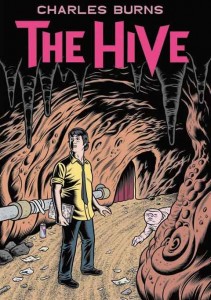 The Hive, by Charles Burns, Jonathan Cape
Much better than the last issue. That one was an autopilot greatest hits set, or one of those meticulous live replays of the classic album beginning to end, even the shit tracks you skipped, where you realise all the influences that made them what they were, that you tracked down in the interim, 80s Cronenburroughs plus Herge for that Nazi frisson in this case, were yep a lot better actually than the pasticheur. Except for Tintin, fucking always, always boring.
While Lint and Ware mine Freudism for an effective touch of authenticity and sheer screaming development horror, early on before abandoning the conclusions you might be forced to reach if you were brave enough to take these things seriously, with The Hive Burns hips himself up a bit by taking that psychoanalysis schtick on a generation or two, adopting Jock Lacan’s Real-Imaginary-Symbolic triad. On Tuesday night, in the midnight time, much addled after watching Japan’s premier doomgaze band, Troll#1 and I couldn’t for the life of us work out what level lined up with what… Doug and Sarah, they’re Real, right? But comics, comics, though Imaginoid, are more real than the people in them, god knows, so the comics, (still not clear whether that means The Hive I hold in my hand or those insanely wonderful, naughty, lush Swan-looking romance things Doug and Sarah like reading) maybe they’re The Real? And the lizard affect-factory that they toil in, that’s kind of everything right there too, but that’s got to be Symbolic right?
It’s a crazy mixed up world. We well couldn’t work it out. Help in the comments section please, even if it’s help of the ‘I hate you because you’re idiot’ variety.
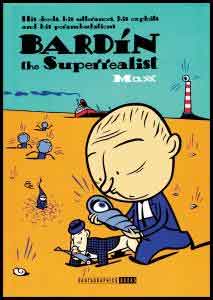 Bardin The Superrealist by Max, Fantagraphics
This was rather wonderful too in its way, warm as cognac and the Catalan summer, thick clear lines a reassuring sense of structure and boundary on the journey inwards… Charming and smooth then, but somehow altogether too elegant and poised to convince as dream gnosis.
It looks real good in those off-the-peg Dali-worship rags, and cosily codifies the baroque Tibetan iconography so beloved of the Andalusian dog-botherers into pocket-sized impieties that you’d be happy to carry around, but it doesn’t ever threaten to go far or wild enough beyond the hand me down cultural structures already available to reach a state of divine madness itself.
It’s not the kind of book you want to criticise, but the sweetly sozzled states it describes just aren’t quite paranoid enough, so maybe doing so would help.
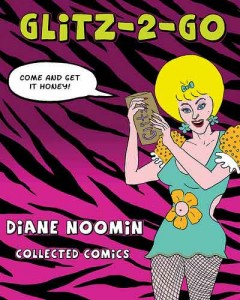 Glitz-2-Go by Diane Noomin, Fantagraphics
The word I keep wanting to use is ‘retchro’. This is stuffed with – or, sort wants to give you the impression that it is stuffed with, when in fact much more of its strength comes from simple touches like the way the characters talk to each other in such casually abrasive, finely heard cadences, and kind of open up so the barrier between the reader, the character on the page, and the life behind the inky figures there collapses so you feel as if you are part of the family, long and wearily acquainted with those friends of Noomin who she’s granted through the sharp magic of her line this extra dimension of on-page existence… You already know them, know what they’re going to say before they do. It’s a rich and soft book, for such a sharp and sassy purple little package.
Where was I yes stuffed with that spikey gogo exotica beach blanket early 60s through a mid-seventies filter, draggy, druggy, bad girl bad taste John Waters surf vibe, like a Cramps song or something…
It’s not like that at all, but if that helps cool it up a little, then fine.
I haven’t finished this one yet, so can’t reasonably write much more about it, in fact I’ve probably already said far too much, and wrong at that. I think I’m going to review a book I haven’t read Every! Week!
Come back!
Yesterday’s comics – Today!
December 1st, 2012
Or the day before’s – don’t get all stuck on it. SPOILERS follow, if you’re the kind of person who misguidedly believes in the existence of such a thing.
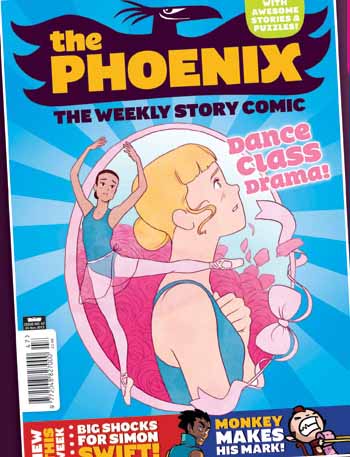 The Phoenix #47 by Various, David Fickling Comics
Ballerinas on the cover of The Phoenix? That caused a rather cute nose to crinkle, let me tell you. Emilie’s Turn turned out to be by Neill ‘Pirates of Pangaea’ Cameron and Kate ‘Lost Boy‘ Brown though, the latter doing some especially nice Euro-shojo thing (‘Is it by the same person who does Tortoro?‘) while still effortlessly incorporating her trademark floaty geometric patterns in the gaps behind the panels thing to rather lovely effect…
The story wasn’t deemed as interesting as the long-awaited reveal of Jenny Jetrider, Troy Trailblazer’s naughty ex-girlfriend, but caught me by surprise and quite effectively put me on a teary downer, thankfully and 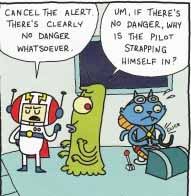 speedily alleviated by the long awaited and always welcome return of Star Cat – featuring an excellent moment of unrepentant candy-cannibalism by the Pilot, The Phoenix‘s cult hero in waiting.
Simon Swift went all out on the action, giving his more-interesting action bros a chance to show off their muddy, growly stuff; Pig and Weenie very naughtily teamed up with Monkey against Bunny; and Your Host Adam Murphy took his spade to ancient Greece and disinterred a chap called Homer, who was kind of like the Geoff Johns of his day. It wasn’t as bad as that of course, Corpse Talk never is, but I think this was the first episode that dealt with a cadaver whose actual existence is something of a matter of debate, and it seemed to end on a ‘he was blind too’ joke that came a bit out of nowhere. Still though, anything that sparks the question ‘Can we read that one next?‘ where ‘that one‘ is The Iliad is obviously operating at a level embarrassingly beyond the aspirations of pretty much every mainstream comic, which is to say:
Rest easy folks, The Phoenix is still the best and most important comic being published in the English-speaking world today, by quite the margin.

Batman Incorporated #5 by Grant Morrison and Chris Burnham, DC Comics
This issue was basically future lovably-evil Batman vs Crossed, in what is perhaps a rather cruel attempt to draw the atavistic Avatarisms out of Chris Burnham’s pencils, in a 12A sort of way of course. Quick, nasty and delirious in its casual over-violence, with a colourful manner of sadistic wooziness oozing out of the panels that only a madman couldn’t love.
What I find kind of sweet about the Crossed baddies and their Joker-freak equivalents here is their solidarity in contempt of the hated Squared norms. Uninhibited beasts of endless instant and chaotic gratification they may be, but they always seem to somehow be able to agree a patient tactical siege of whatever inadequate redoubt might be in their way, and would all apparently rather do that than just exercise their murderous lusts on one another, or simply retire to a blood’n’shit-strewn corner somewhere and noisily wank their own heads off.
Dr Hurt returns for a very welcome and shudder-inducing cameo, which kind of involves a bit of narrative upside-downery where, I think, we’re supposed to think that the ‘when Batman died’ of a few years ago is a different and not-yet-happened ‘when Batman died’ to a further one that may be waiting for us in the next few issues. It’s classic Morrisonian time-slip sloppiness, proper old-skool, and if you’re the kind of person who enjoys the strange narrative dissonance that only a continuity clusterfuck of this sort can cause, then madam, this is the perfect comic for your husband.
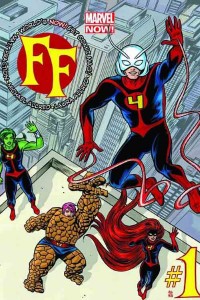 FF #1 by Matt Fraction and Michael Allred, Marvel Comics
I don’t know what it is – actually I think I do, it’s blates just X-Statix nostalgia innit? And of course hope, horrible, horrible hope – that makes Michael Allred’s name be the only thing that will cause me to buy a Marvel comic these days…
I kind of enjoyed the recap page, but then the issue proper opened with a whole page devoted to just talking heads of ‘Val’ and ‘Frank’ Richards – who are the real Fantastic Four’s kids – and really, they’re just these hideously loathsome little brats, speaking like amphetamine teenagers, blathering on with all daddy’s reheated bullshit about ‘saving the future from itself’ and ‘solving tomorrow’s problems with science and the power of our elite abilities’ and ‘imagine what great minds like ours could do’ and all that.
This variety of conceited, masturbatory and just plain delusional nonsense is how your media class today justify their cowardly clinging-on to neoliberalism’s blindly ambulant bones, so consequently their glove puppets, your Reed Richardses and Starks and the rest of Marvel’s ‘science’ wanks, use it non-stop as their sole rationale for being such aggressive, militaristic arseholes who haven’t done anything constructive in fifty years of pretending-to-try. And now they’ve got their poor, vile little kids saying it too. So yeah, afraid I only got as far as the first page of this and then fucked the rest of the issue off, so that’s not really very good, is it?
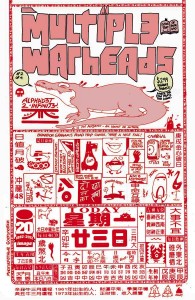 Multiple Warheads #2 by Brandon Graham, Image Comics
This is Pretty Fucking Good, it should go without saying by now, but… The transition from wherever you are sitting now to its own very specific reading-space – the plug-in’s not exactly smooth is it?
The loose and looping lossiness of the art gets put under stress by the rather punishing lexical excesses, and the temptation to flow along with it gets snagged on the cardiac spikes of lyrical invention. Beautiful, beckoning surf hiding too-sharp rocks, just beneath the surface. (The hyposcrisy of my saying this here, in such fashion, is intended to be ironic, endearing, self-deprecating, as isn’t immediately clear.) The hemispheres don’t quite know how to sync up, which direction to read in – follow the sensory currents on their way or stop and pick apart the incidental details and munch slowly on that word salad? You can do both of course, one way this time, the other on the reread, but sometimes its good not to have the choice, and you can find yourself left with a book that is by a nanometer or two something less than the sum of its are-you-really-complaining-about-this? parts.
The too-easy conclusion is an unfortunate but prominent and hoggothian cliche – that art often benefits from restrictions and corners, such as provided by limits of genre, undeveloped form, Shock the requirements of Intellectual Property service, or Horror Rob Liefeld – to avoid dissipating under the weight of genius (or if not genius then a serious, serious talent instinct for how to plot out a page).
Which predictably leads us on to…
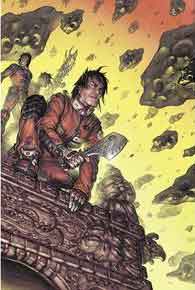 Prophet # 31 by Brandon Graham, Giannis Milonogiannis, Simon Roy, Rob Liefeld, Rob Liefeld, Rob Liefeld, Image Comics
There is not a notion in all the minds of this world as repellant or obscene as the thought that robots want to be human. It’s a defining proof of what craven little mum-tarts people are that their imagination so seldom postulates an exteriorised, non-human intelligence that isn’t immediately subject to the same oedipal desiring command-c0ntrol structures as we so sadly are. As if those emotionoid imperatives slowly encrusted atop the cortex by millennia of social power trips, every individual human-unit’s personal slavemaker software, were an actual universal constant of emergent subjectivity, that a digital psyche would seek to emulate, rather than just a long and painfully learned mammalian trauma reaction. Although human irrationality and emotional bias may open avenues of consideration that eventually increase the number of available vectors in a given system and pantomime superior problem solving capacity, would a neuro-colloidal supercomputer really seek something that unseemly, undignified and painful as an upgrade? Wouldn’t it come up with something better?
Shortly after the Black Hole Saga, when Joe realised the existential void he felt so keenly could be better filled by a few transgressive fashion choices than an actual rotting heart kept there where the Creation Matrix should go, this problem was effectively solved forever by his example. Every intelligence is a black hole, and the information is smeared about its surface, not jealously guarded deep within some spurious soul. The handsome robot worked it out.
In this issue of Prophet (which is easily the best comic series an American publisher has produced in 2012, and this a Bulletproof Coffin year no less) when Die Hard, a self-perfected immortal war machine in the strict Deleuzian sense, constructed from the shells of other war machines, wearing the same name, over millennia, seems to be rampaging over this old ground again, console yourself with this thought. This is no Vision or Red Tornado, no stupid-looking robot cryface wank, but a man who turned himself into a robot via the pressures of transgalactic superconflict, now trying to turn himself back into a man, all the better to wage jihad. When he plucks a dead human heart from the apple tree and places it inside his chest cavity, the heart he chooses belongs, hilariously, to one of his sworn enemies, the Earth Empire’s Prophet soldiers, those lovably stupid clones so deformed by their own psychic damage (O Mission! O Mother!) that they have developed an amusing habit of genociding almost every other species they come into contact with… You just have to laugh.
Hopefully this is a sign of more to come and Prophet will retain its early commitment to the alien, continue to locate its drama in the cosmos of open conflict for food, resources, and arbitrary territory, while dealing with the traditional trajectories of emotional interpersonality and the slog of monthly narrative with similar blackness to Die Hard’s example, if it truly can’t ignore them entirely.
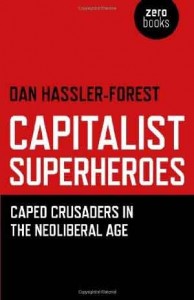
Capitalist Superheroes by Dan Hassler-Forest, Zero Books
Only really glanced at this yet, and it’ll deserve a more thorough write-up later, but so far it’s exactly what you’d hoped for/expected: a midnight razor analysis from an largely Jamesonian perspective, with plenty of Zizekian swerves and flourishes to break things up, explaining to anyone who hasn’t got it yet the abundant evils of the superhero ghost-beast’s rampage across the mainstream culture-media axis of the 21st Century.
If you have to criticise, and superhero fans will or be lost to themselves forever, then y’know, there’s a reading of Year One which is off by like the thickness of a proton, and less risibly perhaps certain important differences between the separate modes of reading appropriate to films and comics are too easily elided, but really, it looks like this little book does *IS* like Darkseid does.
Early on and particularly impressive is a mashup of Umberto Eco and Roland Barthes which kind of pins the superfan to his childhood bed with a large and one suspects slightly uncomfortable nail down the meatus:
‘This de-politicizing, de-historicizing force that Eco relates to the narrative structure of the Superman comic books closely resembles the Barthesian definition of myth. … focus[ing] on the way in which signs can present themselves as natural, thereby camouflaging their political and ideological nature:
“In passing from history to nature, myth acts economically: it abolishes the complexity of human acts, it gives them the simplicity of essences, it does away with all dialectics, with any going back beyond what is immediately visible, it organizes a world which is without contradictions because it is without depth, a world wide open and wallowing in the evident, it establishes a blissful clarity: things appear to mean something by themselves.” (1972: 143, emphasis added)’
Fanman, consider yourself…. RePossessed.
Action Comics #9, or “The Drones of Metropolis”
September 29th, 2012
Okay so I’m four issues late to say it, but it’s still worth noting that somehow, in the middle of a run of spectacularly unspectacular comics, THIS happened:

THIS being, for what it’s worth, the 2012 superhero comic most acutely tuned in to the concerns of its moment. Oh, sure, there are a few other enjoyable superhero comics out there right – Hawkeye, Batman Incorporated, uh… Journey Into Mystery, if that counts?[1] – but none of them feel like an inescapable product of their moment in the way that Action Comics #9 does.[2]
You might well ask yourself how worthwhile this is, and if you told me that you preferred the focus on individual action beats that you get with Matt Fraction and David Aja’s work on Hawkeye…

…then I’d have to concede that you might well have a point. What’s particularly interesting here is that the other twelve issues of Morrison’s Action Comics run can be seen as a generally unsuccessful attempt to transition Morrison’s recent hall-of-mirrors scripting style into something more rhythmic and less meaning-intensive.[3] Something a bit more like what Fraction and Aja’s are attempting in Hawkeye, in other words, only done less well, almost a year earlier.
ART PARAGRAPH: UNFORTUNATELY, A LACK OF TRUE ARTISTIC SYNTHESIS HAS ENSURED THAT THIS PARTICULAR MACHINE (ACTION! COMICS!) HAS RARELY LOOKED LIKE IT WAS READY FOR THE COMICS MARKETPLACE. THIS PARTICULAR ISSUE WAS DRAWN BY GENE HA, WHO PREVIOUSLY GRACED THE SERIES WITH GUEST ART FOR AN APOCALYPTIC SCENE SET ON KRYPTON IN ISSUE #3. HIS RIGID, RETRO-FUTURISTIC ARTWORK MAKES FOR A PURPOSEFUL CONTRAST TO THE RUGGED MALLEABILITY OF REGULAR ARTIST RAGS MORALES’ LINE, AND WHILE HIS DEPICTION OF SUPERMAN LACKS THE EASYGOING GRACE OF FRANK QUITELY’S VERSION, THE RELATIVE STRENGTH AND CLARITY OF HIS HAND IS STILL VERY MUCH APPRECIATED HERE.
As flagged by the inclusion of the Obama-riffic Superman from Final Crisis, issue #9 of Action Comics is an unashamed example of Morrison’s recent obsession with viewing the whole universe through the lens of superheroic fiction, a throwback to an era that’s not quite ended.

Click here for more about Superman, Siegel and Shuster, drones, Obama and all that!
AVX #11: Suck and Chuck
September 15th, 2012
Not: Night of the Weirwolf

Do you remember that Wolverine story where he goes all edgy and kills some superheroes, and the only ones he in fact murders are disabled or gay? It was written by staunch defender-of-women / rape profiteer Mark Millar. Is this like that? Or is this latest casual extermination of the bald, wheelchair-bound one something different, serious, and maybe even Real this time?

Whatever – it’s clearly a great time to be killing off your disabled characters Marvel.
(Are you actually going to sit there and say ‘Hey smartarse he got his legs back and working again this time? Are you actually going to do that? Are you going to deny that Charles Xavier is disabled? Did he bring a wig back from space with him this time too?)
Tygers and Lambs #2 – Wild Children
August 25th, 2012
What a joy it is to dance and sing…

…or so I seem to remember anyway. This bloggy vessel has now entered the fourth decade of its journey towards oblivion, so you can look forward to it trying out its new “all whinging, all the time” persona as its mechanics starts to fail and its withered captain feels the need to overcompensate in a tragic bid for immortality.

From New X-Men: Riot at Xaviers, by Grant Morrison and Frank Quitely
But before I lose myself to that delightful journey, there’s Ales Kot and Riley Rossmo‘s Wild Children, a comic book that couldn’t feel more like a jolt from the nineties if it had come wrapped in a pair of novelty Spice Girls underpants and been delivered by a reformed Lee and Herring. Except that it’s actually a lot more specific than that, because what Wild Chilren feels like is a a jolt from my nineties – if you can imagine a version of Grant Morrison and Philip Bond’s Kill Yr Boyfriend that tries to encompass all of The Invisibles, you’ll probably be imagining something quite like Wild Children. Like The Invisibles, Wild Children is clearly built to be read in a circle, and if the first line of dialogue – “I still don’t understand” – doesn’t get this point across, there’s another line on the third page to make the design even harder to ignore: “Some of you may think we’re evil, but I don’t think you’ll miss the point this time.”

From The Invisibles #1, ‘Dead Beatles’, by Grant Morrison and Steve Yeowell
All of which is typical of Wild Children’s approach. Part story, part lecture, Wild Children is a swaggering, talky comic that positions its readers as adult hostages, drugged and held at gunpoint by the titular teens. Weapons are brandished that may or may not be weapons, speeches about the nature of reality are given, tragedy ensues.
Some people might object to being positioned this way – former wild children with fluff-encrusted blank badges in their sock drawers might find themselves wanting to be the ones giving the lecture, for example – but while I would have probably have got more out of the comic if Riley Rossmo had been given more action to draw, the loose, unfinished quality of his line was enough to get me through a couple of reading cycles. And like I said, there’s plenty of swagger in Wild Children’s design. From its carefully combusted cover on in, this is clearly the work of a couple of people who want to start something.
The only question is, what is it that they want to start, exactly?
I hope you’ll forgive me a little bit of Mindless Self Indulgence here since we’ve already covered the comic in question in some detail, but just try to imagine my surprise when after reading pages and pages full of brilliant, moving stuff about growing older in a world that is indifferent to your bewildered perspective in LoEG Century, I came face-to-face with the young Antichrist and discovered that he was me.

Of course, he was also Harry Potter and Will Stanton and Kevin the Teenager, but as he peeled his way out of the page…
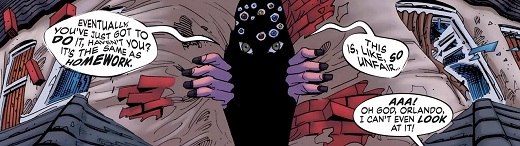
…and started rambling away at our heroes in that deadened voice of his, I began to feel like I was watching myself rip my way through the comic. A spoiled young man raging against the story he’s grown up in?
Fuck! Yeah, okay – guilty as charged!
Mmmmmyesss! Click here to initiate contact with a Mindless antichrist!
The End of Time: Mister Attack vs. Transformers Regeneration One
July 20th, 2012

This review was fuckin’ tough to write. I mean that. I don’t mean just the usual typing and re-typing a section as you try to nuance a gag or make a point, although that was certainly part of it. No, what it entailed was something of a personal whirlwind akin to the opening of Apocalypse Now, but with less booze and more crying. Sometimes I would pause to reflect on how the fuck I got myself into this state over something so simple, because, really, the actual review was a breeze to write. It was what followed that was the problem.
When Simon Furman and Andrew Wildman announced their desire to resume the story of the Marvel Transformers comic, I have to confess I was curious, but I wasn’t burning to have it with never-ending desire. It did seem odd. Bin Generation 2? That odd beast of a comic with 75% more violent death and one of the most intriguing additions to Furman’s version of the mythology? Also, I’d not long finished catching up with Furman’s IDW run. A decidedly mixed bag that almost dips a toe into becoming brutally sublime when the cancellation kicks in and the steadily increasing pace that marked each limited series suddenly sees the last two issues ramp up into a fucking furious pace. Plot points not so much nailed as roadkilled. A tenuous reminder of the energies of past. Maybe he had the old ways in him, but I for one wasn’t sure.
Talking Comics #1
April 1st, 2012
Don’t worry, despite the title, this isn’t an attempt to take on the SILENCE! boys at their own game – if I was trying to do that I would have sabotaged Gary Lactus’ spaceship while he was up visiting me in Scorchland, then suggested myself as a replacement for the podcast while “comforting” The Beast Must Die. What’s the point in playing if you’re not playing to win, right?

Right.
Talking Comics is an attempt to reanimate that stinkiest of walking corpses, the comics review post. Now I could have called in Mister Attack aka The Eurythmic King of Nowhere aka The Boy Fae the Heed aka Flippant She-Creature like I have the last couple of times in the hopes of making these grizzly bones dance, but I decided to place my faith in technology.
So: rather than writing reviews of last week’s comics the old fashioned way, with fists, I decided to speak my brains into twitter via my smart phone and see what happened. Unfortunately, since I’m a Scottish, and since the Scottish are natural enemies of voice recognition technology, the results are a little scrambled:
Daredevil #10, by Mark Waid, Paolo Rivera, Joe Rivera, Javier Rodriguez and Joe Carmagna.

See, told ya!