The Function of The Filth – Preview #2
November 28th, 2014
In last week’s instalment of THE FUNCTION OF THE FILTH, we skipped straight to the “violence” part of the equation. This time round, we’re dealing with sex, because sex is always important in this sort of story.
This sort of story? Well, try not to stop me if you’ve heard this one before!

There’s this guy who wakes up from his mundane life to discover he’s really a disturbingly important human being – maybe the most disturbingly important human being – rather than just another boring arsehole with bad hair. Inevitably, he’s a little incredulous about the whole thing to begin with, but as one world crumbles away he soon starts to find himself more at home in his new reality – and it’s almost always his new reality, whatever complications may arise further down the line.
This detail tends to narrow down the rest of the possibilities of the story so that at least one attractive woman will usually be involved – the idea of “normal” being what it is, can you think of a better way to ensure that the transition from the “real” world to another, more overdetermined world goes well? Cosmic purpose on its own isn’t enough: if the switch over is to be successful then the deal must be sealed with flesh. For this price, plus teleological extras, our hero finds it within himself to be all that he can be.

This story is called The Matrix, or maybe Star Wars, or maybe even Wanted. For all their differences, these stories are all equally at home in the pages of comics and on cinema screens, in visual media where they can best present the dreams of their audience back to them as a dressing up kit, a series of moves or tools or attitudes that can be easily copped and used to remake the world. These stories represent the transformation of dreams into merchandising, and as such their tropes are as easy to critique as they are hard to resist .

But did I say we would be talking about sex instead of violence this time? Yeah… let’s do that!
The Function of the Filth – Preview #1
November 21st, 2014
Fresh from Thought Bubble 2014, it’s the one chapter preview of THE FUNCTION OF THE FILTH, my forever delayed book on Grant Morrison and Chris Weston’s best comic, The Filth, to be serialised in five posts corresponding to the five positions of The Hand!
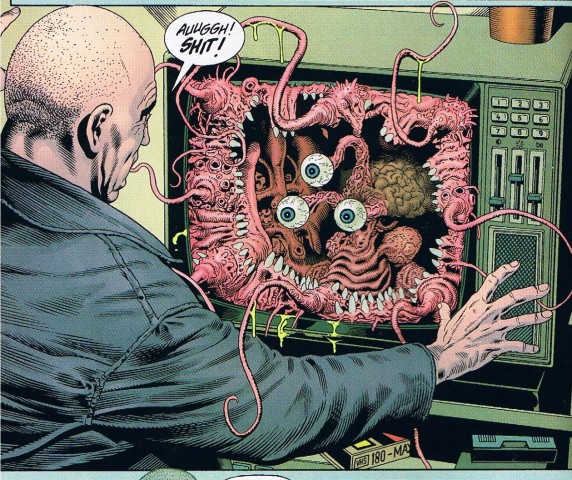
CLICK HERE TO PEEL BACK THE MONITOR SCREEN AND PLAY WITH THE GOOPY MONSTER UNDERNEATH
The Multiversity #1
September 15th, 2014
There’s always a danger in reviewing the first [issue] of anything, of course, said the wise man. Yeah but fuck it mate seriously who cares? There’s your fair warning so. What follows may get silly.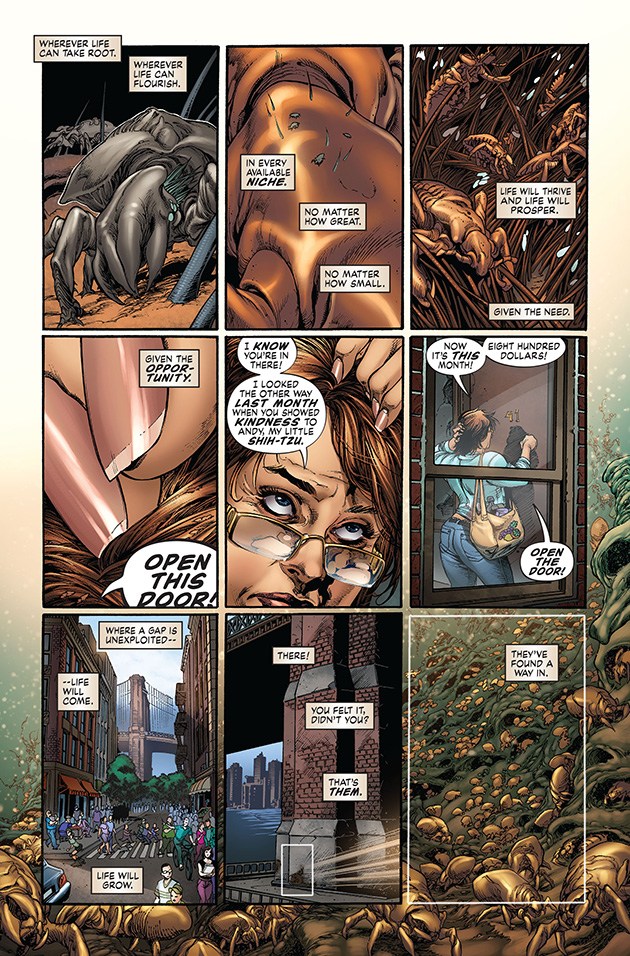
The Multiversity 1
August 22nd, 2014
10:22 PM, I get an email. “New Arrival! BoJack Horseman is now on Netflix”
10:24 PM, I open the comic. The first page on the inside is an advert for BoJack Horseman. It has today’s date on it.
Enter the Multiversity
July 29th, 2014
A brief thought on Grant Morrison’s work that I might disown in the morning…

While hyping his upcoming Multiversity mini series for DC (at least half a decade in the making, and from the sound of it pages are still being done), Morrison has made reference to the Stan Lee method, in which the comic makes the reader an accomplice in the story.
Here’s the man himself, making some typically bold claims for his adoption of this technique in Multiversity #7, Ultra Comics:
I’ve used a lot of hypnotic induction. There’s an old trick that Stan Lee used to do — it was quite popular at Marvel — of the comic talking to you. I took that and this thing, and I think we’ve actually created the world’s first actual superhuman being, which you’ll see how it works when you read this comic. Then the world’s first super human being on this earth has to fight the most malignant entity. So the bad guys in Multiversity who are attacking the entire multiversal structure are also attacking the real world, and this comic is their only way through right now. So it becomes the reader versus the bad guy on the page. I think it’s actually quite scary, this thing. It scared me!
Prismism
July 28th, 2014
With Grant Morrison’s Multiversity finally on the (candyfloss)horizon, he’s been doing some interviews in support of the book on The Comics Internet. You remember The Comics Internet, right? That place you used to go to discuss comics after you got sick of chopping up old issues of Wizard and randomly inserting snippets of inane commentary underneath pictures of classic (#classic) alt comics in TCJ, but before you resorted to gnomic twitter commentary and/or listening to a seemingly endless supply of podcasts while wanking/doing your housework/riding the bus?

The topic of the Prismatic Age of comics came up during one of these press adventures, with only a little bit of prompting from the interviewer from Comics Alliance:
Grant Morrison: Unlike Seven Soldiers… that was a lot more modular. This one is more of relay race, that was the structure we built because each universe is reading the comic books from the previous universe, and that’s how they learn about the threat, basically. It’s more like a chain. It doesn’t have the same intricate jigsaw pattern as Seven Soldiers. It’s quite linear, this one. I wanted to do something quite linear and simple and everyone could “get” this time. This one is for people who’ve never read DC before but want to get into this gigantic maelstrom of characters and versions of characters; the prismatic world of DC.
Comics Alliance: They call it the “prismatic age.”
GM: Yeah!
As long time Mindless readers will already know, this term originated in a couple of posts by our own Botswana Beast. Good little virus that it is, the idea of The Prismatic Age has infected comics fans and academics alike, and if you’ve so far managed to avoid contagion, I’d recommend you do what all the cool kids were doing six years ago and expose yourself to the Bottie Beast!
Here’s a pre-amble, in which BB talks useless taxonomy in A Hall of Mirrors!

A tasty wee taster, just to get you started:
The ideology of the Prismatic Age, what it insistently moves toward, is that all parts are active, all of the time. While not necessarily visible monthly, nor are they hidden or overwritten – this was the notion of Hypertime, never fully realised but approached in the much-loathed-for-rule-breaking Kingdom. Summary of all incarnations, a distillate. This is partly what I find so terribly aggravating about the PopMatters piece that set me on this path many moons ago, apart from its attempts to cloak in inscrutable terminology a daft enthusiasm for two largely consequenceless and really quite markedly shit event-books from last year, is the lack of understanding of either superheroes or, really, the postmodernism it touts. Postmodernism is largely about (oh-ho-ho, I am going to tell you what postmodernism is “largely about” on a comics blog,) textually, shifting loci on a subject, a lack of definitiveness in portrayals and readings – to read Civil War(!!) as somehow having achieved a permanent destabilisation of the superhero archetype because it wasn’t about a binary black & white bone of contention?! No: that ship had long since sailed, it was a pirate ship in a comic read by an African-American child beside a fire hydrant, and the sole difference was that it was big duopoly franchise comic events that were dealing, ham-fistedly of course, with the supposed issues: none of which were terribly worldly, one of which was sort of, if you squinted, slightly topical. Boring, kneejerk Dark Age scions, really – Civil War literally ordains the Keene Act, for Rao’s sake! The spirit of this age seems to me throughout to have been essentially one of recapitulation and of remixing, in this case 2006 remixed 1986 badly – but this is also how you end up with Batmite as a Jungian portent of impending demise.
Check back tomorrow from more Multiversity pre-amble, because apparently I quite like The Comics Internet, when I remember that it still exists!
Freedom, 1984: The Key by Grant Morrison and Rian Hughes
May 4th, 2014

The interesting thing about the free, original comic that Rian Hughes and Grant Morrison created for the BBC’s freedom2014 season is that the very qualities that make it such an effortless, immediately accessible read are also the ones that leave it feeling quite trite in the end.
They don’t hand out Comics Critic Oscars to anyone who still feels the need to point out that Hughes’ art is heavily and beautifully design based in 2014, but Morrison makes expert use of this aspect of Hughes craft throughout this strip, artfully reducing ”big ideas like freedom, meaning, what we’re all here for and why” down to a brief flurry of scenes and images in which the fate of a hooded figure inspires the general public to collectively realise their individual agency:
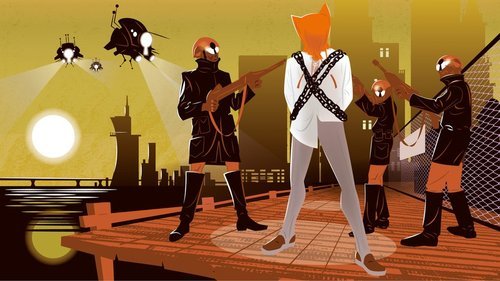
The Key, then, is not a story about freedom but an advert for the idea of freedom. The BBC quoted this line on their website, and sitting on its own it carried the vague air of approval, so to be clear: in saying this, I meant that it had about as much to do with actual freedom as the famous 1984 Apple advert. All the craft on display here is put to the purpose of making sure one Key fits all readers, and while the counterargument would surely be that this smooth quality allows the reader to project their own meanings on top of this scenario I would argue that this immaculate surface would absorb all light that shines its way without giving much of anything back.
And what use is a dystopian fiction if it doesn’t disturb, reflect or challenge our present reality in any meaningful way? The Key Morrison and Hughes have created here doesn’t refer to any actual map; if we recognise the symbols in it, then that’s only because they look like the mental shorthand we’ve created as a guide to other stories on the same theme.

To put it another way: the masterful evocation of The Key would be perfectly at home in an issue of Seaguy, but it would never be an issue of Seaguy.

I’m surely not alone in having bemoaned the fact that much of Grant Morrison’s best work requires a prior investment in comics to be fully engaged with. With considerable help from Hughes, The Key builds out any such issues, but in doing so it also removes any of the struggle that makes so much of Morrison’s work worthwhile.
***
(This article was originally posted at the end of March, in a slightly different form, on my Tumblr.)
Mindless Defectors on True Detective
April 5th, 2014

Still fired up from February’s discussion of what’s worth watching on American TV, Mindless twinset Mark (Amypoodle) and Adam (Adam) have written an Experts Guide to HBO’s ‘True Detective’ and weird comic book fiction for Comic Alliance.
There’s a lot of great stuff about Alan Moore, Grant Morrison, H.P. Lovecraft and Thomas Ligotti in that post – if you’ve read any of Mark or Adam‘s stuff before, you’ll know what to expect, and if not you’re going to enjoy finding out!
“I should hope my writing appalls and horrifies you.” — The Phil Sandifer interview
December 21st, 2013
One of the jokes that the other Mindless Ones have about me is that while I often complain about not having written enough, I’m ridiculously productive (I write two or three books a year, on average). They only make this joke because unlike me, they don’t know Phil Sandifer.
Phil recently released TARDIS Eruditorum vol 4, the fourth volume of his look at every Doctor Who TV story (and many of the books and audios), A Golden Thread, a critical history of Wonder Woman, Last War In Albion Chapter Four, the latest in a series of short ebooks charting the parallel careers of Grant Morrison and Alan Moore, and Flood, a book in the 33 ⅓ series, in which he and co-author S. Alexander Reed look at the classic They Might Be Giants album.
And by recently, I mean in the last two months. He might have released something else since I made that list — I haven’t looked since lunchtime.
Much, though not all, of his work is serialised on www.philipsandifer.com (where I’ll be doing a guest post next week on Final Crisis, incidentally) and readers of Mindless Ones will, I’m sure, find it worth checking out.