For London <-|-> From Hell
November 12th, 2015
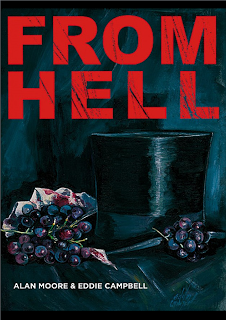
The following post was written as a response to The London Graphic Novel Network’s discussion of From Hell.
Here’s Graphic Novel Network/Kraken bod Joel‘s final flourish, just so you have some idea what I’m arguing against:
when I read [Moore’s] stuff I get the feeling is that nothing has been lead to chance and everything is designed for very definite and exact reasons you know? If other comics are a little jelly and playful and “make your own mind up!” – Alan Moore in a labyrinth of cold hard steel: arranged in such a way that the only possible stance you’ll allowed is that of a mouse – desperately trying to find its way to the piece of cheese at the end.
And here’s my response:
Joel, the way you describe Alan Moore’s work there makes it sound hugely unappealing. I don’t think your account of how his art works is fundamentally untrue, mind, but it makes his work sound awful, tyrannical even – “Imagine being held in the iron grip of The World’s Mightiest Beard… FOREVER!”
And yet… the sense of total control is undeniably part of Moore’s appeal, always has been. It’s there in the famous grids of repeating imagery in Watchmen, in From Hell’s attempts to draw together an occult history of murder, in Promethea’s attempt to overlay scientific theories on Judeo-Christian creation myths. It’s even in the carefully synthesised pulp that fuels relatively Thrill Powered works like V for Vendetta and Halo Jones and (why not?!) Crossed 100.
It’s also the aspect that can curdle his attempts at humour, the thing that sometimes makes his self-consciously light and playful comics feel like anything but, the… oh shit, is this why he always crams those bloody songs into his comics? Is it the final test of his mastery, the compunction to try and make you hear music in a comic? Will he manage it one day?
Maybe. Or maybe he just read too much Pynchon and smoked a little too much Tolkien before going to bed last night.

“Modern life is rubbish, here’s an 8,000 page novel about my garden.”
21 Statements About Comics Criticism from The Beast Must Die
November 9th, 2015

Fresh from his appearance at the debate on comics criticism at S.M.A.S.H. in London this Saturday (pictured above), here are 21 statements on comics criticism from The Beast Must Die:
1. Comics as an art form has the critics it deserves.
2. Comics critics are not as good as critics in other art forms.
3. Comics critics enlighten people about an art form that they might not know about.
4. Comics criticism lacks notable or significant figures in its canon; there are no Pauline Kaels, Harold Blooms or Roland Barthes [‘Bartheses’, surely?].
5. Comics critics are the best critics of all, because comics is an art form free of decades of critical debate and point-scoring and endless spiralling discussion.
6. Comics criticism is a place for juvenile people to snipe at each other pointlessly whilst keeping out strangers from their precious domain.
7. Comic critics who can’t talk about the art in a comic are no good as comics critics.
8. Comics podcasts are a popular avenue for criticism. They are the most ill-informed, badly thought out most lazy form of criticism.
9. Comics podcasts are a popular avenue for criticism. Comics podcasts allow for free-flowing conversation which generates genuinely interesting critical ideas.
10. Most comic criticism is on the internet, and as such often has little or no editorial input, meaning it is littered with mistakes, weak ideas and groundless opinions.
11. A lack of editorial input means that comics critics are free to think in original and interesting ways.
5 for Friday: Travel Is Dangerous
November 6th, 2015
It might seem counterintuitive to name a post about transport, technology, and the different ways we imagine ourselves hurtling into the future after a Mogwai song, but remember: I’m a life-long pedestrian, so like Mogwai I plod along at the side of your automated adventures, only occasionally encountering the violence of twisted metal or getting caught up in the wakes of your passing.

Ahem. Anyway, where was I going with all of this…?
1. Mad Max Fury Road
Oh yes. Here. Always here. If you were lucky, perhaps you woke up one morning this summer after your second or third showing of Fury Road to find Brother Bobsy perched on the edge of your bed whispering his Mad Max monologues straight into your dreams:
The Fury Storm sequence is key to the film’s intent, mapping a space unexplored by the previous Mad Max trilogy. Although climate change, nuclear summer, associated water/petrol resource crunches, and militarised neo-feudalism were all too predictable (or depressingly inescapable) from the perspective of the late 1970s, the history of cyberculture and networked existence went unforeseen. The Fury Storm rushes in to fill this chasm in Mad Max‘s rebooted version of tomorrow.
Imperator Furiosa nevertheless deliberately turns into the storm: eager not just for the camouflage, but the active tactical benefits it affords over her ill-protected pursuers: naked War Boys mistaking annihilation for apotheosis. It doesn’t matter how much they enjoy their lovely day, how they shout and confuse the heat of digital immolation for the light of false afterlife – the War Boys are getting torn into bits in there, while Furiosa and the Five Brides (plus Max himself) are only truly empowered to taste water and freedom after traveling through the storm’s event-horizon and its violent, chaotic multiplicities.
There are several contradictions built into the sort of immersive enjoyment of Fury Road that I’ve experienced – loving a movie that frames women as exquisite things while explicitly rejecting this worldview is complicated – but perhaps none are more fundamental than the sense of hope captured in the above paragraphs, this rapture of collaboration between bodies in a scenario where flesh and blood are just yet more commodities to be scavenged.
If you want to understand how director George Miller, Tom Hardy and Charlize Theron communicate such intense relationships through image and sound, Chris Ready’s your man.
If you need a more critical look at the film’s terminus point and treatment of the female passengers, the Kraken boys might make more suitable tour guides.
2. New roots for public transport
If you’re interested in identifying Fury Storms in our present moment in the hope of mitigating or better preparing for the bigger storms yet to come, you could do worse than read this Novara media piece outlining six meaningful ways we can work together to fight climate change now.

For the sake of this travel themed 5 For Friday, it’s the fourth option that’s most attention worthy here, seeking as it does to re-imagine the urban environment as a zone connected by free transportation (“There’s little need to burn fossil fuels to get around cities – if the right transport and energy infrastructure is in place”) and suggesting new sites of mutual struggle, such as those between environmental activists and public transport employees:
Opening up mass struggles for public transport also offers opportunities for alliances with transport workers – such as fare strikes/free rides, as pulled off by a collaboration between Occupy Wall Street and rank-and-file transit workers in NYC in 2012.
Developing and sustaining these relationships will no doubt make the spectacular coordination of Fury Road look like child’s play, but while you’d be foolish not to take the difficulty of a journey into account before embarking on it, that doesn’t mean that you should treat all difficult journeys as though they are impossible.
3. Autobanô
But maybe all of this talk of choosing your journey is just terribly outdated, what with automatically driven cars assembling in a secluded car parknear you right now. While the possibility of robots taking the jobs of professional drivers provided a new front for the debate about the relationship between automation and the world of work, it was this article on the ethics of programming cars to kill is the one that’s taken me captive.
The key line, for me:
People are in favor of cars that sacrifice the occupant to save other lives—as long they don’t have to drive one themselves.

In contrast to the toxic, dust-filled landscapes and radiation scoured pageantry of Fury Road, this suggests a very clean, carefully managed sort of dystopia. Think Cosmopolis as invigorated by J.G. Ballard – a future in which an elite class is driven around from one anodyne, too-easily diagrammed space to another, protected from the lower classes who populate the space in between by the clever programming and sturdy construction.
Action sequences in which driverless cars are programmed or hijacked have been part of our fiction for a while now, but for all my apocalyptic pulp rhetoric it’s the solidification of common human reactions that’s most unsettling here. We can perhaps understand people who make split-second decisions to put themselves first, but to specifically program a car to plow into a crowd of strangers in order to protect one passenger, to reproduce these survival instinct as code, to make them marketable… all of this is far harder to feel at ease with, for this pedestrian at least!
4. Rumble Strip
That diagram of different crash scenarios burned itself onto my eyes the first time I saw it, overlaying its emotionless reductions of life and death scenarios onto my everyday experience. It took until my vision had cleared for me to realise that I’d been here before:
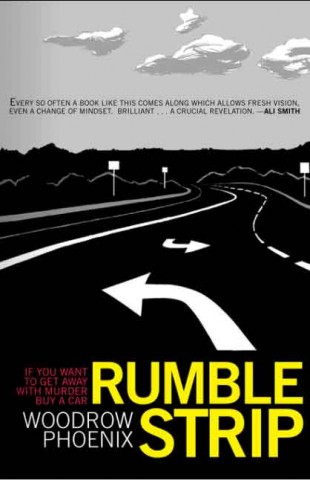
As Bobsy (yeah him again!) said back at the time of Rumble Strip’s release:
…the visual language of roads, the set of consensual signifiers that give punctuation and meaning to the otherwise meaningless grey expanses, the easy-to-read fluency of the roadsigns and road-markings, the minimalist and directly unambiguous design principles they adhere to – are an almost too-perfect subject for interrogation via the comicbook medium.
The three previous entries in this post have dealt with where we might be going, charting alternate destinations for our journeys. Woodrow Phoenix’s Rumble Strip is something else entirely – a lucid expression of the journey as we experience it now.
5. No DeLorean
As Marnie Stern fan #1, I’m duty bound to say that she gets a pass on Back to the Future nostalgia for life, but everyone else could do worse than read this post on fake geek guys, hoverboards and how the obsession with technological commodities in the Back to the Future drowns out any consideration for how its fetishised future would have been built and by whom.
This might seem to be beside the point – the people who made those movies knew their way around a product, after all – but since we’re not exactly lacking in signs pointing us towards that sort of future, we should stay mindful of other possibilities.
After all, they may just end up taking us beyond our current limitations, to somewhere we’ve yet to imagine.
Quick thoughts on The Martian
November 2nd, 2015
Far beyond its absence of green ladies and wormholes linking baddads of the past and gooddads yet to come, this is an overwhelmingly functional movie, but that’s not a criticism so much as it’s a sign that I was awake enough to notice the movie’s basic effects.
The transmission of practical genius is one its keys goals, but while this is most obviously signified in Rich Purnell(/Donald Glover)’s wild eyes and inattention to his own living conditions or the triangulations that blink up on Beth Johanssen(/Kate Mara)’s monitor, its most interesting expression comes in the scenes dealing with Mark Watney(/Matt Damon)’s attempts at life on Mars.

These scene aim for a “based on a true story” vibe through a mixture of heavily reduced scientific exposition and direct to fake-real camera addresses that remind me of computer game cut scenes in their overpoweringly “clean” flaws, the carefully composed cracks in their recording.
Material #1-4: Breaking Free
October 28th, 2015
A few thoughts on Material, a prematurely cancelled comic by Will Tempest, Tom Muller, Ales Kot and Clayton Cowles that feels like it’s worth not just reading but talking about – and maybe even continuing?
!) IT’S ABOUT TIME
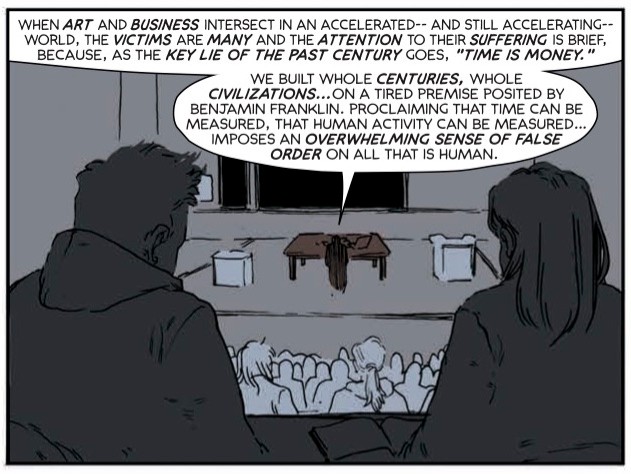
Like so much contemporary mass media, Material seemed aware of its readers’ ability to act as biocapitalist broadcasting stations, trusting that they would work harder and smarter than Image comics’ marketing department – that its readers would talk about it on podcasts, write essays, send enthusiastic tweets, anything to try and share the experience of it. Its methods of going about this was somewhat obvious but effective: the comic lectured you, provided prompts for further reading, tried to link scenes in the comic to other texts, be they topical text pieces in the back of the comic or the names and references scattered in the margins.
Even while it was still being published, then, Material seemed to revel in its status as an incomplete text. The art echoed this approach, with with Will Tempest’s none-more-loose linework held together almost entirely by the carefully coded block colouring. It looked and felt like work-in-progress, and with the action currently suspended, its characters’ lives have that feeling too.

Everything in this book is material for the reader; the question is, how much work do you want to put in? How much do you want to let Material work with you?
As I’ve already said, by publicly engaging with the comic we become part of the marketing scheme, “self-facilitating media nodes” or some such Barley-bollocks. Is that all there is to it though? Value is fundamental to the idea of currency of course, and when you’re offering up cash on the promise of receiving a worthwhile experience it’s doubly hard to disentangle financial motives from your response, but that doesn’t mean that we should give in to the tautological worldview that says since everything can be sold it is best judged by its commercial worth.
Material‘s current status gives us pause to consider this question, temporarily free from questions of cash money and how to spend it. It brings the other questions of trust – is this going anywhere? is it just wearing the raw tragedy of the moment like a shiny new suit? – into the foreground.
Flashback to… The Ultimates!
October 22nd, 2015
What I like best in art – and I like loads of stuff, I like jokes that I can’t help but laugh at, I like being able to just fucking marvel at someone doing something that seems impossible, I like that moment when something that didn’t seem like it could possibly come together does, and so on – is being put into difficulty. Not in terms of being faced with something that’s hard to watch/read/look at/listen to necessarily, more in that I like it when I’m made to confront something that I can’t easily resolve or ignore or explain away.
The Millar/Hitch Ultimates doesn’t look like the most promising territory for this sort of experience, and for the most part that’s true. It’s probably the last Mark Millar comic I was able to enjoy without vomiting up qualifiers, and it definitely represents the last point where Bryan Hitch’s artwork looked good to my eyes, but if I like it at all then I like it in a fairly breezy way. I laugh at the crude bits, I follow the fight scenes, I enjoy the brash, bratty character beats, and all of this is good.
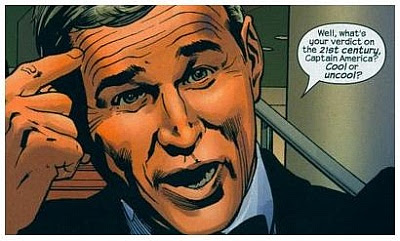
The point of difficulty, for me, the point where I find myself getting really tangled up in the book, involves a cameo by the man who was President of the United States of America at the time the story was published:
Five For Friday: In a Rich Man’s World
October 9th, 2015

- What the fuck is money? Who makes it? It’s the government, yeah? Or maybe the banks. This episode of the Kraken podcast makes for a cheerful introduction to this topic, and if you’re left wishing that they got a bit more into the question of what they’d do for money, well, there’s a whole big world of people wanking for coins out there for you to concern yourself with.
- If you’d plashing up to the deep end, the New Economics Foundation have put together a report on the prospects for an independent Scotland creating its own digital currency, the “ScoutPound”. The NEF argue that if £250 worth of it were issued to every Scottish citizen, it would boost the spending power of the poorest and boost business. Critics in the comments argue that the administration of this would be more difficult than presented and/or that it’s all just an New World Order plot, but then again these criticisms are generally applied to almost anything that’s “proposed” on the internet these days, so…
- If you need to wash the taste of BitCoin out of your mouth after reading that, here’s a post on Basic Income (also known as giving people enough money to ensure that they won’t die of poverty) that takes issue with some of its technolibertarian supporters, and another that casts a sceptical eye on some of cryptocurrency driven Basic income proposals. I’m a big advocate of Basic Income as an idea, so it’s good to read critiques like this – shout outs to Charlie Stross for the links!
- Bringing it back down to Earth for a minute, here’s a news article on the Govanhill pound, a local currency that has been created by a community artist at the Govanhill Baths, just round the corner from my old house. The exchange rate for the Govanhill Pound is variable, with the suggestion being that it amounts to “a hundredth of a person’s weekly income”. If you were going to make a joke about artists needing to print their own money don’t bother unless you’re going to wince when you say it.
- Finally, in case you were wondering where all the comics chat went, here’s a link to my post on Eddie Campbell’s book about money, the title of which I stole earlier in the post. Every other comics critic I’ve discussed The Lovely Horrible Stuff with has told me that they think it’s good, but slight – I reckon they’ve just not realised that it’s a dapper bit of bunting that’s been hung around a gaping, cyclopean abyss…
The Failure of The Filth
July 2nd, 2015
The five people who are eagerly awaiting my book on Grant Morrison and Chris Weston’s pestilent fantasy The Filth will note that the book has still not been released yet.

That I have failed to finish this project in time for the release of the hardcover edition of The Filth will surprise no one who has retained interest in the project for this long. The fact that said hardcover contains just the bare minimum of fresh material – a script for issue #6, some sketches that make the book even more difficult to read on the bus, the reheated contents of the charmingly crap Crack Comicks website – will also fail surprise anyone with a basic understanding of both comics and capitalism.
Good little enemy of the entertainment complex that I am, I paid to consume The Filth for the third time anyway. The hardback edition simulates the glossy colouring of the single issues rather than the battered bog roll of the trade paperback. It offers the reader a sense of solidity, of lasting luxury, that the previous editions lacked.
The Filth is a disgusting, slippery mess of a book. As Terrance Moreua said in the comments to one of my preview posts:
The visual grammar of The Filth is all over the place. The discontinuity being part of the point, of course. There are times when it seems to be Morrison’s script callouts (the tv cameras) and times when it seems to be Weston (background texture effects, etc) and times where it’s really fucking hard to tell (the goddamn photoshop transform tool effect to signify getting squeezed into the crack, or getting your personality fucked with in psychedelisex)…
Essentially, I find The Filth to be textually rich, garishly colored, expressively acted, disgustingly rendered and more. But comparatively poorly composed. I think there are too many components fighting for interplay. And while that’s part of the larger point, I think a little less noise and little more signal would have heightened the contrast between the two much better.
Another way to say all of that would be to say that The Filth is comics.
I Am Not a Comics Critic #3: Wandering Worst Bits
June 8th, 2015
Beast Wagon #1, by Owen Michael Johnson, John Pearson, Colin Bell, and Gavin James-Weir (Changeling Studios, 2015)

I have no idea what this comic is. I cannot it read it. It renders reading impossible. What is that smell? No, that’s too kind a word for it. Stench is too florid, too learned. This comic doesn’t smell, it hums. Is it glue? My mind tells me that it must be, glue or something like it, some aspect of the binding.
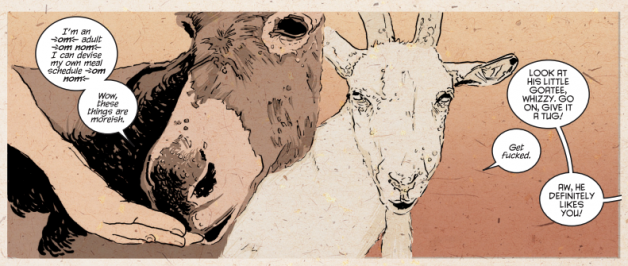
It’s not the staples though, staples could never smell like this. It’s the glue. That’s what my brain tells me, but there’s another reaction, a deeper one. Probably just a different function of the brain. Definitely that. And yet it also feels like it’s a function of the body. I know, I know, all parts of the same system, but it’s like hearing a lion scream at you in the zoo: you know there are physical and social constraints preventing the brute from eviscerating you but part of you is still howling to run!
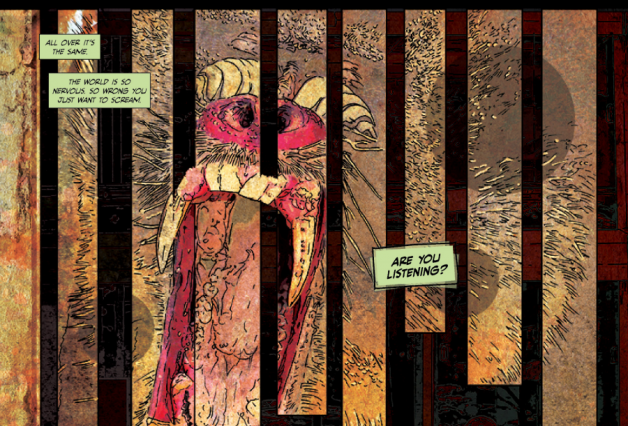
It’s only a comic, just a mess of words and pictures on the page, just paper and ink. Ink doesn’t smell like this, does it? Probably not even if you use it wrong. No, I can’t read it, I want to get rid of it, I need to get it out of my house, need to wash the smell of it off me.
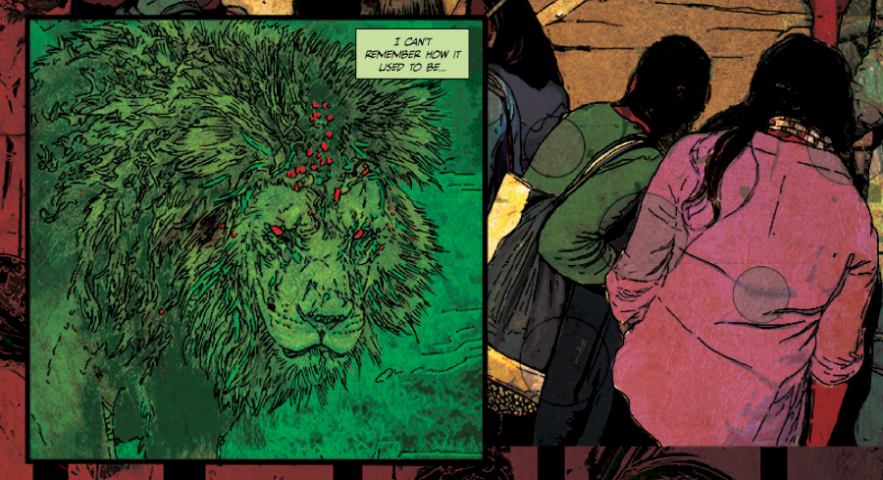
I think this comic is planning to kill me.