White Chalk – Dial H #13 Re-viewed
July 17th, 2013
You might not know it, but you gamble every time you pick up an issue of Dial H: the ink in which this comic is printed contains a rare sort of toxin, exposure to which dials up one of three parallel universes. Before your eyes make contact with the page, you know that any given episode has a 33.333333333% chance of being: (A) a sloppy pastiche of the Morrison/Case Doom Patrol run, (B) a snazzy pastiche of a good proto-Vertigo comic (like the Morrison/Case Doom Patrol run) or (C) a genuinely effective post Alan Moore/Grant Morrison superhero comic.

Issue #12 of Dial H saw China Mieville, Alberto Ponticelli and co rolling(dialing?) the reader into a hopelessly tangled version of their own story in which none of the lines (whether in the art, plot or dialogue) connected meaningfully. Issue #13, meanwhile, provided a clear and direct line to the best of all possible worlds(/comics).
Comics being a collaborative medium, Alberto Ponticelli’s pencils tighten up with Mieville’s script, and the unstable environments of issue #12 are forgotten in favour of an information-dense, two-layered landscape. Ably assisted by inker Dan Green and colourists Tanya and Richard Horie, Ponticelli works for maximum accessibility at every turn, framing our regular cast as pedestrian browsers walking through a block in which comics sprawl on every wall. Thanks to the arr team’s heroic efforts, we’re always able to read what’s going on as we glance past our heroes’ shoulders:

It might seem strange that an issue that breaks to recap the plot of the previous few issues should be better than anything being recapped, but Dial H is that rare superhero comic that actively thrives on exposition. Other standout issues in this series have explained where the powers Nelson and co dial up actually come from (#0, #11), and explored the difficulties that arise from contact with unreconstructed racist fantasies (no not Game of Thrones, issue #6).

Dial H is at its best when explains its own mechanics because theme is built into the design of this revamp more clearly than it’s expressed by any of the action on the page, a quirk (or fault, depending on your tolerance for this sort of thing) that only strengthens the book’s Karen Berger-edited pedigree.
Just think of the many walking tours through authorial interests that characterised that first flush of post-Alan Moore, British invasion comics, all those scary strolls through the green, trips out into blue forgotten worlds, the evening walks that lead you right underneath the Pentagon and straight on into the heart of the American scream.

SILENCE!#69 Gary’s Big Adventure
July 16th, 2013
WARNING TEAM!
This week, still bereft of The Beast Must Die, Gary Lactus goes on a quest to find him. His journey takes him into a lonely Reviewniverse where he mutters to himself about Tank Girl: Solid State, Daredevil, Justice League, Hawkeye, Young Avengers, Superman Unchained, Batman, Ghosted, Astro City and Avengers Arena.
Then we venture into a whole new realm baring little or no relevance to the already fairly loose remit of SILENCE! Gary Lactus’ manufactured alter ego Fraser Geesin talks to lovely Dan Fardell about comedy, the Man Of Steel film, Ivor Cutler, Ron Geesin and other stuff. Dan is currently filling in for Kerry Herbert on Kerry On Comedy, every Tuesday 3pm on BHCR.
TRUTH ACCEPTED!
SILENCE! is proudly sponsored by the two greatest comics shops on the planet, DAVE’S COMICS of Brighton and GOSH COMICS of London.

SILENCE! #68 HOLIDAY SPECIAL!
July 12th, 2013
Right then, sorry about this. Gary Lactus here. Hello. We’re very nearly back. What we have here is an exciting mixture of TWO amazing formats.
FORMAT 1: I, Gary Lactus apologise my way through some reviews of things like, (well exactly like to be honest) Satellite Sam, The Walking Dead, Uber, Avengers, The Superior Foes Of Spider-Man, Daredevil, and Dial H.
FORMAT 2: A LIVE recording from Cartoon County, straight after The Beast Must Die (in his best Dan White costume), had been interviewed by Alex Fitch of Panel Borders, the radio programme and podcast about comics. He’s proper and it’s good so definitely go and enjoy it! What happened after isn’t as good as Panel Borders but it’s fun. Alex joins us along with plenty of folk like Dave Stone, Joe Decie, David Lloyd and Bobsy chipping in with opinions on comics! Actually it’s a bit of a drunken free for all but with me holding the mic throughout and going on with Bobsy for too long about Jupiter’s Legacy. There’s also talk of Aces Weekly and… I’m sure there was something else… Anyway, what’s the point in me listing everything here? I’m not some goddamn Narratorbot! Hopefully if you’ve read as far as this you’ll have some some idea as to whether you want to listen or not.
Oh yes, I do sing an amazing song which you’d never guess was completely improvised. And there’s a special new Summer Special theme tune.
It’s fffphreschhh!!!
SILENCE! is proudly sponsored by the two greatest comics shops on the planet, DAVE’S COMICS of Brighton and GOSH COMICS of London.
“Everything’s Starting Now” – CHANGE by Ales Kot, Morgan Jeske, Sloane Leong and Ed Brisson
July 11th, 2013
EXPOSITION: From the first few pages onwards it’s clear that this is one of those LA stories, an everyday apocalypse in which a strung out and savvy cast of screenwriters, rappers, astronauts, agents and cultists collide against a genre-mashed backdrop; the prophetic screenplay that drives the story is modeled on The Last Boy Scout, but Richard Kelly’s media-frazzled sci-fi meltdown Southland Tales seems the more fitting tonal counterpoint for this story of a city stuck on an apparently endless cycle of destruction.
You might remember reading about all this in the early hype, but if not you can always obtain the first issue for free online and get a flavour for it yourself.

The main characters in CHANGE are lost and ambitious souls, tilting after people and projects like a set of modern day Don Quixotes, struggling to find their way to an imaginary elsewhere that might just resemble home if they can stick the landing.
If there’s a criticism to be raised here it’s perhaps that the women in this comic tend to be framed at the centre of the madness, while the men are given more active roles as explorers. Richard Doublehead (“the Virginia Woolf of screenwriters”) and rapper turned movie producer W-2 and find themselves instigating the plot and exploring it respectively, and in their dueling roles both men are spurred on by the loss of their partners. Charlie Kaufman style maverick screenwriter and surprisingly competent car thief Sonia has a more active role than either of the female love interests, but her ability to write what’s about to happen still positions her as being somehow in tune with the madness where her fellow protagonists affect and are affected by it:

Thinking about Sonia’s character, I keep coming back to Angela Carter talking about her experience with the surrealists:
…I had to give them up in the end. They were, with a few patronized exceptions, all men and they told me that I was the source of all mystery, beauty, and otherness, because I was a woman – and I knew that was not true. I knew I wanted my fair share of the imagination, too. Not an excessive amount, mind; I wasn’t greedy. Just an equal share in the right to vision.
If Sonia has anything, it’s vision, but somehow her goals seem less tangible those of her male counterparts; for all that her voice is the most purely entertaining one in the comic, I still can’t help but feel that her arc is also the least satisfying. Even the astronaut, who spends most of his page time cut off from the other characters, finds himself on a journey to be reunited with them and with himself:

Click here to see if I can bring this post down to Earth safely.
Doctor Who: Fifty Stories For Fifty Years — 1995
July 2nd, 2013
There are two very different ways of looking at the character of the Doctor — two mutually-contradictory views of the character that have usually remained unspoken but which have fuelled decades of fan arguments, many of which have been proxies for one or other view.
The first is that the Doctor is not, in himself, a particularly special person.
Doctor Who: Fifty Stories For Fifty Years — 1994
June 30th, 2013
By the early 1990s, it had become clear, despite the BBC’s occasional claims otherwise, that Doctor Who would not be returning to the TV any time soon.
While the New Adventures were an acceptable substitute for many Doctor Who fans — and in the opinion of many even an improvement on the TV show — there were those who simply weren’t satisfied by words on a page, and needed to see old character actors being menaced by improbable monsters before they could feel fully happy.

Doctor Who: Fifty Stories For Fifty Years — 1993
June 29th, 2013
By 1993, Doctor Who is a potential, rather than an actuality. The TV show has been off the air long enough that it could realistically be revamped, not just brought back. It’s not a TV series any more, but an idea for a TV series — an idea which can be done in many different ways.
Particularly, there were two ways that the series could be dealt with. The first, and perhaps the most obvious, was to make it ‘darker’ and more ‘cult’.

Jupiter’s Legacy the Death of Frank Quitely
June 29th, 2013
Answering! the gjallahorn blown by a respected campaigner of old. Scorning! the gnarled admonishing finger of grumpy teach and his selfblind pretensions to impartiality:
Jupiter’s Legacy is really a very dull, very poor indeed, comic, F-minus, forced, tired, artificial, very disappointing, get the fuck out of my house. Sapped of all grace and mana by over repetition of zombified tics and gestures: laughably inept in its socioeconomic analysis: not even pathetic in its yearning for the world of five years plus past: idolatrous in its devotion to the never-there assurances of the old American century? Everything you’d expect of its famous author-shyster. These few years, no one with a soul to save or a clue about anything important has stepped across the threshold of number 10, and no honourable man could ever drop his knee before the Queen of Evil.
But don’t take Frank Quitely’s drawings with you, for pity’s pain.


a) Fancy a drink captain, you unprofessional fuck? What drink? The one in your hand! Look really closely. Yeah there, take a sip. You can’t? It hasn’t been set up properly? The continuity and detail of this scene is entirely tossed off? Forget it cap, someone can go back and draw it in your hand later, sfine.

b) Magic sliding towards you wall? Is that? I mean, these are new, fashionable glasses, so maybe I’m, but come on, really? When Quitely was alive he’d nail the 3D modeling and that tricky perspective. It is possible instead nails have been run in to his poor dead hands prior to commencing work on this comic.

c) Sometimes I wonder if the dialogue in this comic could be any more dogshit? As for the pictures, don’t worry about any kind of aesthetic clarity, and for fuck sake make sure you don’t get any rough energy in there either.

PS – no nudery, just prudery. More fucking blood you prick, this is for kids!
Mark Millar’s writing is so bad it makes the art go bad, basically. Here’s hoping by christ for a resurrection of Frank Quitely before he has any more high profile superhero work coming out…
Mad Men season six finale back and forth part 1
June 27th, 2013
Cross-posted from She’s An Astronaut
Mark: What a fantastic finale that was. A good riposte to the claim last year that Mad Men’s storytelling jumped the shark, becoming more reliant on cheap shock value because Weiner had run out of ideas. If Megan had died the way people thought she would the critics might have had a case, but as it was we got a typically understated episode, with an ending so enigmatic only someone watching closely would be able to properly understand it. My partner burst into tears when Sally and Don exchanged glances, but a casual viewer would be left scratching their head. Quietly devastating. Proper Mad Men.
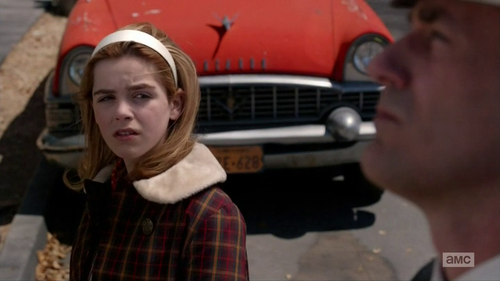
Matt Weiner often talks about his writing process starting with the last image and I love the idea that he began with the simultaneously comprehending and uncomprehending look (amazing acting!) Sally gives Don just before the before the credits roll. It was so moving and funny at the same time. Partly it was the contrast, the shock of ending on something so light after months of emotional turmoil. But mostly it was the just the sudden recognition of the surprisingly gentle truth that this was the only way the story could end.