Alphabetical villain thing: All the Cs part 1
July 12th, 2010
Over to Bobsy for the first one, a lost gem of a bat-ghoul.
Cadaver
Think like Dr. Phibes or ‘the Price of Fear’, Vincent Price’s radio series of horror tales that he would front and narrate. Cadaver is like a behind the scenes mastermind, crafting these little theatrical events for unwitting but ironically-deserving Gothamites to get caught and come to a grisly end in. This would be like The Game or traditional long-cons, but low key and intricate, involving doppelgangers, stooges, switches, hi-tech surveillance, all painstakingly researched and executed, and performed with an unusual amount of stagey flair, blood, and medieval death motifs.
Cadaver worships death – not as one worships a god, as one worships a favourite matinee idol, and seeks to flatter her with wonderfully inventive murders.
He should have a beautiful assistant: Who is that mysterious, alluring, new secretary who is tempting this average joe into a dizzying series of betrayals that results in him dying nob-first through the office shredder? That kind of thing. Batman is called into the bizarre crime scene by a baffled Gordon, and painstakingly reconstructs the chain of events leading up to it. Cadaver is crap in a fight of course (but his assistant isn’t) and there are always loads of death traps in his hideout (usually abandoned art deco hotels, mausoleums or churches). Cadaver spends a lot of time pacing about wearing cloaks and Phantom of the opera masks, quoting the bloody bits from obscure Jacobean dramas.
A quick review of Batman & Robin 13
July 8th, 2010
IS HOT SEX

Batman says “yes” to POPCRIME
July 6th, 2010

In Batman 700 Morrison threw out a particularly juicy idea, that the bat-foes of 50s and 60s were pop-criminals. Morrison being Morrison he didn’t explain the concept any further so here’s a few of my thoughts
- What is popcrime? Clownish capers, catty conundrums, fowl felonies. Catwoman stealing the giant emerald eyes of Bast, the Penguin besieging the city with hundreds of robot umbrellas, those are examples of pop-crime.
- Popcrime is inherently ostentatious and showy, the grander the better. It’s made for alliterative headlines, and for minimum casualties. It’s popular, fun, sensational and most importantly carnivalesque in the original sense of the term: dates in the Christian calendar when social norms were turned on their heads and nonsense reigned
- Amy recently suggested to me that successful superheroes, and one assumes the supervillains, lug around permanent autonomous zones. Follow the link if you haven’t heard the term before, but the idea, very simply, is that certain spaces largely operate outside the control structures of the wider culture and generate their own form and function from within. I’m not hugely into Hakim Bey, the chap who came up with the idea, but I think that it could be a fruitful way to approach the concept of the superhero, and I’m particularly interested in the parallels between the supervillain as popcriminal and the supervillain as PAZ. Bobsy tells me that Bey was heavily into the idea of spaces and communities so perhaps the straightforward situationism is more what I’m after here, but either way we’re on the same track. The Joker is always on, and even those whose costumes aren’t acid etched into their skin are very rarely halfway committed when they take on their superidentity. Back in the popcrime days Batman might have occasionally caught a glimpse of Edward Nigma, but 99% of the time the fella was all Riddler and the world had to make room.
- I’m thinking that the popcrime Catwoman is more like a contemporary artist than a crook. She isn’t motivated by money or by greed in a straightforward sense, nor is she hugely invested in vengeance or a lust for violence, although these things could well have their place within the popcriminal schema. It’s the raw outsiderness, the absurdity, the virtuosity and the immensity of pop-crime that’s the attraction. Turning the city into a crazy feline themed amusement park, featuring live action battles with Batman and Robin is what pop-crime is about – it’s the thing itself.
- Popcriminals don’t have to be mad. Going back to the Catwoman example, she doesn’t purr all the time because she’s insane, and she’s not obsessed by cats in the clinical sense, and she doesn’t try to claw out Batman’s eyes because she hallucinates paws where palms should be. The pop-crime Catwoman is all about becoming, an attempt to inhabit a role, to get lost in it, a psychologically necessary part of the pop-crime edifice. Committing cat-themed crimes wouldn’t be half as enjoyable or half as successful if she didn’t given herself utterly to the experience.
- Popcriminals make me think of mods and punks and late 80s ravers. Youth movements are all about adopting larger than life identities. Pop-criminals just do it bigger and better. It’s super-fashion.
- I miss popcrime. Let’s face it, while there’s some reasonably sophisticated superhero comics around these days, the actual criminal activities of supervillains are seldom very interesting. I’m bored of seeing blokes dressed up like cobras being reduced to purely physical threats, only ever good for a fight scene or two or the odd heinous crime. I can get fights and heinous crimes any old place – can’t say the same for popcrime. Can’t get popcrime for love nor money.
Popcrime: discuss, my lovelies.
Alphabetical villain thing: B is for…
June 28th, 2010
And so we continue.
All the As can be found here, along with an explanation of what the billy-o I’m doing
Bane
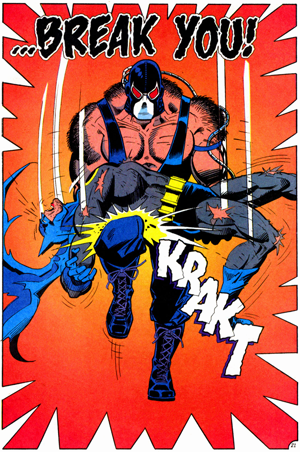
Amy’s already done this one and it can’t be bettered. All that’s left to be said is that Amygdala and the rest of those muscle men live permanently in Bane’s liefeldian shadow. If Bane is leader of the cult of bulk then they can only ever be his disciples; Sweaty, raging, flesh machines lost in the stink of his meat locker come gymnasium.
Black Mask

Dirty. Nasty. Fucker.
Start with the mask: you’ve got dehumanisation and the death of identity. This guy’s face isn’t just a black skull, these days it’s a black skull with red eyes – that’s demonic evil straight outta the 80s. There’s also something specifically horrific about a skull wearing a suit, it brings to mind the triumph of the material, modern monsters like the denizens of Hostel, and Patrick Bateman, terms like slasher and torture porn.
The character’s origin is begging to be jeuged up into a full blown Giallo nightmare. After murdering his parents for interfering with his love life, Roman Sionis takes control of their business and markets a cosmetic that hideously scars thousands of women. You’ve got brutality, misogyny, matricide and patricide, operatic vileness. Dirty. Dirty. Dirty. People who care about boring shit will be quick to point out here that Roman didn’t know what the product would do, but I like to think of Sionis spending his nights “market testing”, and fucking his lover, Circe, over the same desk where he makes the phone calls, has the meetings, and deliberately and methodically works to ensure that his facial treatment will do the maximum damage possible.
While we’re feeling gratuitous, perhaps it would be good to work an oedipal subtext into his background: maybe his mother, a woman who wore a disturbing amount of make-up, loved him just a bit too much, maybe his Father hated him for it, maybe that’s why they tried to destroy Roman and Circe’s burgeoning romance.
As a paid up member of the misogyny can fuck off club, and someone who isn’t particularly interested in seeing the Bat-franchise rub more grime n grit into its spandex I’m not very keen on Black Mask’s torture happy ways. I could do without a villain who lives to stuff women into refrigerators, but I’m happy to concede that he readily gives himself to the kind of voyeuristic violence and horror so popular with today’s audiences. So I say go with it, have him be all that stuff that the crime lord incarnation of the Penguin couldn’t hope to be. Have him be one hell of a nasty bastard.
Play up the monstrous verging on supernatural slasher angle by having his masked henchmen simply be an extension of him – think you’ve killed the fucker? Guess again, kid – and forget all that cultist stuff. The false-face gang aren’t his minions, they’re his claw. Have him kill and kill and kill, give him an ebony room with an operating table, and casino where the patrons can bet against the lives of their enemies’ children. Have him make Catwoman’s sister watch while her husband is tortured to death and then force her to eat him.
Hang on, he’s already done that…
Or maybe just bin the horrible git.
Blockbuster
There’s two sorts of Blockbuster and they’re both more than a little yawn inducing.
1. The chap who drank the science potion and got strong and dumb and was exploited by his criminal brother. He’s a bit like the green Hulk.
2. The chap who got strong and then did a deal with the devil so that he could also be clever. He’s a bit like the grey Hulk but with a bigger head.
The first has the whole tragic monster thing going, which certainly fits with the kind of story that some people like to tell with Batman but I couldn’t give a monkey’s about, mainly because it’s been done to death in Batman and elsewhere (the Hulk, Frankenstein, why am I bothering to list these?, etc…). The second is just… well… it isn’t really anything. Big strong criminal = so what? I suppose you could do something with the hackneyed Faustian bargain bit but I wouldn’t want to.
Whatever, see the Bane entry.
Alphabetical villain thing: A is for…
June 24th, 2010
In the grand tradition of our Rogue’s Reviews and inspired by Zak Sabbath’s Alphabetical Monster thing, his attempt at reviewing each and every entry in the D&D Monster Manual, I’ve decided to take on all the Bat-villains, starting with…
Batman 700: Zom’s thoughts
June 13th, 2010
A quick preambulatory moan:
Oh the art, the art was as ever a big problem. I’ll let the lovely chaps over at Comics Alliance fill you in on the specifics, all you really need to know is that the central aspects of the issue’s locked room mystery – when the Prof was killed and who did the killing – were obscured by an art error that should have been spotted by the editorial team, or, you know, someone. It’s just not okay that something like that was allowed to slip through, and it makes me wonder exactly what sort of relationship Morrison has with the editorial staff, let alone his artists. Maybe they were just in a big rush, although it’s hard to imagine why given the lead in to this issue.
That aside, I enjoyed 700 in a bitty way, but wasn’t too keen on the book as a whole. The segmented structure helped to legitimise the former response in my mind however, and consequently I feel no shame in taking the annocomment approach. Seems appropriate.
Batman vs Robin: awesome-tations
May 17th, 2010
It’s only just occurred to me that we’ve been gipped. I went in expecting a three issue contest of wits and fists between Dark Damien and the Cartwheeling Crusader and what I got was a lot of stuff in caves, and secret passages and wotnot.
Of course the reason why I’m not complaining is because the whole thing turned out great anyway, with the last issue a serious contender for best issue of the run so far, at least as far as exciting plot beats are concerned. A doubly impressive feat when you consider that Morrison pulled it off without the pencil-pyrotechnics of Quitely or Stewart. Not to do the art team down, their efforts certainly contributed, memorably on a couple of occasions.
But enough with the preamble and on with the awesome sauce.
Alex Sinclair vs Batman & Robin
April 27th, 2010

I was brought up on the comic books of the eighties, when colours were flat and negative space was in high demand, when digital meant computer games suffering from colour clash, and when today’s smooth colour gradations were the holy grail of the demo scene. On the whole I don’t want naturalism from my colouring and I definitely don’t demand some early 90s bedroom coder’s version of it. Which leads me, kinda, to my point.
Ever since mindless pal David Uzumeri compared the colouring of Batman & Robin #1 to a badly rendered GIF, I’ve been promising a response. I was troubled by David’s reaction because I thought the blotchy, banded, fuzzy colour gradations added immensely to the atmosphere of the issue, and because I believe David’s objections to only have a tenuous grip on the critical centre. It’s an understandable way of reading the colouring, but I’m of the opinion that with some prodding its dominance can at least be partially undermined and other readings more readily admitted.
Still – excuse me – DAMN fine 20 years on
April 9th, 2010

Happy 20th, Dale
(Head into the comments to find out how YOU can help bring back Twin Peaks!!1!)