notcomics: Walking Dead episode 1
October 28th, 2010
I’m not going to talk much about zombies, I’m afraid. Zombies aren’t the problem.
Post credits Walking Dead opens on Andrew Lincoln’s Sheriff’s Deputy chomping on hamburgers with his partner, Shane, played by Jon Bernthal, and shooting the shit about their marriages. Both men badmouth their wives, Shane makes some huge and rather unpleasant generalisations about women, and Lincoln goes on to describe his wife as cruel and a bad mother. What Darabont seems to be going for is Tarantino, what he comes up with is charmless dialogue peppered with misogyny. Unfortunately the show goes on like that.
All the female characters are either shit-talked, absent, evil zombies/bad mothers, and/or reckless. Men? They’re gun wielding, authoritarian, tough and very much in charge. There’s a scene late on where Shane tells off his wife for wanting to help other people, accuses her of jeopardizing the life of their child, and not only does she come round to his way of thinking, she also decides that this is in fact a very sexy moment*.
Whether the show continues in this vein or not remains to be seen. There’s a lot of room for it to paint a picture of women as human beings. It’s also worth bearing in mind that while Lincoln describes his wife as a bad mother, the possibility that he will be plagued by guilt for being absent when the zombies came leaves the door open for a more thorough examination of masculinity and the male role. So at this very early stage I’m willing to give Walking Dead the benefit of the doubt, but the fact that there is precisely one scene where the show demonstrates what could be construed as a positive view of women doesn’t bode well.
There’s no doubt that Darabont can direct, the plot is strong, and the show does understand what’s nasty about zombies, but we’ve come to expect compelling dialogue and a nuanced approach to gender politics from our quality US dramas. So far Walking Dead exhibits little of either.
*ADDENDUM: It’s been noted in the comments that I have mistaken Rick’s family for Shane’s (thanks, Basque). While I’m embarrassed by my lack of perceptiveness I have to say that adding infidelity to the list of sins committed by women doesn’t exactly weaken my case.
Knight and Squire #1 review
October 18th, 2010
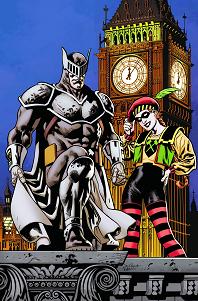 Paul Cornell and Jimmy Broxton
As a British fan of Morrison’s bat-run I was always going to pick this up, and on the whole I’m glad I did. Much has been made of the over-abundance of British cultural references and idiomatic turns of phrase by my American chums, which comes as no surprise given that Cornell’s attempts to paint DC-UK as exotic even forced me to stop and think about some of the dialogue, and that’s despite the glossary at the back of the book. To some extent I feel for those who struggled, this self-evidently isn’t a comic for everyone. If you’re not an anglophile or a Brit who’s prepared to weather what could reasonably described as Cornell’s heavy handed approach to British cultural representation then this isn’t the comic for you. This first issue also isn’t a book for those who want a lot in the way of plot, and what little there is it at least as concerned with servicing Cornell’s primary aim, introducing a milieu, as it is with moving the Knight and Squire’s story forward.
With the above caveats in mind, it’s as an exercise in world building that the book worked for me. I liked the pub where Britain’s super-community meet, as a concept I think it has the scope to stretch out beyond its soapy roots (the British pub sits at the heart of the UK’s two favourite soaps, EastEnders and Coronation Street), and in this issue it served both as an efficient means of condensing the DC-UK fictional landscape and setting the light-hearted tone. I enjoyed the humorous character introductions even if I thought they lacked the creative electricity that a Moore or a Morrison would have imbued them with. Captain Cornwall made me chuckle (the very idea), and I particularly liked the Milk Man, who as a concept managed to straddle the line between being silly, cosily familiar and a bit weird in a satisfyingly pythonesque way (an adjective which could start to wear thin if we’re still trotting it out in two issues time, I grant you). I was also happy to see that Cornell, like Moore before him, is capable of using the more trainspottery elements to bolster his efforts. To have Jarvis Poker ‘the [Great] British Joker’ speak briefly in Polari brought the character to life in one panel thanks to the strong association between comedy, that opaque language of 50s gay culture and the shade of Kenneth Williams.
Broxton’s art, while failing to clearly communicate the mayhem and action towards the end of the book was articulate enough to convey everything that Cornell needed to get across, and managed to be just cartoony enough to reinforce the book’s general feeling of warmth. It’s tricky to do a bar-room brawl and it’s tricky to design and draw a comic that’s heaving at the gutters with new characters. If that sounds like I’m damning him with faint praise that because to some extent I am, but I’m also prepared to give him the benefit of the doubt at this very early stage. As I’ve noted above, this wasn’t a remotely plot heavy issue, and was mainly built from panels introducing new characters and concepts, as a consequence we’ll see how Broxton fairs when he needs to push the story uphill rather than link up a bunch of largely disparate elements in an anarchic pub.
If I have any big worries for this book they’re around the idea that “moderation” is a concept on which to build a superhero comic. Cornell goes to great pains to set-up this idea: the very notion that supervillains and superheroes would share the same drinking establishment requires it*, as does the woolly subplot where a young turk has to choose which side of the hero/villain divide he will stand, as if he were choosing between apples and oranges. While I think moderation has its virtues, and I can see why someone might want to sell it to an American audience (sorry, Americans), moderation isn’t the bedrock of entertaining popular fiction, quite the opposite, and as a guiding principle it runs the risk of feeling very forced. This first issue could afford to be quite self-aware, in fact it benefitted from it, but the same approach might become more of a problem down the road, especially if the plot is unduly effected by such meta-texual concerns, and particularly if those concerns are antithetical to drama.
*At least it does in so far as Cornell’s vision for the pub goes.
I hereby award this comic three brains out of five
The Prism #1 – a Mindless Zine
October 5th, 2010

UPDATE: PLOK’S ESSAY IS NOW FIXED!
Finally, here it is. The Prism is the first and possibly the last (but by no means the least) Mindless Zine, beautifully designed by our Dan White.
We have:
Sean Witzke on Casanova
Amypoodle, Bobsy and Zom on The League of Extraordinary Gentlemen: Century
Go Robo 4, a new strip by Dan White
David Allison on Brian Chppendale’s Ninja and Maggots
Andrew Hickey on comics and Christmas (that’s how late this little project is)
Plok on Kirby’s celestial dreams
The Satrap rogue reviews Kang
It’s a big file, 19 megabytes of non-stop, comics oriented, PDF action, but it’s worth it, because you’re worth it. Download from Mediafire here.
If you have any problems getting hold of the file let us know!
Building a better Batsignal
September 26th, 2010

- The phantasmal Bat-Signal of Nolan’s films with it’s spooky overtones works, somewhat counter-intuitively, with a drive towards a more realistic Batman, both in the aesthetic sense in that it marries with new colouring techniques in the comics, capable of rendering more precisely the qualities of light, and in the conceptual sense: it’s more plausible than the erstwhile cone of light, and gestures in the direction of a Batman more constrained by a realistic set of rules. The symbol’s ambiguous presence can also work to stake out an ultra-noir view of the character, less superhero more urban myth. The citizens of Gotham don’t know who or what this Batman stands for, or what he is or even whether he’s actually real, in much the same way as they don’t know whether that light does in fact constitute a signal or whether it’s, in line with the official explanation given in Nolan’s films, just the product of faulty equipment. This Batman is inherently mysterious, a creature of the shadows, someone (something?) to be unsure of. This isn’t a Batman who has much use for the golden chest emblem.
Notcomics: Half formed musings on the Coens, Fargo, and inexplicability
September 17th, 2010
No Star Wars was Sean Witzke’s attempt to countdown his 100 favourite films. A really wonderful series of posts. Got me thinking about all sorts of things.
Like the Coen Bros. I’m not sure I entirely agree with Sean when he posits that their films are on some level about the inexplicable. I see where he’s coming from, but that’s not how I’d choose to phrase it because inexplicability has strong connotations of the supernatural, and while the supernatural is certainly present in their films, I think they’re getting at a number of less reductive things, most obviously an epistemological gap between the world as it is and what it’s possible for people to know or understand. Historically that gap has been filled by God, supernatural agencies, etc… but as students of philosophy (as well as having a Jewish heritage, and therefore likely to have some religious issues to work through – see A Serious Man) the Coen’s will be well aware of other more down to Earth attempts to do away with the problem, hence a number of their films taking, however implicitly, less overtly fantastical views on the subject. For example, unpredictability, incompleteness of information and psychological dissonance all feature heavily in the Big Lebowski as serious obstacles to a fuller comprehension of the world, but God isn’t in the picture, although the idea of the omnipresent narrator is affectionately played with.
But to go back to Sean’s point, watching Fargo last night I was struck by the fact that, while nothing about the film seemed to require supernatural explanation, it worked hard to paint the disconnect between the characters’ worldviews and the messy, unpredictable reality they faced – an epistemological gap that manifests as a persistent incompleteness of knowledge – as in some way mysterious and sinister. The entire context of the film (a thriller) pushes for that kind of atmosphere, but the movie’s snowy landscapes and pitch black nights, with their suggestion of hidden things, and form from formlessness – echoed in the silence of the film’s most sinister killer – layer in a feeling that while the film’s events might ultimately be explicable, there is still a fantasmal otherness to them.
What’s interesting is that while Marge could discover all the salient facts, and while she demonstrates time and time again that she has the ability to assemble them in a way that makes sense and lines up with reality, even if she did so (and I guess we’re supposed to think that she will given her role as police chief), we have to wonder whether she would be left any less disturbed or perplexed? The problem here is less epistemological, in that it isn’t necessarily tied to the extent of one’s knowledge or what is knowable, and more existential, at least it is if you take the view that existentialism is more about description than factual content, which it would be hard not to do given that existentialism doesn’t deal in quantifiable facts. Looking at Fargo one is tempted to argue that the film is saying that while its plot can be *entirely* explained by mundane causal processes, and that those processes are at least potentially knowable, this point of view is in some strange, fundamental way inadequate. It fails to account for the awfulness of death and murder and the sheer bloody absurdity of it all. The why not the how. The problem is that why might not be answerable. It might not even be a proper question.
Or something.
Alphabetical Villains thing: Cs part 3
August 6th, 2010
Clayface
Me: so why do you like Clayface so much then?
The Boy: He’s scary
Me: But what’s scary about him
The Boy: He’s got goop
Me: But what’s scary about goop?
The Boy: Carnage and Venom have got goop, and there’s no man.
Me: No man inside Clayface, you mean?
The Boy: Yes. He hasn’t got a man.
Me: What’s good about Clayface?
Amy: I’m thinking of a story where you could have a dead body buried inside him. Maybe even in a coffin.
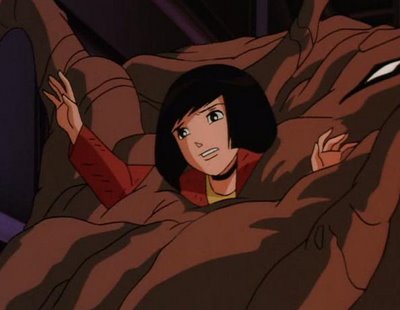
I struggled long and hard with this one until I realised that Clayface isn’t a character, he’s something that happens to you. I can’t imagine a Clayface story arc being up to much, the obvious and done to death route is to go all snoretragic, loss of humanity, etc… but personally I think I’d aim for a few panels where someone (perhaps the little girl in the panel above) is dragged screaming into its earthy darkness and play out the consequences. Clayface isn’t a monster that I want to understand, I don’t want a POV shot or interiority, you don’t identify with walking graves, you have people get buried alive in them, and you make sure that you make the getting buried alive sequence is suitably terrifying and distressing.
Clayface is a one or two issue, all horror bat-foe, and that’s that. He’s a horrible inevitable event like death. There is no man.
Cluemaster
Fuck Cluemaster
Next: finally the Ds
Alphabetical villain thing: All the Cs part 2
July 28th, 2010
Catwoman
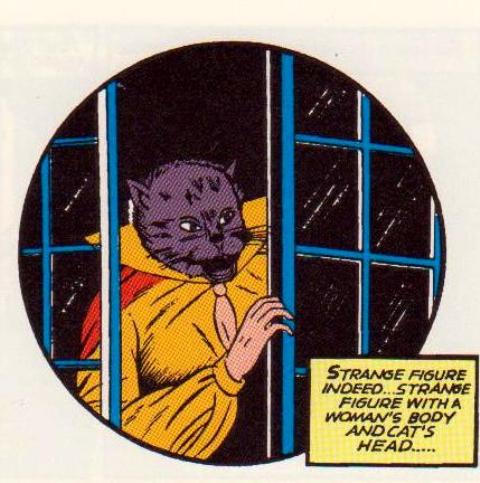
Before you go any further you should read (or remind yourself of) what Amy had to say about her in his ancient Rogue’s Review. It’s a little bit woolly in places but it’s also full of great ideas and he covers most of what I have to say here and then some. Not only that, he manages, in true Poodle style, to anticipate popcrime and Morrison’s it all happened approach to the bat-characters, but instead of focusing on Bruce he spends his energy on Selina. His take on her relationship with Holly is especially cool.
Stop heading down. His is better. Go read and come back.
Batman & Robin 13: Amy’s annocomments
July 14th, 2010
PAGE 1
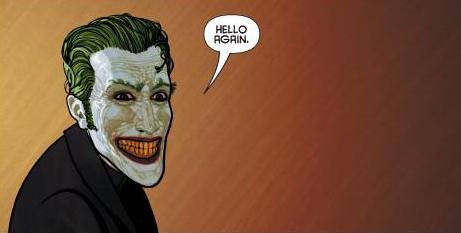
This is just perversion pure and simple. Morrison understands the best villains should be perverts, and while, yes, dodgy, perverts are people too, and we’re all perverts, etc., i wouldn’t have it any other way. That whispered ‘yes’ is gold. This thomas has waited his entire life to see his wife and child slaughtered in front of him – it’s the fulfillment of a dream, why he got married and had a kid in the first place – and now he’s off to have the biggest orgy ever while shouting ‘WHAT HAVE THEY DONE TO YOU? INNOCENCE!’
And we all know where that leads, the spaffing out of the sun.
Check this out, you dirty mindlesses
July 13th, 2010
I love Matt Seneca and so do you. His last two posts on Batman alone are perhaps some of the most articulate, evocative, and downright passionate words I’ve ever read on the art [ed – not the writing. See the comments below] of drawing men in knickers.
Stop fucking about and get over there