Doctor Who: Power Of Three and the Time Of Angels
October 4th, 2012
Yes, it’s an extra-special double review!

In which I look at the last two episodes of the most recent mini-series of Doctor Who
Doctor Who: A Town Called Mercy
September 22nd, 2012
One of the little tricks Steven Moffat has been playing to keep the fans onside is to have, as an undercurrent in his series, references to a specific previous era of the show. Last year, there were a lot of little nods to Patrick Troughton’s last year on the show, almost all of which will have passed the casual viewer by.
This year, Moffat seems to have chosen William Hartnell’s last year or so to pay a sneaky ‘homage’ to. In the year when Steven Taylor was the companion, there was a Dalek story featuring an actor who later went on to play a companion, in a different role (in fact there were two), there was a story about a space ark, featuring the crew interacting with extremely large animals, with a dubious moral message, a trip to New York (coming up tomorrow in this series)…
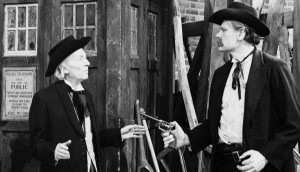
and the story often considered the worst in the series’ history.
Doctor Who: Dinosaurs On A Spaceship
September 11th, 2012
I suspect this will be the hardest episode this series for me to write about. Normally there is something interesting to say about an episode, even if only about how it failed. And more importantly, normally I have something *different* to say from what other people are saying. But this time, my reaction can be summed up in the same sentence everyone else is using:

Doctor Who: Asylum Of The Daleks
September 3rd, 2012
Does Steven Moffat not want to be writing for the Daleks?
It would make sense that he doesn’t — the Daleks are fundamentally uninteresting antagonists from a story point of view. They’re an incredible visual and aural design, of course, but as far as stories go, there aren’t really very many that you can do with them.
Doctor Who: Fifty Stories For Fifty Years – 1979
August 20th, 2012
Before we get going with this, a quick question — I’ve been thinking of releasing this series of posts, when finished (some time next year), as a book. Would anyone actually buy and read such a thing, or is it a bad idea?
I’m asking now, because here is where we head into a totally different realm of Doctor Who. I’ve done sixteen of these posts so far, and there are thirty-three after this. But fourteen of the sixteen previous ones have been about TV shows, with only two (Dr Who And The Daleks and Doctor Who And The Cave Monsters) dealing with non-TV stories. Of the thirty-four stories from 1979 to 2012 I’m dealing with, only fourteen of those essays will be talking about stuff that was actually on TV in those years. Four of them won’t even be about Doctor Who.
Because much of the 23,717 words I’ve done in this series so far has been setup. It’s only now, as we get to the close of the 1970s, that I can really start talking about what I want to talk to. From now on, these essays will be getting much longer, and much less in the “this happened, then this happened” vein. I have things to say. You have been warned…

Everything about Doctor Who changed in 1979, because Doctor Who Weekly started.
Doctor Who: Fifty Stories For Fifty Years: 1978
August 4th, 2012
Sometimes, plans change…
When I was planning this entry, it was all going to be about how this is the story in which two figures who will be important to this narrative from now on enter — Douglas Adams, whose first story this is, and who would go on to write two more and script edit the next series, and me, because I was born two days before episode two of this story aired. So from now on, the entries will be slightly more personal, as I will remember at least some of them from the time of broadcast.

But instead of being about people entering the story, it has to be about people leaving it.
Doctor Who: Fifty Stories For Fifty Years: 1977
June 17th, 2012
How good can a story be before its bad aspects are excusable?

The Talons Of Weng-Chiang is notable for many things — it’s the last story for Philip Hinchcliffe as producer (and he let the show go so far over budget to make it a good one that the budget was slashed for future series…), it’s the last story that David Maloney ever directed for the show, it’s one of Robert Holmes’ best scripts — but there are two things that make it especially notable — the blatant racism, and the terrible special effect of a rat
Doctor Who: Fifty Stories For Fifty Years: 1976
May 22nd, 2012
Through the millennia, the Time Lords of Gallifrey led a life of peace and ordered calm, protected against all threats from lesser civilisations by their great power. But this was to change. Suddenly, and terribly, the Time Lords faced the most dangerous crisis in their long history…

Doctor Who: Fifty Stories For Fifty Years: 1975
May 13th, 2012
1975 was the last year that everything changed for Doctor Who. We’ve seen that there are three main forces behind the feel of Doctor Who , the producer, the script editor, and the star. Season 12, which started in the last week of 1974, was the last time that all three would change at once during the show’s original TV run. (Technically, producer Barry Letts stayed on for the first story of the season, after Pertwee and script editor Terrance Dicks had already left).