Avengers Vs. X-Men #0 Review
March 29th, 2012


Zak to the Zuture: Z000AD prog 1ZZ5
March 24th, 2012
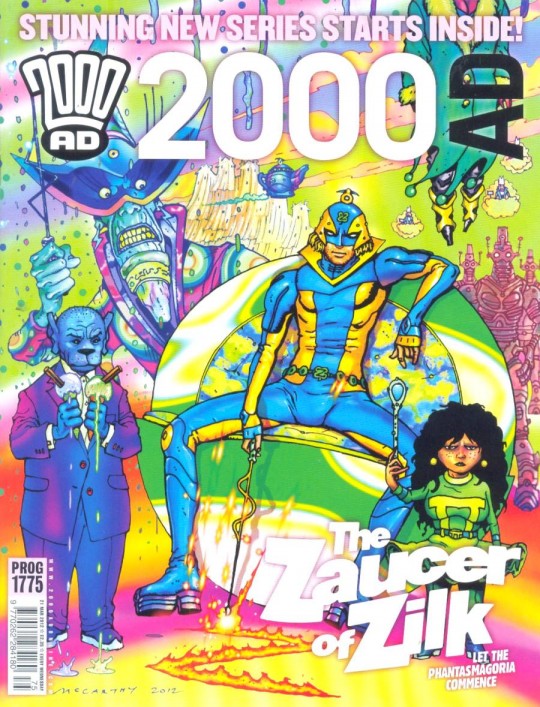
NOT the best comic got this week – that was the Dahmer one, shit man – but five pages of McCarthy = min five extra pp worth reading, so ten in total twenty-three and a half pee a page, stiff but SOLD!
BUT the second best comic of the week, and it was more like fifteen cash-worthy pages as it turned out, maybe a smidge above that even. Well worth the getting.
Resurrecting this sometime feature then, like the apparently endless reincarnaions of one’s interest in “)))ad itself, to ask the timeless question – Any Cop?
Believe. Renaissance, new Golden Age, best in decades, all that.
Bulletproof Omen
January 25th, 2012

Elephantmen #33, by Richard Star King and Shaky Kane. Gregory Wright on colours. Image 2011.
Despite his brutal murder in the final issue of The Bulletproof Coffin, Richard Star King, undead and loving it, is still making comics from beyond the veil.
Telly Terror: Threads
October 26th, 2011
 aka the obvious one…
Like Elephant, I didn’t see Threads at the time. It was deliberate this time, another video, borrowed years later on the strength of fearsome reputation. I think – but these memories could well be half invented, half-recounted – I think I can remember the day after Threads was first shown. Shocked and ashen elder sisters, parents bravely pretending everything was just the same as before.
We all knew we had a neighbour not 20 miles distant, forever an unwelcome megatechnological interloper into our innocently bucolic existence, who even if not an obvious first-strike target, still had that doorstep Chernobyl possibilty about it. Parents had explained roughly what it would mean if it went tits up, and I was shocked that there wasn’t something they could do about it. There was an apocalyptic timebomb just down the road. How did they go on without panicking? Why weren’t they screaming, shaking their neighbours and duly elected representatives by the shoulders, awakening them to the threat, begging for something to be done? How could normal life as I had always known it be so permanently close to the precipice of extinction?

Watching Threads again now, as the hardy among you will, that’s still the frightening thing – the destruction of the parental superego, manifested as the pathetically heroic, hopeless efforts of the municipal employees, those clerks and accountants, supervisors and secretaries holding onto the world, to save us all through continuation of a neat and orderly bureaucracy. The accumulated ballast of human society, those cultural codes and social securities, worthy words and high hopes, and all their inevitable extinction in the awful new reality beyond the opening of the atomic portal.
The sickest joke is the collapse of all those habits and symbols would not be instant and total. They’d persist in their broken, poisoned, ineffectual form for a short time after the initial massive surge of human casualties. The words and numbers we use to organise our newly nonexistent world would be walking around undead in the fallout, scorched and sick but stumbling shortly on, for some time after we were sick and starved and gone, prior to the eventual (and as it turns out, unlikely) dominion of the cockroach.
_______________________________
Other posts in the Notes From the Borderland series:
The Overlook Hotel – Kubrick’s The Shining
The Telly Terror 1: Elephant
October 23rd, 2011
Watch this clip. Do so unaware and unshielded, and come back and read the rest of the post after the clip has made you a different person. For the full authentic experience, or as close as you’ll get without being me twenty odd years ago, watch the final execution only, from about 4.12.
http://youtu.be/iJK_2xg_s6k
It’s doubtful any reading this is too young to remember VHS video. You would record a show onto a thick black fat analogue tape, and watch it later, again and again. When you had seen a show enough times you would tape over it with another show. The contents of each cassette gradually became a patchwork palimpsest of overlapping programmes, the end of each show running into the start of the next, or cutting into a film half-way, a rolling scrapbook of missing beginnings and abrupt endings.
Between the joins of one show and the next was the all pervasive void of snow, empty space on the tape, blank matter, the nonsense noise of the TV and VCR saying nothing to each other. The snowstorms were phase-shifts in your viewing experience, synaptic pauses triggering unstable responses to unpredictable stimuli. Evil faces looming evanescent from the abyssal squalls.
I don’t remember what I was watching beforehand, but I remember the snow, and I remember the last final minutes of Elephant. I haven’t watched it again since, so if the details her are wrong in fact, that’s unavoidable but hardly important. The endlessly brief expanse of ghost-space coalesced int two men, a brutalist building of British municipal anonymity, a landscape instantly familiar and obscure. They walk in eerie silence, with ominous purpose. They come to a third man who awaits them in an enormous, evacuated warehouse space. Walking in wordless footsteps, the pair reach the third man, who shoots one of them at point blank range in the head. The target falls away, cold and gone, while the camera peers, not flinching, or explaining or remarking, just showing, the oddly perfect star of blood and body on the curdled shining wall.
I sat agape, helpless, pulse and mind racing to come up with the appropriate physiological response, establish the right questions to make the right frame to understand this incredible eruption of quiet chaos into my pleasant little life. It was impossible to explain. I never mentioned this to a soul – what one thing was clear was that this was something I should not have seen, and could not be spoken of, even if I had wanted to brave the threat of explaining it to someone else, of fitting it into words. I rewound it of course, not too shocked for that, to convince myself it was real.
I was not the same person after that point that I had been before. I was the lone custodian of a precious terror that over the years I largely suppressed. It wasn’t until last year, and youtube of course, that the memory itself was unburied, that I learnt about Alan Clarke, and discovered what the elephant in the room really was.
Today, as then, the tellybox is a maligned feature of the household. It blasts idiocy daily into our domestic lives, provides an environmental niche where appalling things like X-Factor, adverts, and the 24hr news cycle may thrive. To admit to watching it is a shame, an admission of defeat. It breeds all kind of awful things.
But that glimpse of Elephant, that giant secret mystery of mine, those silent screaming strange minutes that still frighten me and are so precious and treasured, that was a product of the telly too. For me that moment has become an emblem of the cathode ray’s possibilities, its capacity to disturb instead of pacify, to entrance and enhance the viewer’s perception of the world, and to provoke instead of mollycoddle. The telly isn’t, or needn’t be, a mere transmission conduit for the flat consumerist imperatives of our teetering society. It can be something weird, and frightening, and magical, and uncanny – a really existing portal into impossible new territories. It can open up realms of fascinating and essential new potentialities.
As part of our Notes from the Borderland series (love that logo), we will be posting clips of telly that disturbed and detourned our minds. That shit us right up. The scariest, most toxic and wonderful moments of fear and strangeness we could find. You will not enjoy them, but they will make this most deliciously creepy time of the year yet more terrible and brilliant, sharp like a dead shark’s tooth. And teach you new respect for the baleful gaze of that odinic eye, that sits there, among you every day, flashing moments of bleakest wisdom from the corner to the heart of your living room.
_______________________________
Other posts in the Notes From the Borderland series:
Great moments in bastardry – Kill ’em all
September 24th, 2011

‘Multi award-winning writer Mark Millar has revamped the X-Men, launched a number one Spider-Man title, brought Captain America into the 21st Century and made Superman a communist. He is also the writer of the US industry’s biggest-selling comic book of the past decade, Marvel’s Civil War, published in 2007. His Wanted comic series was the industry’s biggest-selling creator-owned book of the last ten years until he smashed his own record with Kick-Ass, each issue selling more than Spider-Man and X-Men from issue one with an unprecedented five printings every issue. Both properties were sold as movies before the first issue hit the stands and everything Millar has ever created is in various stages of theatrical development. Wanted starred Angelina Jolie and James McAvoy. Kick-Ass stars actor Nicolas Cage.’
As that other great villain John Bender says, ‘The world’s an imperfect place’.
Still, Nicolas Cage though…
Eurobaddies: a spotter’s guide
September 15th, 2011
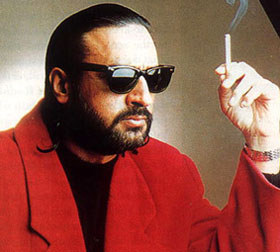
Hooray! It’s the 80s! Reaganomics forever unshackles money from concrete notions of labour and production! Credit and finance win forever! But wait: the American psyche becomes suspicious – it can smell something is not right. How can wealth no longer be attached to the creation of tangible value? What about the vast and mighty powerhouses of industry and agriculture (and forcible ‘freeing up’ of overseas markets – but forget about that for today) that American prosperity was built on? Are these going to rot? Is money just going to be a run of digits now, moved from place to place, percentages creamed-off for the great and the good to grow very fat on while the working man is left to suffer and starve? It is? Well that’s just unAmerican dammit! That’s dishonest, effeminate even – positively European in its emasculate, corrupted chicanery.
Beast and bobsy’s classic classics: the best of the League of Extraordinary Gentlemen part II
August 5th, 2011
-
Welcome to England
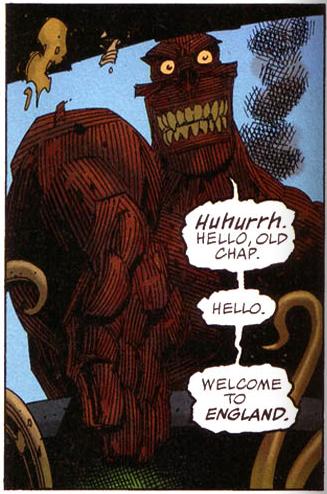
Perhaps the most terrifying words ever read in a comic?
The Martian invaders, who Wells presents as being foul on a level deep enough to be both visceral and ontological, are upon facing a grinning English gentlemen made instantly sympathetic, as we realise we’ve been cheering for the wrong side all along.
This isn’t what the Martians are supposed to be. It’s one of Wells’ great tricks – they’re the bad guys that the reader is permitted on a planetary scale to Other and despise. It’s okay to revel in the violence of the conflict and the cruel irony of their demise. They’re not like us. They wouldn’t show you any mercy. They don’t belong here. It’s OK, you can hate them and enjoy their pain. It’s OK.
It’s not OK. From chapter 1 we’ve been presented with the Martians’ badness (they’re not even Martians! They’re not even from there! Not originally, not like the good Martians) as a simple, natural fact. So we cheer when they are chased off that planet. When these disgusting things arrive on ours, and treat those nice Wokingians exactly as generations of Englishmen have treated those they met as they set foot on shore, we are shocked and appalled and call righteously for vengeance upon them.
What if they just want somewhere safe to live?
It’s the final kick of the second book, hidden away in one small panel in the middle of the sequence that’s supposed to be giving us our final emotional catharsis. The scale of what Moore and O’Neill do in these panel isn’t to be underestimated – it’s something of a watershed moment in English literature – trumping Wells’ Woking, Larkin’s Slough and Morrissey’s seaside town they forgot to close down. The repellent subject here withering under the poet’s red-hot glare is nothing less than England itself. The raw, fearful symbolism encoded in the imagery is unforgettable: the unleashed upper-crust, standing above England’s fetid carotid artery, physically devouring, digesting and delighting in the pain of this insect that thinks it knows about war and extinction, the gentleman so happy in their mutual immolation, their mingled ashes spread on the filthy red weed-choked water.
Come not to England ye monsters, ye Martians – there are plenty here already.
Beast & bobsy’s classic classics: the best of the League of Extraordinary Gentlemen part I
August 4th, 2011
-
I Can See You!
Bobsy and I were worried that we’d make this ‘Best Of’ a bit too Hyde-heavy, but it seems somewhat inevitable that this would the case, given the crowd pleasing nature of the big ugly bastard. If we can’t all love our Id what can we love…?
Way back in the first volume of the League there was a moment that you just knew was going to have some repercussions later on down the track. Caught midway through some brutal black ops with Edward Hyde, the Invisible Man gets a brief glimpse at his bleak, black future. In the sequence, we cut to an infra-red heat image of Griffin, seen through Hyde’s animal eyes. With the simple words “What? What are you looking at?” right there and then you just knew that Griffin’s invisible chips were cooked. By Christ, we didn’t know how horrible his comeuppance would be in Book 2, but with the look of feral glint in Hyde’s eyes in the next panel we at least get a hint. It’s the look of a cat about to commence the hunt with it’s mouse prey.
The simple but effective juxtaposition of Hyde’s ‘I’m not blind you know‘ with the realisation of quite how far from blind he actually is, is classic Moore. No-one does horror in comics quite as well Uncle Alan, and when pared with an artist as subtle and talented as O’Neill the effects are devastating.