Doctor Who: Dinosaurs On A Spaceship
September 11th, 2012
I suspect this will be the hardest episode this series for me to write about. Normally there is something interesting to say about an episode, even if only about how it failed. And more importantly, normally I have something *different* to say from what other people are saying. But this time, my reaction can be summed up in the same sentence everyone else is using:

Doctor Who: Asylum Of The Daleks
September 3rd, 2012
Does Steven Moffat not want to be writing for the Daleks?
It would make sense that he doesn’t — the Daleks are fundamentally uninteresting antagonists from a story point of view. They’re an incredible visual and aural design, of course, but as far as stories go, there aren’t really very many that you can do with them.
Doctor Who: Fifty Stories For Fifty Years – 1979
August 20th, 2012
Before we get going with this, a quick question — I’ve been thinking of releasing this series of posts, when finished (some time next year), as a book. Would anyone actually buy and read such a thing, or is it a bad idea?
I’m asking now, because here is where we head into a totally different realm of Doctor Who. I’ve done sixteen of these posts so far, and there are thirty-three after this. But fourteen of the sixteen previous ones have been about TV shows, with only two (Dr Who And The Daleks and Doctor Who And The Cave Monsters) dealing with non-TV stories. Of the thirty-four stories from 1979 to 2012 I’m dealing with, only fourteen of those essays will be talking about stuff that was actually on TV in those years. Four of them won’t even be about Doctor Who.
Because much of the 23,717 words I’ve done in this series so far has been setup. It’s only now, as we get to the close of the 1970s, that I can really start talking about what I want to talk to. From now on, these essays will be getting much longer, and much less in the “this happened, then this happened” vein. I have things to say. You have been warned…

Everything about Doctor Who changed in 1979, because Doctor Who Weekly started.
Doctor Who: Fifty Stories For Fifty Years: 1978
August 4th, 2012
Sometimes, plans change…
When I was planning this entry, it was all going to be about how this is the story in which two figures who will be important to this narrative from now on enter — Douglas Adams, whose first story this is, and who would go on to write two more and script edit the next series, and me, because I was born two days before episode two of this story aired. So from now on, the entries will be slightly more personal, as I will remember at least some of them from the time of broadcast.

But instead of being about people entering the story, it has to be about people leaving it.
Hurricane Selina and the Superdaughter
June 17th, 2012
Guest post by Hollistic Tendancies
Finally someone asks the question that needs to be asked. “You guys, are we seriously going to let the guy with the police-sketch face of a rapist tell us what to do?”
The Veep’s daughter comes to visit, and that Selina starts out by describing this as Parental Ground Zero is a good indication of how views this special relationship. “God, today is like the perfect storm,” she snarls when told her daughter will be there in two hours.
“Tell her I’m canceling the lunch that was supposed to prove there is nothing more important than Catherine, because something more important than Catherine has come up.”
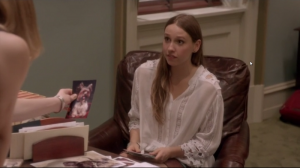
She’s quiet; people talk over her and make perfunctory attempts to talk at her which only provide a painful juxtaposition to their immediately switching gears and ignoring her hesitant replies. She’s taking an experimental theater course and wants to get a dog based on a photo that makes Amy say “It looks astonished, like it’s attached to jumper cables or something” because she thinks “it’s cute.”
Doctor Who: Fifty Stories For Fifty Years: 1977
June 17th, 2012
How good can a story be before its bad aspects are excusable?

The Talons Of Weng-Chiang is notable for many things — it’s the last story for Philip Hinchcliffe as producer (and he let the show go so far over budget to make it a good one that the budget was slashed for future series…), it’s the last story that David Maloney ever directed for the show, it’s one of Robert Holmes’ best scripts — but there are two things that make it especially notable — the blatant racism, and the terrible special effect of a rat
Getting Over Mild Food Poisoning is a Long Time in Politics
June 10th, 2012
Guest post by Hollistic Tendancies
“I need you all to make me have not said that. I need you to have make me unsaid it.”
Ah, here in episode 2 of Veep, we The Thick of It fans are in familiar territory: this could have come from the episode where the press conference had to be about nothing.
And yet, this is again very definitely America.
Meet The Veep: Guest Post By Holly Matthies
May 25th, 2012
My first thought upon hearing that Armando Iannucci was making a Thick of It-esque show for America was YES! Awesome! Because I love The Thick of It and, even though I’m from there and thus know what it’s like, I love America.
My second thought, of course, was how are they going to fit in all the swearing? There aren’t going to be any “we’ve negotiated for 100 ‘fuck’s per episode” type rules on that side of the pond. Even if it is HBO. The BBC has people on the Today programme say “cock-up” like it’s official government terminology. I don’t think America can compete with that.
Of course this is not the only thing different about America. Here’s how the Veep travels:
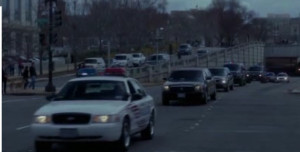
Police cars and police motorcycles, sirens blaring, lights flashing, a row of big black bulletproof versions of the strangely bulbous American SUVs that everybody drives. We’re clearly not in the Department of Social Affairs and Citizenship any more!
Beep beep, who’s got the keys to the Veep? Click here to find out, vrrrmmmm!
Doctor Who: Fifty Stories For Fifty Years: 1976
May 22nd, 2012
Through the millennia, the Time Lords of Gallifrey led a life of peace and ordered calm, protected against all threats from lesser civilisations by their great power. But this was to change. Suddenly, and terribly, the Time Lords faced the most dangerous crisis in their long history…