Doctor Who: Fifty Stories For Fifty Years — 1993
June 29th, 2013
By 1993, Doctor Who is a potential, rather than an actuality. The TV show has been off the air long enough that it could realistically be revamped, not just brought back. It’s not a TV series any more, but an idea for a TV series — an idea which can be done in many different ways.
Particularly, there were two ways that the series could be dealt with. The first, and perhaps the most obvious, was to make it ‘darker’ and more ‘cult’.

Doctor Who: Fifty Stories For Fifty Years — 1992
June 23rd, 2013
One of the things that people who want to defend the Doctor Who produced in the sixteen years the show was off the air often say is that it was hugely influential on the programme once it returned to TV.
Doctor Who: Fifty Stories For Fifty Years: 1991
June 9th, 2013
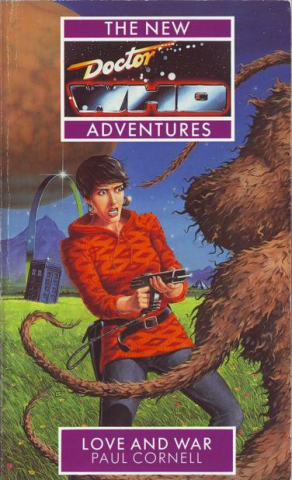
By 1991, Virgin Books (who had bought up Target some years previously) were rapidly coming to the end of the TV stories they could novelise, and there was no likelihood of a new TV series coming out any time soon. There was only one thing for it.

They’d have to hire people to write some new, original Doctor Who stories.
Doctor Who: Fifty Stories For Fifty Years: 1990
June 4th, 2013
By 1990, Doctor Who had finished on the TV. There was nothing left but the hopes of the occasional of old shows on VHS or (for stories that had been destroyed) cassette, the comic strip in Doctor Who Magazine, which surely couldn’t keep going that much longer now there was no TV show, and the Target novelisations, which themselves had to come to an end once there was nothing left to novelise.
Doctor Who: Fifty Stories For Fifty Years: 1989
June 2nd, 2013

As I write this, it has just been announced that Matt Smith is quitting the role of Doctor Who, effective as of the end of the year. There’ll be a new Doctor. There’s always a new Doctor.
Doctor Who: Fifty Stories For Fifty Years: 1988
May 26th, 2013
The Happiness Patrol is one of the greatest triumphs of Andrew Cartmel’s aesthetic as applied to Doctor Who. It’s a Brechtian political satire about consumerism and Thatcherism, a cutting polemic and the logical end-point of the theatrical tradition which I have spent much of these essays arguing is where Doctor Who is most at home.

Doctor Who: Fifty Stories For Fifty Years: 1987
May 25th, 2013
A quick note before I begin here — I had no home internet access for a month, and so wasn’t able to watch or write about the rest of the recent series. Sorry to those who were hoping for more reviews. That’s also why I haven’t looked at comments recently.

Doctor Who: Fifty Stories For Fifty Years: 1986
April 18th, 2013
The levels of taste and good judgement in the Doctor Who production office in the mid-1980s can be summed up in three words:
Doctor Who: Fifty Stories For Fifty Years: 1985
April 1st, 2013
Eric Saward hasn’t received a lot of love in these essays so far, but in the last full series he script-edited, Colin Baker’s first, he finally found a coherent aesthetic vision for Doctor Who. Whereas previously he’d been content to throw in as much violence and references to old stories as he could, by this point he had been converted to The Church Of Bob Holmes, and had come up with a semi-formula for the show that worked in the three stories that year where he could try it — comic double acts, vicious black humour, and a smattering of post-modernism with characters commenting metafictionally on the action. The fact that new companion Peri’s catchphrase became “all of these corridors look alike to me” gives a hint of the way Saward’s thoughts were trending.