Auto-animator: Imprisoning in Prison Pit Book I
September 22nd, 2010
In anticipation of this week’s UK release of Prison Pit Book Two, the follow up to Johnny Ryan’s psychopathically nasty but much-loved and lauded 2009 bio-carnage fightfest, let’s take a closer look at one of the many striking and remarkable panels we were so luckily and unapologetically offered by Book One.
Click to enlarge, and then again to go close-up – it looks great all blown-up and backlit.
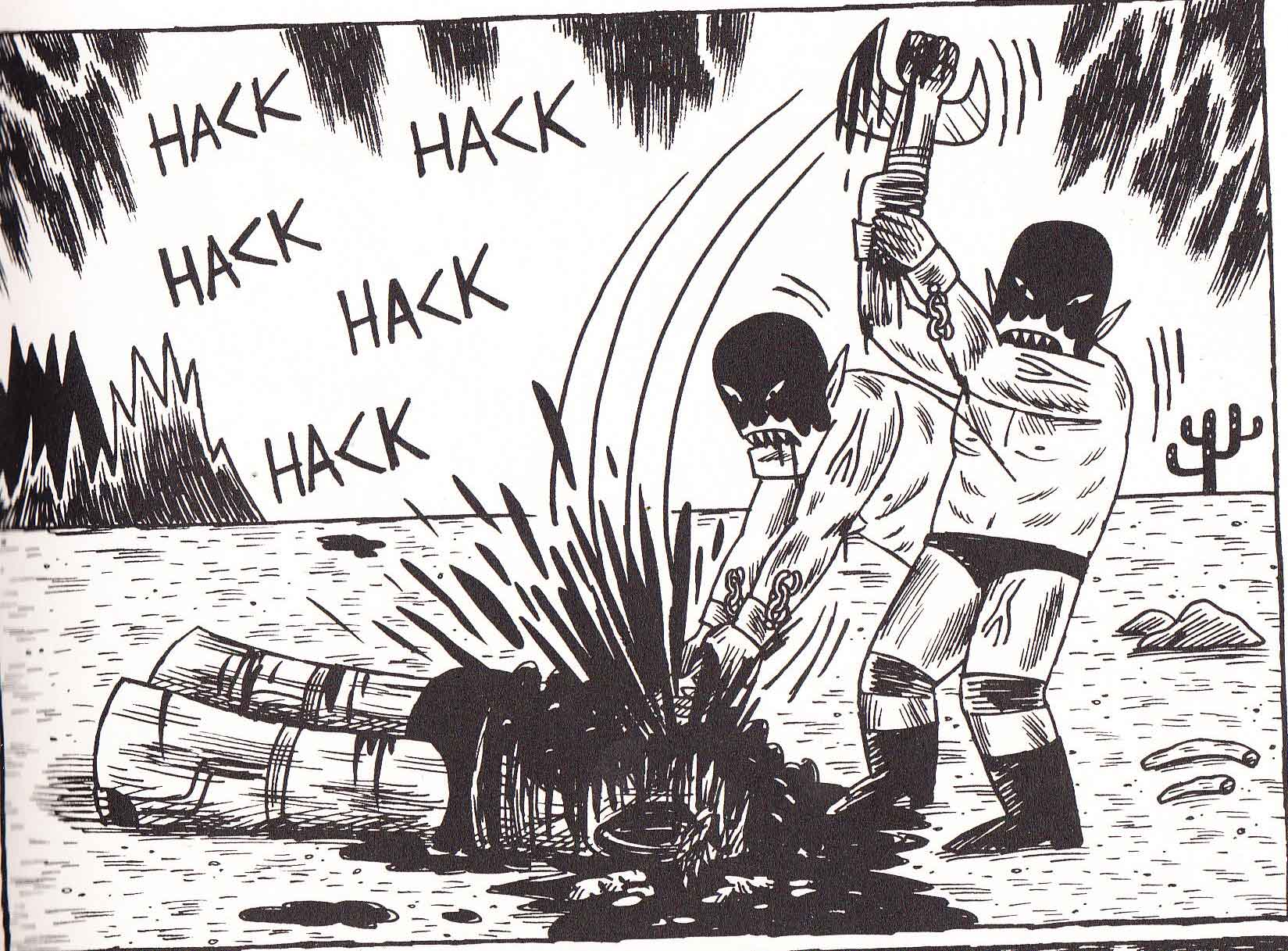
Of all the strange magics a comicbook can work on you, the simplest and most primevally engaging is the creation of motion. The static picture interacts with the reader’s brain and its preferred habits of interpretation to creates an apprehension of movement. The simple layers of the animator’s cells can be dispensed with to a degree: occulted kinetic energies flow and crackle on the contours of the single, isolated page; the cognitive processes at work here are relatively well mapped, but the affect of the effect is seldom considered.
Leaving aside for reasons of mental hygiene the temptingly obvious conclusion that the page itself actually is alive, that there actually is real, directed, infra-organic movement trapped there on the paper – primitive, sympathetic angels and aliens snared in an unforgivingly inky and repetitive prison*, the dangerous, all-too human desire to free them – we might have to consider the separate elements of design and composition, the fleeting and in Ryan’s case deliberately savage pencil strokes, the paths of dead lead that nevertheless serve to conjure this simulation of vital, dynamic unreality.
[*This panel works perfectly as a microcosm of the book itself, of course. There he is, CF, stuck in the panel, stuck in the Pit, really not happy about it, hacking and chopping and bashing and cutting and slashing and hacking again and again and again.]
Motion lines. You don’t have them in real life… except, you sort of do. They don’t appear to the eye, even the mind’s eye, but this comicbook convention does in fact represent a function of human perception. The person walking towards you does not leave convenient aftertrails of their image in their wake, allowing your mind and memory to understand. But you still know where they were a moment ago, don’t you? You know which direction they are travelling, where they were a moment ago, and weirdest of all, where they will be in a few moments time, provided their speed and trajectory doesn’t alter too much. This isn’t a terribly complex or difficult process. How do you think those pigeons avoid being splatted by cars? Depth perception and the ability to judge distance and speed are not luxurious human traits, more like simple processes adapted for basic survival. Like I said: Primeval. It runs deep. It works in a scratched groove on a cave wall, the schoolboy’s notebook, the brutalist-naive Fantagraphics trade paperback.
What’s great about this panel – a genuinely innovative formalism perhaps, I don’t bl88dy f88cking know – is the way the motion lines are a double edged sword, two discrete effects occurring simultaneously in the same space (Einstein was wrong! And not just cos seven sets of identical clothing is not a good look!)
Initially the lines do what you expect them to – they follow the axe-swing that begins top-right (this whole panel works against the flow*, twice – left-to-right and bottom-to-top), bringing the eye down to land with a heavy thwack. CFs screaming angry face follows you down too – the movement doubles and redoubles. Then a weird thing happens, and you notice that the same motion lines that a minute ago were saying ‘down this way’ are now saying ’back up this way’. So you follow CF again as he painfully drags the hand-axe from the mess of flesh and metal at his feet. And then back up at the start, you realise that the punishment he’s dealing out to this poor old asshole on the floor isn’t over yet, he hasn’t had enough, he’s going to hit him again. Down we go. And back up, and… This goes on for quite a while, this moment held fast and stretched out, until that face, with its look of rage and hatred – which you’re reminded of twice with each blow in a horrible, mathematically obscene doubling of infinity – passes from raw emotion to something blank and quite sublime, and far more upsetting. You then start to realise that you’ve been looking at this panely, observing it’s recursive, crystalline banality, for quite some time now. You realise that unless you’re careful you can watch this panel playing itself out, in real time, again and again,for hours and hours of black ink blood and soft steely impact and you could continue to do so quite unaware of the deformities growing in your now hopelessly lost little mind for hours and hours more …
But you really, really shouldn’t. And you’re back in the room.
*‘Shoot the Fox? Against the flow?!’ Name that sporting event reader…




Leave a Reply
You must be logged in to post a comment.