Doctor Who: Season 22: Introduction
July 4th, 2017
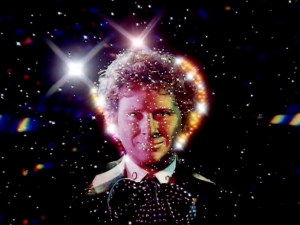
It’s Doctor Who week here on mindlessones.com. Specifically, it’s Doctor Who Season 22 week.
MINDLESS ONES AT THOUGHT BUBBLE 2016
November 5th, 2016
Are you celebrating comic book Christmas in Leeds today? Are you struggling to fight off the sense of despair that comes with another winter, suddenly sure in the knowledge that your attempts to break the wheel of time itself have been unsuccessful – again! – and that while it might feel like you’re living in a bubble where nothing ever changes, that’s an illusion that can’t survive winters yet to come?
Are you at the Thought Bubble comics convention, trying to find something that will make the change of seasons seem bearable?
If so, why not come see the Mindless Ones at tables 13 and 14, New Dock Hall?

We might not be able to solve your problems, but I can guarantee that we’ll haunt your dreams.
We’ll also be blogging for money throughout the weekend – for a penny a word, one of us will write about any topic of your choosing. If you’re looking to be really cruel you should wait until Sunday morning when we will be at our most vulnerable and ask us to write a 25,00o word justification of the life of Mark Millar.
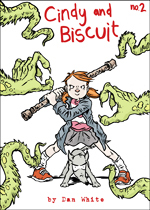
The Beast Must Die / Dan White is here, selling Cindy and Biscuit – The Bad Girl part 2:

If you like comics that are packed full of adventure and strangeness and gross humour comics, you’ll like Cindy and Biscuit!
Gary Lactus / Fraser Geesin is here flogging his autobiographical comic The Cleaner:

If Fraser wasn’t a pall I’d have made a fool of myself online by banging on about The Cleaner at every possible opportunity. As it is, I’m mostly going to stick to burbling lovingly at him in the pub, telling him about how the attention he pays to the overlap between everyday chores and outsized thoughts makes for one of the most hilarious and profound comics going.
My main man Mister Attack / Scott McAllister is selling copies of his student sit-com comic Wake Up Screaming, and Points on a Graph, the story of a man who is separated from his body and still has to go to work on Monday:

Scott’s one of the funniest guys I know, and his comics are a testament to his digressive wit and wicked imagination.
Andrew Hickey / Andre Whickey will be here selling his books about Doctor Who, Seven Soldiers, The Beach Boys, and the concept of entropy for £3 a pop – not a bad price to have a load of new connections in your head. Andrew will also probably be writing 10,000 words a minute and shaming the rest of us with his ever-productive brain. The bastard.
SILENCE! #187
May 9th, 2016

LET EM KNOW I’M LOOKING FOR A BIG FAT DOPE SACK WITH ENDS TO SPEND
Did you know that it’s Free Comic Book Life this life? Well it is: all comics are free in this life – and who’s to say about the next? – thanks to the generosity of Mr Stan Lee, an adorably uncley sort who invented the medium we call comic books and all the superheroes so beloved of your local multiplex.
But in a life of free comics, comics unchained and in flight, comics whose parole board hearing finally came through, comics who finally managed to dig that hole and jump over the fence, comics comics fripping everywhere, in a life full of free comics how are you going to pick the right ones to read?
Don’t worry your pretty little head or your ugly old mug about it, because Gary and the Beast, except not the Beast, are here again to tell you what the good comics are in another roar-ripping episode of SILENCE!
<ITEM> Adminism at the top of the show: sponsorshizzle and eff see bee dee news.
<ITEM> Then in probably the best thing to have happened to this podcast in a call code for an LA homicide of shows, Mr Carter’s Math(s) Class use their angelic tones to in unison open The Reviewniverse – an imaginary place – aren’t they all hmm, hmm? – where comics are talked of. Gary and NotBeast bash their heads on Tom Gauld’s Mooncop, Alan Moore’s Cinema Purgatorio, Becky Cloonan’s The Punisher, Kaare Kyle Andrews’ Renato Jones The One%, Black Mask’s 4 Kids Walk Into A Bank, the telly license payer’s Dr Who and perhaps not much more.
<ITEM> Oh and Captain America: Civil War – we talked about that in there too but I can’t remember if it was before the comics or not.
<ITEM> Sorry! Thanks love you!
Click to download SILENCE!#187
Contact us:
[email protected]
@silencepod
@frasergeesin
@thebeastmustdie
@bobsymindless
This edition of SILENCE! is proudly sponsored by the greatest comics shop on the planet, DAVE’S COMICS of Brighton. It’s also sponsored the greatest comics shop on the planet GOSH! Comicsof London.

Thought Bubble Post: Daleks and The Cleaner
November 15th, 2015

Yes, it’s another THOUGHT BUBBLE SPECIAL POST!
This is the first of two essays commissioned by James “patron of the arts” Baker, who has asked for five hundred words each from me and Bobsy. James wants me to talk about what Daleks mean to me.
It’s a difficult one, actually, because I grew up in the 1980s, when the Daleks were mostly being used for their recognisability, but being written by a writer, Eric Saward, who would much rather have been writing Cybermen stories. So while the standard iconography of the Daleks tends towards a combination of fascism and Frank Hampson space adventure, for me, the Daleks are all about body horror. The formative Dalek story for me was Remembrance of the Daleks, and so I think of humans being turned into Daleks, of Davros reduced just to a head, of dead bodies being processed for food.
SILENCE! #86
December 17th, 2013
Welcome to this EXTRA SPECIAL edition of SILENCE! Get ready to swivel your mind with delight as you are guaranteed 100% Gary Lactus and 0% The Beast Must Die in the following narrowcast. Christmas really has come early! Pinch yourself! HARDER! USE TOOLS! DO IT ON A MORE SENSITIVE PART OF YOUR BODY! NOT THERE! THERE! That’s right, this is not a dream! Stop crying and listen to Gary EXCLUSIVELY reveal his latest work as sci fi writer M. Gary M. Lactus! Then THRILL as he interviews Gareth Brookes about his truly unique graphic novel, The Black Project. Then listen to it over and over again, louder and louder until next time! Keep it cosmic!
Contact us:
[email protected]
@silencepod
@frasergeesin
@thebeastmustdie
@bobsymindless
This edition of SILENCE! is proudly sponsored by the greatest comics shop on the planet, DAVE’S COMICS of Brighton.
It’s also sponsored the greatest comics shop on the planet GOSH! Comics of London.
Doctor Who: Fifty Stories For Fifty Years — 2012… and the next fifty years
November 23rd, 2013
Before the last of these essays, a little bit of other stuff…
This post is going to go live at precisely midnight — at which point it will be the fiftieth anniversary of Doctor Who, and so this is the last of the fifty stories essays.
Enough people said they would want a book of this that I’ve put one together, and that is also available from midnight tonight. You can buy it as a paperback, hardback, Kindle ebook (US) (UK), or non-Kindle ebook (with no DRM on the ebooks). And for those of you who visit us at Thought Bubble, you can buy a paperback copy off me personally.
But don’t worry if you’re too poor to buy one, or you just don’t like me and don’t want me to have money — the essays are essentially the same as they were when published here, but without the dodgy screencaps, and with quite a bit of copy-editing and fact-checking. You can still read the original versions here for free.
But anyway, here’s the last essay
Doctor Who: Fifty Stories For Fifty Years: 2011
November 22nd, 2013
Doctor Who: Fifty Stories For Fifty Years: 2010
October 29th, 2013
Doctor Who has had several radical reinventions over the years — when it stopped being about Ian and Barbara, when the Doctor first regenerated, when it became an Earth-bound show during Pertwee’s time, when it stopped being on TV altogether and became a series of books…
Most of the time, the programme has a tendency to revert back to something like the mean, but each time it retains some of the new with the old. Steven Moffat’s reinvention of the programme is, one suspects, another time when this will be the case.
Doctor Who: Fifty Stories For Fifty Years: 2009
October 20th, 2013
“What we may be witnessing is not just the end of the Time War, or the passing of a particular period of post-war history, but the end of history as such: that is, the end point of mankind’s ideological evolution and the universalization of Western liberal democracy as the final form of human government.”
With apologies to Francis Fukuyama