Mindless Ones at Thought Bubble 2025
November 15th, 2025
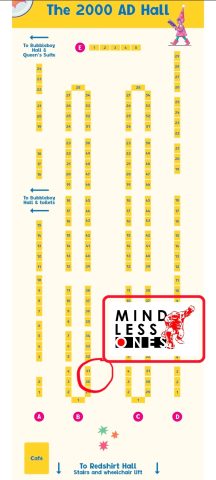
If you’re near Harrogate this weekend and fancy talking into our faces or buying our comics, come visit us at Thought Bubble comics convention, tables B30-31, 2000AD!
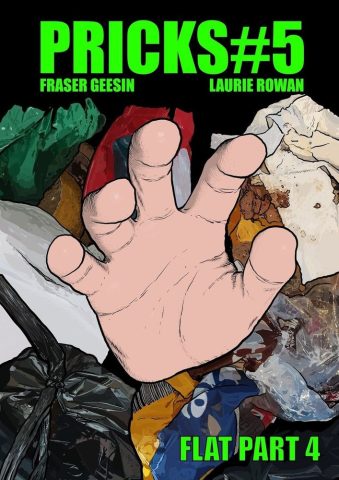
Big massive genius Gary Lactus will be there with the latest issue of Pricks, the comic that’s come closest to capturing the feel of this rotten moment we find ourselves in. As for how it gets this tactile sensation across to the reader, well, you’ll have find that one out for yourself.
Mister Attack and Tam Rolland are debuting Reliable Witness this weekend. Taking Glasgow’s mythology as its starting point, this is a modern horror story in the style of Delano’s Hellblazer – just remember, you heard about it here first!

Handsome Dan Cox will be flogging his Doom Patrol zine, collecting work previously seen on the Mindless Ones newsletter (subscribe today!). Every issue comes with an individually collaged cover, because of fucking course it does.

Hench legend Paul Jon Milne is back with Suture, sure to be one of the year’s most powerful comics.

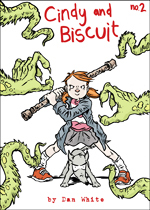
Last but not least, fancy pants author The Beast Must Die will be sat beside us at his own table, B29, 2000AD Hall. The Beast will be selling copies of the first two volumes of Cindy and Biscuit, alongside Secret Oranges, a collection of his early works.


The Beast Must Die will also have copies of the first issue of John Riordan’s William Blake biography Los at his table, because sometimes brilliance needs company.

If you’re about today, Saturday 15th November, Gary Lactus and The Beast Must Die will be hosting the SILENCE! to Astonish panel with Affable Al Kennedy at 1.45 in Panel Room 1 – Queen’s Suite.

As the blurb above says, this year’s show will feature the dream lineup of Al Ewing, John Allison, Kieron Gillen and Megan Huang as guests – 18+ only, in case someone does a swear.
MINDLESS COMMUNICATION – Watters
August 9th, 2025
Makes cool art/music, for example: We Are No Longer Strangers (2024). Official Daredevil enthusiast. Worth keeping an eye on his Instagram, always something going on there.
Who are you and how did you become a man without fear?
My name is Watters and I am what many describe as “cool music guy”. Basically I am an Artist who makes lots of cool things all of which are informed around my lived experience as a disabled person.
However what I feel sets me aside from a lot of what is out there when it comes to representing people like me is that what I make isn’t made to be anything in particular and what I mean by that is a lot of your typical mainstream disability programming tends to fall into two schools, the first being inspiration porn which often consists of infantilising disabled and neurodivergent people and presenting us almost like Zoo animals, a good example of this is Channel 4 producing a show called “The Undateables” and then touting it as inspirational programming and representation, it exists purely to make non-disabled people good about themselves.
The second is the trope of tragedy, that life as a disabled person is miserable, “they can’t do anything” and are often in fiction window dressing/a storytelling object.
What I do and what I make is neither. It is one of the most honest and real representations of disabled life but more specifically my life. Because that’s all it is. It is me unabridged.
Read the rest of this entry »MINDLESS COMMUNICATION – Al Ewing
July 26th, 2025
Writer, Absolute Green Lantern (with Jahnoy Lindsay, 2025 – ), Metamorpho (with Steve Lieber, 2024 – 2025), The Immortal Thor (with Alex Ross & Co, 2023 – 2025). Ace podcast guest. Superstar DJ. All round sound human being.

Can you remember the first time you thought about alien intelligence?
Probably last week. I’m doing at least one book about alien thought processes and how an alien philosophy might differ from our own… while still cheating it all completely by having that different alien philosophy say things about very real and destructive human philosophies that we can’t get away from. That said, I always enjoy a nice New Wave of SF story about navigating alien systems of being, so there’s plenty of that in the DNA.
What are the chances of anything coming from Mars?
A million to one, they said! The chances of anything coming from Mars are a million to one – but still they come!

You once said it was important for Metamorpho to have a sincere relationship with the audience. Which element do you have the most sincere relationship with?
I’m incredibly sincere about the element oxygen. I think that’s the one you really can’t fake a relationship with. Eventually, of course, I’m going to have to break up with oxygen – but not by choice.
Can you say anything about the future of Absolute Green Lantern?
The further along I get with it, the more it reveals itself to me. Every issue from here will bring new and strange revelations until the tangled timeline of the book is entirely filled in… at which point, having untangled time, we tangle space and take a detour to the other end of the universe. I’m writing that one now.

In your dreams, are other worlds still possible?
I still dream, both literally and figuratively. If I were to believe that other worlds were no longer possible, I’d have to drop comics and become an op-ed columnist.
What’s next for you in this world?
Life’s a bit of a Red Queen’s Race at the moment – I’m running full tilt to stay where I am – but some future plans are starting to make themselves known in the present. Big things are manifesting in the world of Thor, for example. Meanwhile, in the personal realm, I’m DJing again – that might go somewhere exciting, or stay at the level where it’s a comfortable night out with friends.
***
Hamlet was a Dinobot too
July 15th, 2025
To be, or not to be. That is the question. These comics I hold… Are they a record of what will be, or only of what may? For if the future is indeed immutably foretold in these short reviews… then my demise is but moments from that confirmation.
Worms: Book The First – Erika Price

Last time I talked about Erika’s work on here I just about got the sense of it over – “It’ll get under your skin. You’ll want it there.”
What this doesn’t quite capture is how her work feels once it’s worked its way past your psychic barriers. A line from this issue presents itself: “That night rippled through the whole city.” I knew this comic was the real stuff, the best stuff, by the third page, when the backdrop to a confession seemed to writhe and twist in front of my eyes across three rancid panels.

Erika’s comics have always been warped formal marvels, with carefully worried lines stacked on top of each other in patterns both intricate and suggestive of some sort of deeper unravelling, but there’s a mounting sense of dread to Worms that might just surpass anything she’s done before. Topical stuff, really – a conclave and its aftermath. Dark intimations about the new leader. Stuttering guilt, barked theories, recrimination. Writing to match the art, check the sequence where an internal monologue is put through the shredder while Eulogiuseley sits in front of knife and fork, lost in lost thoughts, feast not yet in front of him: “Have you ever woken up one morning to find your whole world, nay, your whole reality, is rotting away beneath your feet?”
Ripples within ripples within ripples. The whole city. The night. “Have you ever woken up one morning to find your whole world, nay, your whole reality, is rotting away beneath your feet?” There’s a mounting sense of dread to Worms that might just surpass anything Erika’s done before. Did I say that already, before the feast?
Detective Comics Annual 2025 – John McCrea (art), Stefano Raffaele (art), Fico Ossio (art), Al Ewing (script), Lee Loughridge (colours), Triona Farrell (colours), Ulises Arreola (colours), Tom Napolitano (letters)

We famously love a gonzo Bat-epic around here, but do you know what’s a wee bit undervalued in the post four dimensional Bat-squid era? A nice done-in-one mystery with Batman in it. “Detective Comics” they’re calling it, over on whatever cursed platform they’re using to propagate new sales pitches these days.
This annual is a perfect example of the form. Starts with a locked room murder and works its way to a big face-off with the perpetrator by way of a scenic trip to York. Vivid scene setting across its locales, from the hermetic rich man’s world where we begin to the very English churchyard where things get weird. Three artists for three sections so the “art jam” aspect of it doesn’t get too grating. John McCrae’s chapter is the clear stand-out, his work a welcome break from the impacted gothic house style. McCrae’s pages are full of bright pink light and well kent cop faces, all characters drawn with a bit of spring in their limbs, all backdrops rendered like unusually convincing film sets.

The panel above gives the trick away: even when writing a functional Bat-mystery, Al Ewing finds away to bring the uncanny into the story. The Bat’s solid but flexible, y’see – it can solve a crime, beat a magician at his own game, and incorporate Ewing’s current thematic occupation with unfathomable tech fuckery along the way. That’s why it’s the McCrae sequence that really sings. For a few pages in the middle there, the art is clearly every bit as adaptable as the guy with the big cape and the bulging toolkit.
As for computers, “Sophisticated idiots–they do only as they’re told.”
The Return & other short comics – K.Briggs

Already reviewed in a recent issue of the Mindless Ones newsletter – subscribe today if you haven’t already – and now available to order! To borrow some words that aren’t my own:
Briggs doesn’t really make comics like anyone else I know, I think there’s probably a “high Vertigo” ‘95ish influence but it’s not… they are never really narrative driven, I think they are ponderous if you can imagine that not being used pejoratively; a synonym of meditative but that has implications that I find sort of annoying, there’s a strong fine art sensibility that I only know enough about to vaguely recognise and can’t perform any disquisition on really, but I always find the work moving and connecting in ways that are… essentially I think what is done here with colour and collage drawing the eye across simple, diaristic blank verse – everything is everything remember & this is closer to ee cummings than it is to 95%(?) of comics – is what we have always been trying to write about, the art of life, these intercuts and disjunctions are essentially omnipresent in my own experience but to read a story – per my earlier post-Gaiman misgivings about “story” – or even biographical account, it’s incredibly rare to find something that matches the abstruse mind(/less) in action; M John Harrison’s writing about writing anti-biography Wish I Was Here is probably the closest to authentically being inside someone’s head I have chosen to be…
The comic in part is about having things in your head that other people have put there, I awoke with the dreamlike phrase “You have disconnected yourself from your real self” the other day – about my latest sexual frustration probably – it is a feeling or sensation I know and see mirrored here… all the stupid presets folk wanted to put on you, well they were wrong because how the fuck would they know better; the process of building the right life is long, hard, onerous and you will have to be so strong, and the haters and losers can waylay you… here is a pathfinder, though
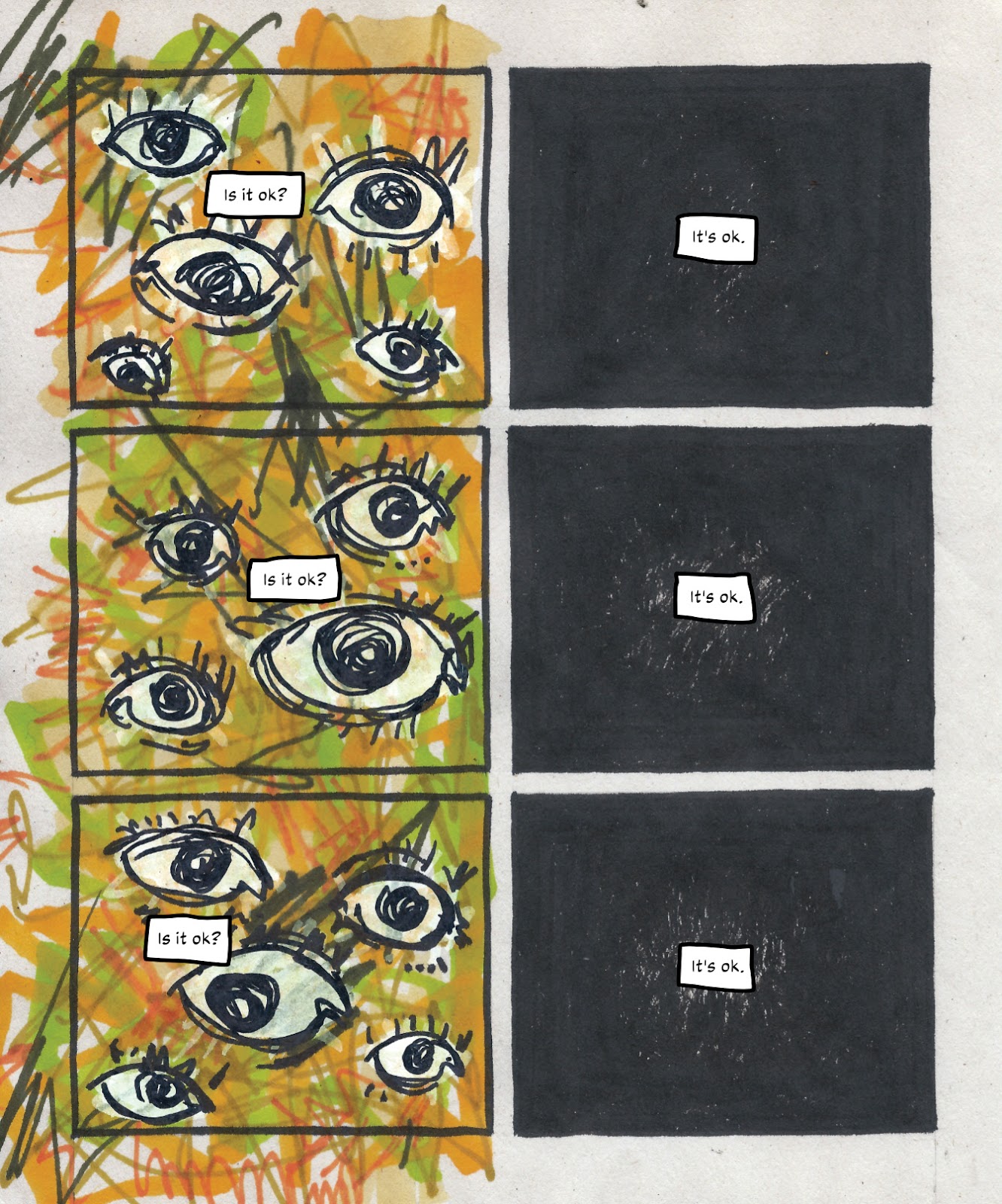
I’m feeling too close to the page to add much to that right now. What I will say is that the fine art element is in full effect here, as it always has been with Briggs comics, but that The Return is their most immediate experiment in autobiography so far. The tactile aspect that’s always been there in their use of collage matched here by the immediacy of the line, the shape making more urgent than ever; reading all of these strips in one go, it’s possible to feel like the art is streaming directly into your brain.
Read the rest of this entry »MINDLESS COMMUNICATION – Kieron Gillen
July 12th, 2025
Writer, The Wicked + The Divine (with Jamie McKelvie, 2014 – 2019), We Called Them Giants (with Stephanie Hans, 2024), The Power Fantasy (with Caspar Wijngaard, 2024 – present). Also writes a mean newsletter (not the kind that hurts your feelings), sometimes even talks about games.

Tell us about power.
Power is a fantasy.
Tell us about fantasy.
Fantasy is power.

I sometimes wonder what my career would look like if I just was happy to just release gnomic statements into the world and wasn’t addicted to trying to communicate with people. I suspect “I’d have more free time” instead of indulging my hypergraphic bullshit. Seriously, I was going to download a ridiculous amount of stuff in the microinterview before deciding that, no, Kieron, it’s Microinterview. Understand the brief.
To actually answer the question, Power is the ability to make reality align with your preference. As such, all power is suspect. A lot of my work has circled back to the soft power of art, specifically to be suspicious about it – writing stories about stories fucking us up, writing the equivalent of the warnings on cigarette packets. I’ve concentrated on that aspect of power as it’s my neck of the woods – but also as it’s the one which is the first, necessary step to any other abuse of power. One needs to tell themselves a good story to be happy to kill someone. The power of art is to aim the gun of most other forms of power.
Read the rest of this entry »MINDLESS COMMUNICATION – Tom Humberstone
June 28th, 2025
Writer/artist, Suzanne (2022), I’m A Luddite (And So Can You!) (2023), Introduction to Charts (with Chrissy Williams, 2024). His Grave Offerings newsletter is gorgeously illustrated and sharply written; you might go so far as to say it’s ELITE.

What can you tell us about the similarities between comics and poetry?
There’s a quote in Alan Moore’s Writing For Comics where he discusses comics that try to mimic film techniques that has always stayed with me:
“In the final analysis you will be left with a film that has neither movement nor a soundtrack […] Rather than seizing upon the superficial similarities between comics and films or comics and books in the hope that some of the respectability of those media will rub off upon us, wouldn’t it be more constructive to focus our attention upon those ideas where comics are special and unique?”
Too many people, I think, see comics as storyboards for film projects or view the page as a series of shots rather than a collection of panels. It’s always struck me that we were looking to the wrong medium for inspiration. Comics, for me, have always been much closer to poetry. And thinking of them that way allows a creator to do so much more lateral and abstract thinking about how to approach a page’s layout and composition. You stop thinking in terms of shots and think more holistically about the page itself. That’s not to say I don’t look to film for inspiration – I’m always reading about what cinematographers have to say about depth of field, shot compositions, lighting and colour. But we should, as comics creators, be looking to every medium to help us understand what our own does so well.
Chrissy Williams and I co-edited a book about poetry comics and came up with a list of statements that could be true of poetry and comics:
- economy of line is paramount
- each panel and page must be carefully constructed
- consider how much will fit on the page
- put everything in its right place
- choose whether to prioritise ideas or form
- juxtaposition is an important tool
- composition is not linear, but a whole system of architecture
- the reading process is one of interpretation rather than perception
- the reader is inextricable from the art
- all the right notes, not necessarily in the right order
- what happens off the page is as important as what happens on it
- the impossible can be made possible
What can you tell us about the differences between comics and poetry?
Ultimately, I think it comes back to that Moore quote about trying to focus on what makes comics special and unique. You can draw parallels to and inspiration from other mediums, but as a comics artist, I think it’s also worth coming back to asking yourself: “Why should I communicate this idea/story/feeling in the comics medium instead of all the others?” Sometimes the answer to that question can be as simple as: “Because I know how to make comics.” But it’s worth thinking about all the same. Comics can do things that other mediums can’t and can’t do things other mediums can – we have to find ways to play into their strengths.
Read the rest of this entry »MINDLESS COMMUNICATION – Craig Collins
June 14th, 2025
Writer/artist/certified hunk. Collaborator with Iain Laurie on small press comics with unpleasant titles (Crawl Hole, Roachwell, acht, Metrodome’s not too grotty). Purveyor of occult wisdom (Billy Quest, The Ultimate Ross Geller Fanzine). Script droid on Ales of the Unexpected.

How did you and Mark Brady come to do a monthly strip for Ferment magazine?
Mark and I had finished our first bit of collaboration – tactile medieval battlefield workplace silliness in Medieval Times – and were considering a few things for our next project. I’d been getting Beer52 boxes for a few months and noticed the comic they had going in Ferment had dropped out the magazine. I thought we could have a lot of fun with it and I do like the challenge of a short gag strip, so we worked up some strips for a speculative pop at it. Unexpectedly enough, we were successful!

Do you guys get much feedback on the strip from readers?
Not a thing! It’s kind of crazy to think that given the membership of Beer52 and the number of people receiving Ferment magazine we must have somewhere between one and two hundred thousand people at least giving the strip a cursory glance once a month. Far, far more than has read any of our other small press work. But no, not a word either way. It’s cool though, we are stoic in the face of ambivalence.

Are there any particular strips that are favourites or felt like some sort of breakthrough?
I wouldn’t say breakthrough, as the groove and working pattern we found from the get go has served us really well and we haven’t had to modify it. But I have loads of favourite strips, and what’s fun is to link back to older strips and characters and expand the secret internal mythology of Ales that only Mark and I care about. To pick a favourite off the top of my head, maybe the Pilsner Pickelhuabe one as it’s a bit of classic Ales escalation and exactly the kind of thing Mark does an outstanding job on.
Any chance we’ll see a collected edition of these strips in the future?
I’m pulling that together, albeit in a stop-start manner for what seems like forever!
Do you and Mark have any other projects on the go, together or separately?
If I get an Ales collection complete in some shape or form it would be lovely to go back to Trapped!, our dungeon crawling fantasy comic.

Finally, if you had to be any X-Men character who would it be and why is it Gambit?

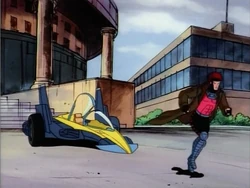
Covid brought about significant changes to th’ way we live, and some of them have been difficult for ol’ Remy LeBeau. Jus’ one example is the ubiquity of de contactless payment. One day Gambit is taking an X-Jet through McDonalds drive through (de McRib is back). Garçon leans out wit’ the payment machine an’ the Cajun reaches for th’ Mastercard. But den de muscle memory kicks in – first we charge de card MWAAAAP – an’ den we flicks it through the window. Bang. Limbs an’ blood an’ broken glass… that boy is dead. Maybe others. Next ting we know, de Cajun is on th’ run an’ de Professor is screaming in his head “GAMBIT, RETURN TO DE MANSION! REMY, YOU HAV’ TO FACE DE JUSTICE!”. An’ no McRib. So what I’m sayin’ homme, is dat Gambit is tryin’ to be a better man in a complex an’ ever-changing world.
MINDLESS COMMUNICATION – Isobel McKenna
May 31st, 2025
Guitar/bass/effects/vocals: Guisers, Even Sisters, Blue Kanues… fukken hunners of bands, honestly (see below). You can enjoy Isobel’s patter here, and support her on the Vivarium Sounds Patreon or by trading cash for local sonics on Bandcamp.

What are the best sounds you’ve made?
The stuff I’m doing in my band Blue Kanues each time we play together. No matter what song I bring to practice, the three of them Hannah, Laura and Mattie all come up with the most beautiful parts. We are going to record an album and will be playing a Glasgow show at the end of June (UPDATE: June 27th at Sharmanka Kinetic Theatre, gig fans! – Ed).
What are the best sounds you’ve heard?
The best sounds I have ever heard was deep in Hangasjarvi when I lay down in the what seemed to be quiet forest and then after a few moments of silence there was sound coming at me from every direction.
What can you tell us about East Kilbride?
Coming from Motherwell, East Kilbride seemed quite fancy when i would visit my uncle as a kid and when I was a bit older I played in bands there with my cousin and his pals and smoked a lot of hash with old punks and hippies and bams and listened to all the music they would play me, a lot of which was terrible but among the dross was stuff that really encouraged me to play more music
What can you say about Glasgow?
Glasgow is where I live just now. I like walking up to the flagpole in Queens Park and try and get up there to see the nick of the central belt every day. The buses are extortionate.
You’ve got a track called ‘Target: 2006‘. Which Transformers are best and why?
Target 2006 was the first big story in the UK comics after Dinobot Hunt for me. I remember reading it all before the movie came out so knew who Galvatron was in advance. My favorite Transformer is probably Ratchet. I had the wee toy of him and thought he looked really cool and then saw that the comic and cartoon representation of him was quite different to the toy. I really liked him sneaking about the Ark and recovering the Dinobots and then later the horror of him being merged with Megatron. Great cunt.

What are you working on now?
I’m working on a few things. The Blue Kanues album is the main focus but I also play bass in a band called Life with Laura who plays guitar in the Kanues. I just recorded a black metal record with Laura and it will be getting mastered and mixed by Robert Dallas Gray and we are going to look at having it come out as a physical thing. The band is called Spring and the record’s name is Forth.
I walk around with a microphone and make noises for Even Sisters with Robert. I do a band with my bf called The Loaning where we have been filling up cassettes with jams and field recordings all made on a portable wee fisher price cassette recorder. I have a country band called OPULENCE who plan to play one gig and record an album.
I’m also working away on a lot of songs I have been recording on my phone and then overdubbing on a 4 track and there are close to 30 songs on it. I keep playing guitar and bass, either or both every day.
IT IS THE YEAR 2025!
May 26th, 2025
From secret staging grounds on two of Cybertron’s moons, the valiant MINDLESS ONES prepare to draft some short comics reviews…
Metamorpho: The Element Man #5 – Steve Lieber (art), Al Ewing (script), Lee Loughridge (colours), Ferran Delgago (letters)
Issue after issue, Ewing and Lieber find new ways to turn the language of groovy “educational” comics into an invitation to play. My favourite individual example of this so far is in issue #3, a two page spread drawn like a maze puzzle for kids/timefuct beatniks, with inserts showing our heroes blundering through a series of traditional perils.

Without this fundamental conceit, and its perfect extension of “a solid chromium foot… one of the hardest substances in the human body” into a bespoke absurdist aesthetic, some of this comic’s barbs against “A.I.” would have felt like mere prompts for applause. As it is, they’re of a piece with the Mad Mod’s monologues, or this issue’s grand duel between solar avatars – carefully arranged incongruities set in opposition to the banal ones our culture is producing en masse.

Resistance is all about finding the space in between the circuits, you see. Easier for Element Woman and Andor than you or me, but don’t let that stop you trying, Metamaniacs!
Batman/Superman: World’s Finest Annual 2025 – Dan McDaid (art), Christopher Cantwell (script), Mark Waid (story), John Kalisz (colours), Steve Wands (letters), Dan Mora (cover)
Let me pay this comic one of the highest compliments I know: having read it, I don’t need to read any of the other issues in this series. This despite the issue in question being part 3 of a 6 part crossover between this comic and Justice League Unlimited. Writing an entertaining single issue under these conditions is a distinct formal challenge, and Cantwell and Waid have a lot of fun with it here, loading up a villainous plan with a twist that is both skilfully foreshadowed and compelling in its own right.
Artist and friend of the blog Dan McDaid has been doing some great work over at DC comics lately, finishing up extended runs on Kneel Before Zod (with Joe Casey) and Shazam! (with Josie Campbell). Zod provided plenty of opportunities for McDaid to flex his big boy drawing arm while depicting rugged action against a series of classic sci-fi landscapes. Shazam, meanwhile, showed that he could provide moments of formal play and true menace in an otherwise amiable fantasy.

This World’s Finest annual is all about the villains, though, and its chief appeal – beyond the old school comics writing craft mentioned above – is the amount of fun McDaid has drawing these goons. My favourite moment comes in this panel, where Bizarro, Cheetah, Lex and the Joker contemplate their own dark futures.

I don’t know which detail I’m most fond of here, Bizarro looking like he am no shat his pants, Lex and Cheetah’s duelling eyebrows, or the Joker’s stream of consciousness slowing to a trickle as he doubts his life choices and the company he keeps.
The annual is full of wee bits like this. Plastic Man swamping the villains and the page itself; a fun collision between Superman and Bizarro; some impeccable disdain from Lex. The art of providing familiar pleasures is easy to underrate until you realise how seldom it’s done well.
Read the rest of this entry »